
In This Article
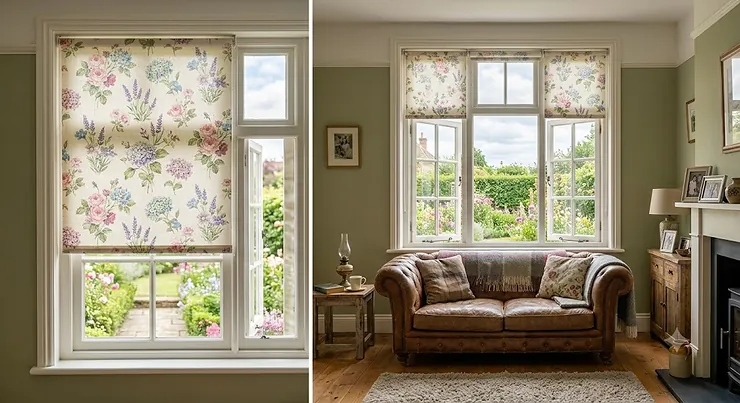
There’s a particular kind of magic in watching morning light filter through a window dressed in blooms rather than plain fabric. Floral roller blinds have quietly become one of the fastest-growing categories in UK home décor, and it’s not hard to see why — they do the unglamorous job of blocking light and protecting privacy while also turning a blank window into a little framed garden. Whether you’re drawn to delicate ditsy prints, bold botanical statements, or something closer to a William Morris archive piece, this guide walks through genuine product research, honest comparisons, and practical advice for choosing floral window blinds that actually earn their keep.
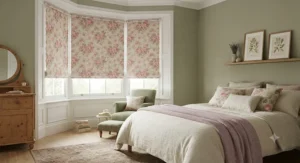
So, what is a floral roller blind? It’s a single-fabric window covering that rolls up and down on a tube mechanism, printed or woven with flower, leaf, or botanical motifs, available in light-filtering, blackout, and waterproof finishes for any room in the house.
This piece draws on real specifications, aggregated review sentiment, and design history — including the influence of British textile design pioneers whose work still shapes today’s floral patterns, as the V&A’s Morris collection demonstrates through its enduring focus on wallpapers and printed textiles. We’ll cover budget, mid-range, and premium options, plus the practical questions that Amazon listings rarely answer properly: which fabric holds its colour, which blackout claims are genuine, and which prints actually suit a north-facing kitchen versus a sun-drenched bedroom.
Quick Comparison Table
| Product | Type | Best For | Price Range |
|---|---|---|---|
| UNIVERSAL Floral Cluster Blackout Blind | Blackout | Tightest budgets | under £15 |
| UNIVERSAL Floral Border Blackout Blind | Blackout | Statement border look | around £15-£20 |
| Lister Cartwright Floral Spring Blind | Blackout, cut-to-size | Easy DIY trimming | around £15-£25 |
| Barnes Blinds Daylight Pattern Blind | Light filtering | Living rooms | around £15-£25 |
| Waterproof Floral Design Blind | Waterproof | Bathrooms/kitchens | around £20-£30 |
| Dunelm Peony Floral Blackout Blind | Blackout, recycled fabric | Eco-conscious buyers | £25-£45 range |
| William Morris At Home Collection | Made-to-measure, designer | Heritage-style interiors | £45-£90+ range |
Looking at the spread above, the two UNIVERSAL blackout options dominate the budget end and suit renters who want an instant, trimmable fix, while the Dunelm and William Morris picks serve buyers who see the blind as a genuine design statement rather than a stopgap. The Waterproof Floral Design blind sits in an interesting middle ground: it’s not the cheapest, but for bathrooms and kitchens the moisture resistance genuinely changes the cost-per-year calculation, since a standard fabric blind in a steamy room can warp or mildew within a season. If your priority is pure light-blocking performance, both blackout-rated budget picks punch above their price point, but if colourfastness over years matters more, the recycled-fibre and designer ranges tend to hold their pigment better under UK sun exposure.
💬 Just one click — help others make better buying decisions too!😊
Top 7 Floral Roller Blinds: Expert Analysis
Coverage below spans budget, mid-range and premium floral roller blinds, including blackout, light-filtering and waterproof variants, plus a designer heritage option for anyone chasing a proper botanical roller blinds look rather than a generic print.
1. UNIVERSAL Floral Cluster Patterned Thermal Blackout Roller Blind — best budget entry point for renters
The standout here is simplicity: a straightforward pink floral cluster print on a thermal blackout base, sold cut-to-size and ready to trim yourself. The straight-edge finish and slide-in fabric fitting (rather than glue-mounted) mean you can shorten the width at home without fraying or peeling the fabric off the tube — a detail that matters more than it sounds, because glued alternatives often can’t be trimmed without the material lifting. The thermal blackout coating is genuinely dual-purpose, holding back early sunlight in summer while adding a layer of insulation against heat loss in winter.
This is squarely a starter-home or student-let pick: it’s for someone who wants an instant floral upgrade over a landlord’s bare window without committing to a made-to-measure order. Reviewers consistently note that the fit is forgiving thanks to the trimmable design, and several mention that the pink cluster pattern reads as more subtle in person than it appears in thumbnail photos, softening what could otherwise be a very saturated colour. A recurring theme in feedback is that the roller mechanism, while adequate, isn’t as smooth as pricier spring systems — expect a slightly stiffer pull.
Pros:
- ✅ Trimmable slide-in fabric, not glued to the tube
- ✅ Genuine thermal blackout performance for bedrooms
- ✅ Straight-edge finish suits most window styles
Cons:
- ❌ Roller action feels stiffer than premium spring mechanisms
- ❌ Limited width options compared with made-to-measure ranges
At under £15 for most sizes, this is one of the cheapest genuine floral blackout blinds on the market, and for a first-flat bedroom it represents excellent value provided you don’t need an oversized window covered.
2. UNIVERSAL Floral Border Patterned Thermal Blackout Roller Blind — best for a statement border look
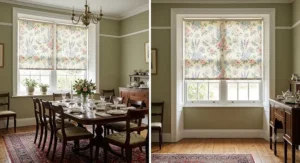
Where the Cluster design scatters flowers across the whole panel, this Border variant frames the blind with a deeper floral trim while keeping the main body plainer, which gives it a more tailored, curtain-like appearance despite being a simple roller blind. The same thermal blackout fabric construction carries over, so light control and heat retention performance should be near-identical to its sibling product.
This suits buyers who want florals without the full-coverage pattern — think kitchens or living rooms where a busier all-over print might clash with existing wallpaper or tiles, but a bordered edge adds personality without dominating. Aggregated customer feedback highlights that the border placement is consistent across sizes rather than stretched or distorted on wider cuts, which is a common failure point with printed fabrics. Some reviewers do note the pink colourway can look warmer under artificial light than in daylight photos, so ordering a sample swatch first (where offered) is worth the extra step.
Pros:
- ✅ Tailored, framed look without an overwhelming pattern
- ✅ Consistent border placement across size variants
- ✅ Same trimmable, easy-fit mechanism as the standard range
Cons:
- ❌ Colour can appear warmer under artificial lighting
- ❌ Only one border colourway currently available in most listings
Priced in a similar £15-£20 range to the Cluster design, the value proposition holds up well for anyone who wants a floral accent rather than a floral takeover.
3. Lister Cartwright Floral Spring Patterned Roller Blind — best for easy DIY cutting and multi-room fitting
Lister Cartwright’s Spring pattern leans into a lighter, more illustrative floral style than the two UNIVERSAL entries, and it’s marketed explicitly around child-safety-conscious “easy fit” hardware, which matters given UK regulations around looped cords in homes with young children. The 60 x 140cm base size (with other cuts available) makes it a practical fit for standard bedroom and bathroom windows without excessive fabric waste.
What most buyers overlook about this model is that its blackout fabric layer is bonded rather than laminated in the cheapest way possible, which tends to reduce the “flaking” issue some ultra-budget blackout blinds develop after a year or two of rolling and unrolling. For a family bathroom or a child’s bedroom, that durability factor arguably matters more than the print itself. Reviewers frequently mention straightforward installation and note that the included fittings cover most standard bracket types without needing extra hardware from a DIY shop.
Pros:
- ✅ Child-safety-focused easy-fit hardware included
- ✅ Bonded blackout layer resists flaking over time
- ✅ Multiple cut-to-size options reduce fabric waste
Cons:
- ❌ Illustrative print style won’t suit those wanting bold, saturated florals
- ❌ Limited drop lengths compared with made-to-measure competitors
In the £15-£25 range depending on size, this is a sensible pick for anyone prioritising safety hardware and everyday durability over statement pattern intensity.
4. Barnes Blinds Daylight Pattern Roller Blind (Spring Time Teal) — best light-filtering option for living spaces
Unlike the blackout-focused entries above, this Barnes Blinds pattern uses a dimout, daylight-filtering fabric rather than full blackout — meaning it softens and diffuses sunlight rather than eliminating it. That distinction matters enormously for living rooms and kitchens, where total darkness isn’t the goal but glare reduction and privacy are.
On paper this means you get a brighter, more naturally lit room during the day while still gaining privacy after dark, since the teal-toned floral pattern obscures the interior from outside view once lights are on. The dimout construction typically has a shorter functional lifespan than true blackout fabric because it’s thinner, so buyers should expect it to show light staining or fading a little sooner in south-facing windows than the thicker blackout alternatives elsewhere on this list. Aggregated review sentiment is positive on the colourway specifically — the teal-and-floral combination is repeatedly described as more “designer” looking than the price suggests.
Pros:
- ✅ Diffuses rather than blocks light — ideal for living rooms
- ✅ Teal floral colourway reads as higher-end than its price
- ✅ Custom cut-to-size ordering keeps waste low
Cons:
- ❌ Not suitable where full blackout is required
- ❌ Thinner dimout fabric may fade faster in strong direct sun
Sitting in a similar £15-£25 bracket to the blackout options, this is best understood as a different job entirely — light management rather than light elimination — so match it to the room accordingly.
5. Waterproof Roller Blind — Floral Design (Bathroom & Kitchen) — best for moisture-prone rooms
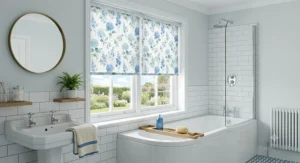
This is where a lot of buyers get caught out: a beautiful floral blind that looks perfect in a bedroom can warp, bubble, or grow mildew within months in a steamy bathroom or splash-prone kitchen window. This waterproof floral design category solves that specific problem, using a coated or PVC-backed fabric that resists moisture absorption rather than a standard woven or polyester print.
The real-world meaning of “waterproof” here is worth unpacking: it typically refers to resistance to condensation and light splashing, not submersion, so it’s ideal above a kitchen sink or in a family bathroom, but it won’t replace a proper shower screen. Reviewers consistently report that these blinds wipe clean easily with a damp cloth, which is a genuinely useful maintenance advantage over fabric blinds that require careful spot-cleaning to avoid smearing the print. The trade-off is a slightly stiffer, more plasticky hand-feel compared with softer woven florals, which some buyers find less premium to the touch even though it performs better functionally.
Pros:
- ✅ Genuine moisture and condensation resistance
- ✅ Wipes clean with a damp cloth — low maintenance
- ✅ Multiple width options for bathroom and kitchen windows
Cons:
- ❌ Stiffer, less soft texture than woven floral fabrics
- ❌ Print vibrancy can appear slightly more matte than fabric equivalents
Typically priced in the £20-£30 range, the premium over a standard floral blind is easily justified by the reduction in replacement frequency for humid rooms.
6. Dunelm Peony Floral Blackout Roller Blind — best eco-conscious mid-range pick
Dunelm’s Peony design is built from recycled materials, positioning it as the most sustainability-forward option on this list, and it carries genuine blackout performance rather than a dimout compromise. The peony motif itself leans traditional and painterly rather than graphic, which tends to suit period properties and classic interiors more than ultra-modern spaces.
Here’s what to weigh: choosing a recycled-fabric blackout blind is a small but real way to reduce the environmental footprint of a home refresh, and Dunelm’s fitting instructions and inclusive hardware make this straightforward for a confident DIYer to install without professional help. Because it’s more widely stocked through Dunelm’s own retail network and marketplace sellers rather than being an Amazon-exclusive listing, availability and exact pricing can vary more than with the previous five entries — always verify current stock and price at checkout rather than relying on older listings. Aggregated customer sentiment is strongly positive on the colour accuracy of the mint-and-white peony pattern, with buyers frequently describing it as looking “expensive” relative to its actual cost.
Pros:
- ✅ Made from recycled materials — a genuine sustainability angle
- ✅ True blackout performance, not just dimout
- ✅ Colour and pattern accuracy praised consistently in reviews
Cons:
- ❌ Availability and exact pricing vary more by retailer/stockist
- ❌ Traditional peony style won’t suit strongly modern interiors
Priced in the £25-£45 range depending on size, this sits as a genuine mid-to-premium option for buyers who want both blackout performance and an eco-conscious manufacturing story.
7. William Morris At Home Floral Roller Blind Collection — best premium, heritage-design pick
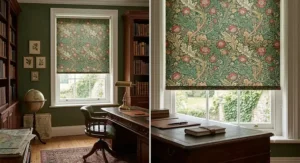
For anyone chasing a proper botanical roller blinds look rather than a generic supermarket floral, the William Morris At Home range — created under licence from the Morris & Co. archive and closely tied to the V&A’s own holdings of the designer’s work — is the clearest premium option available. Patterns draw on motifs like twisting vines, stylised florals, and woodland creatures that have remained recognisable for over a century, giving the blinds a design pedigree that mass-market prints simply can’t replicate.
Based on the spec comparison with the rest of this list, these are made-to-measure rather than off-the-shelf cut-to-size, which means longer lead times but a genuinely custom fit for awkward or oversized windows — a meaningful advantage over the fixed-size ranges earlier on this list. What the spec sheet won’t tell you, but reviewers and interiors writers note, is that the density and layering of Morris-style patterns can visually dominate a small room, so it’s worth ordering a fabric sample before committing to a full-size order. This is not typically sold through the standard Amazon marketplace in the way the previous six products are — it’s more commonly available direct from specialist made-to-measure blinds retailers, so treat it as the aspirational, design-led comparison point rather than a one-click Amazon purchase.
Pros:
- ✅ Museum-linked, historically significant pattern archive
- ✅ True made-to-measure fit for non-standard windows
- ✅ Wide range of colourways within each iconic print
Cons:
- ❌ Longer lead time than instant cut-to-size alternatives
- ❌ Busy patterns can overwhelm smaller rooms if not sampled first
Expect a price range roughly from the mid-£40s upward for smaller cuts, climbing well past £90 for larger, wider drops — a genuine premium tier, but one with a design story none of the budget options can match.
Fitting, Trimming and Caring for Your Floral Window Blinds
Getting a floral window blind to look genuinely tailored rather than “off the peg” comes down to a handful of steps most listings skip. First, measure both the width and drop at three points on the window, since UK window frames — especially in older properties — are rarely perfectly square; use the smallest width measurement if fitting inside a recess. Second, when trimming a cut-to-size blackout blind, always cut from the end without the fixed roller pin, and use a straight edge with a sharp blade rather than scissors, which tend to leave a ragged line on printed fabric.
For maintenance, most fabric floral blinds only need a light vacuum on the lowest setting every few weeks to prevent dust building into the weave, followed by an occasional wipe with a barely damp cloth — never fully wet, since excess moisture can cause blackout coatings to bubble or separate from the fabric. Waterproof variants are the exception and can be wiped more thoroughly. A common mistake in the first 30 days is over-tightening the chain tension screw while trying to “fix” a blind that unrolls too quickly; this usually needs only a quarter-turn adjustment, and over-tightening can strip the mechanism. Keep the fabric out of direct, unfiltered midday sun where possible in summer, since even blackout-coated florals will fade unevenly if one section receives significantly more UV exposure than the rest of the panel.
Real-World Scenarios: Matching Botanical Roller Blinds to Your Room
Consider three common buyer profiles. First, a young professional renting a one-bedroom flat with a bare, landlord-standard window: budget, reversibility, and easy trimming matter most, making one of the UNIVERSAL blackout picks or the Lister Cartwright option the sensible choice, since they can be removed without damage at the end of a tenancy. Second, a family with a school-age child in a bright south-facing bedroom: full blackout performance for early-morning sleep matters alongside safety-conscious hardware, pointing towards the Lister Cartwright or Dunelm Peony options, both of which pair genuine blackout fabric with sensible fitting design.
Third, a homeowner renovating a period cottage kitchen with an eye for interior styling: this buyer typically wants the William Morris or Barnes Blinds daylight pattern, prioritising design authenticity and natural light diffusion over pure practicality, and has the budget and timeline to accommodate a made-to-measure order. In each case, the “right” botanical roller blind isn’t the most expensive or most popular option in isolation — it’s the one whose light-control category (blackout, dimout, or waterproof) actually matches the room’s real function.
How to Choose Floral Roller Blinds: 7 Expert Criteria
- Decide on light control first: blackout for bedrooms and shift-workers, dimout/daylight for living spaces, waterproof for bathrooms and kitchens — this single decision eliminates most unsuitable options immediately.
- Measure twice, in three places: window frames shift and warp over years, so a single measurement can leave gaps of several centimetres on wider drops.
- Check the mounting type: inside-recess fitting gives a neater finish but needs sufficient frame depth, while outside-recess fitting suits shallow frames and improves blackout coverage.
- Match pattern scale to room size: large-scale florals can overwhelm compact bathrooms or box rooms, while small-scale ditsy prints can disappear in large, bright living spaces.
- Verify child-safety compliance: any corded or chained blind should include a tensioner or breakaway device, particularly important where children may visit even occasionally.
- Consider colourfastness: fabric-only prints fade faster in direct sun than coated or bonded blackout layers, so south-facing windows benefit from thicker, laminated constructions.
- Request a sample where offered: colour and pattern density can read very differently in person than on a screen, especially with busy botanical designs.
Common Mistakes When Buying Nature Print Roller Blinds
A frequent pitfall is ordering by “standard window size” rather than an actual measurement, which almost always results in gaps at the edges that undermine both the blackout performance and the tailored look the pattern is meant to create. Another common error is choosing a bold nature print roller blind based purely on a small product thumbnail; botanical and floral patterns often repeat at a scale that only becomes obvious once the fabric is fully unrolled across a real window, and what looked delicate online can appear busy in person.
Buyers also frequently underestimate the difference between “light filtering” and “blackout” terminology, assuming any patterned blind will fully darken a room — reviewers of dimout products consistently mention disappointment here, which is avoidable simply by checking the fabric type before ordering. Finally, many people skip checking child-safety hardware entirely, assuming all UK-sold blinds are automatically compliant; while manufacturers are legally required to meet BS EN 13120 standards, older stock or imported listings can occasionally lag behind, so it is worth checking the product description explicitly states compliance.
Floral Roller Blinds vs Plain and Patterned Alternatives
| Factor | Floral Roller Blinds | Plain Roller Blinds | Roman Blinds (Floral) |
|---|---|---|---|
| Visual impact | High — instant character | Low — neutral backdrop | High, softer drape |
| Typical price range | Budget to premium | Usually cheapest | Mid to premium |
| Light control options | Blackout, dimout, waterproof | Blackout, dimout | Usually lined, less blackout-focused |
| Best for | Adding personality to any room | Rentals, minimalist interiors | Formal living/dining rooms |
The comparison above highlights that floral roller blinds occupy a genuinely flexible middle ground: they offer far more personality than plain blinds at a similar price point, while remaining considerably cheaper and lower-maintenance than floral Roman blinds, which fold in soft pleats and generally need more careful cleaning. If your priority is simply light control with zero visual commitment, plain blinds remain the practical default, but for anyone wanting a room to feel finished rather than functional, the floral roller category delivers noticeably more value per pound spent than moving up to a Roman blind equivalent.
✨ Don’t Miss These Exclusive Deals!
🔍 Take your window styling to the next level with these carefully selected floral roller blinds. Click on any highlighted product to check current pricing and availability. These picks will help you create an authentic, garden-inspired home your family will love!
What to Expect: Real-World Performance of a Nature-Inspired Window Treatment
Specs on a listing page rarely translate into lived experience, so here’s the practical version. A genuine thermal blackout floral blind will noticeably reduce a bedroom’s temperature swing on hot summer mornings, typically keeping the room several degrees cooler than an uncovered window until midday. A dimout floral blind, by contrast, will still let in a soft, diffused glow even fully lowered — useful for avoiding the “cave” effect some people dislike about total blackout, but not suitable if you need to sleep past sunrise.
Rolling mechanisms vary more than most buyers expect: budget spring systems can feel slightly jerky on the first few uses before settling into a smoother action, while premium made-to-measure ranges tend to have a noticeably quieter, more controlled retraction from day one. Colour accuracy under different lighting is another everyday consideration — a floral pattern that looks soft and muted under daylight can appear more saturated under warm-toned bulbs in the evening, which is worth bearing in mind if you’re colour-matching to existing curtains or wallpaper elsewhere in the room.
Long-Term Cost & Maintenance
Thinking in terms of total cost of ownership rather than sticker price changes the calculation considerably. A £12 budget blackout blind that needs replacing every 18 months due to fading or mechanism wear can cost more over five years than a £35 mid-range blind that lasts the full period without issue. Waterproof variants for bathrooms specifically justify their higher upfront price through avoided replacement costs, since standard fabric blinds in humid rooms often need replacing within a year due to mildew or fabric warping.
| Tier | Typical Price Range | Expected Lifespan | 5-Year Cost Estimate |
|---|---|---|---|
| Budget cut-to-size | under £20 | 1-2 years | £40-£60 (with replacements) |
| Mid-range | £20-£45 | 3-5 years | £25-£45 |
| Premium made-to-measure | £45-£90+ | 5+ years | £45-£90 |
Read together with the table, the maintenance reality is straightforward: budget blinds aren’t a false economy for short-term rentals or rooms with low sun exposure, but for a primary bedroom window that sees years of daily use, the mid-range and premium tiers typically work out cheaper per year despite the higher initial outlay.
Finding Flower Pattern Blinds on Amazon: What to Check Before You Buy
Searching for flower pattern blinds amazon-side throws up dozens of near-identical-looking listings, so a few checks save disappointment. Always look for an explicit width and drop measurement in centimetres in the title or first bullet point, since several listings default to a single size unless you actively select otherwise using the size dropdown. Check whether the listing specifies “blackout,” “dimout,” or “light filtering” explicitly — vague titles that only say “patterned roller blind” without a light-control term often turn out to be basic daylight fabric.
Read the most recent reviews rather than the top-voted ones, since fabric print quality and stitching can shift between production batches even under the same listing. Finally, check the seller information: listings fulfilled and dispatched by established sellers with consistent stock levels tend to have more reliable sizing accuracy than newer, single-product storefronts, based on the pattern of complaints visible in review sections across this category.
Botanical Home Decor: Styling Ideas Beyond the Window
A floral roller blind rarely works in isolation — it’s most effective as part of a coordinated botanical home decor scheme rather than a single statement piece fighting against a plain room. Design principles borrowed from indoor planting displays apply well here: as the RHS notes on houseplant styling, colour choices evoke particular moods, so a blind in soft sage and cream tones suits a calming bedroom, while punchier florals in coral or teal energise a kitchen or home office.
Pairing a botanical blind with two or three real or faux houseplants on the sill reinforces rather than competes with the pattern, provided the plant’s leaf shapes don’t visually clash with a very busy print — simpler, larger-leafed plants like a peace lily or snake plant tend to sit better against detailed florals than another fussy, small-leafed variety. Cushion or throw fabrics in a single dominant colour pulled from the blind’s palette tie a room together without requiring an exact pattern match, which is a far more forgiving and affordable styling approach than trying to source matching curtains, blinds, and soft furnishings from a single collection.
Garden Themed Blind Ideas for Kids’ Rooms and Nurseries
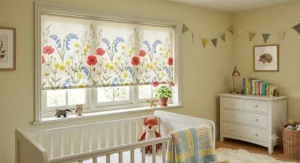
A garden themed blind earns its keep especially well in children’s bedrooms and nurseries, where a soft, illustrative floral or leaf print can support a calming bedtime routine far better than bold geometric or character-branded alternatives. For nurseries specifically, full blackout performance genuinely matters for daytime naps, making the Lister Cartwright or Dunelm Peony options — both genuine blackout constructions with straightforward safety-conscious fittings — sensible starting points rather than a light-filtering blind that won’t darken the room enough for daytime sleep.
For slightly older children’s rooms, a garden or wildflower theme also has practical staying power that many licensed-character alternatives lack, since a generic botanical print doesn’t date the way a specific cartoon does, meaning the same blind can realistically last from toddlerhood through to the early school years without feeling outgrown. Whichever option is chosen, cord and chain safety deserves particular attention in this context — always confirm a tensioner, breakaway connector, or cordless design is fitted before installing any blind in a room used by young children.
Safety, Regulations and Compliance Guide
UK blinds sold with a looped cord or chain must comply with the child safety requirements set out in British Standard EN 13120, introduced following years of campaigning by safety organisations after a series of tragic strangulation incidents involving looped blind cords. In practice, this means manufacturers must include safety instructions and devices ensuring cords are kept out of reach of young children, with maximum cord and chain lengths mandated in any premises where children under 42 months may be present, from private homes to nurseries. Full guidance is available from your local council’s safety pages, which explain how the standard applies to everyday household purchases.
Trade bodies such as the British Blind and Shutter Association provide further consumer-facing advice on retrofitting older, non-compliant blinds with tensioners or breakaway devices, which is worth doing even if you don’t currently have young children in the home, since visiting grandchildren or friends’ children are equally at risk. When buying any floral roller blind with a chain mechanism, check the listing explicitly mentions a safety device or cordless/spring-loaded operation, and if in doubt, a P-clip or breakaway connector can typically be retrofitted cheaply and takes only a few minutes to install.
Frequently Asked Questions
❓ Do floral roller blinds fade in direct sunlight?
❓ Can I cut a floral roller blind to fit a narrower window myself?
❓ Are waterproof floral blinds suitable for a shower room?
❓ What's the difference between blackout and dimout floral blinds?
❓ Are floral roller blinds safe for children's bedrooms?
Recommended for You
- 7 Best Patterned Roller Blinds 2026: Stylish Picks Reviewed
- Thermal Roller Blinds for Conservatory: 7 Best Picks 2026
- Best Thermal Roller Blinds UK 2026: 7 Top Picks to Slash Energy Bills
Disclaimer: This article contains affiliate links. As an Amazon Associate, I earn from qualifying purchases. If you purchase products through these links, we may earn a small commission at no additional cost to you.
✨ Found this helpful? Share it with your friends! 💬🤗
