
In This Article
Right, let’s be honest about something before we go any further: buying blinds is one of those jobs that sounds trivial until you’re standing in your living room with a tape measure, three browser tabs open, and a creeping suspicion that “pleated” and “honeycomb” might secretly be the same thing wearing different hats. They’re not, by the way — more on that shortly.
If you’ve searched for best pleated blinds, chances are you’ve hit one of two walls. Either you’re drowning in near-identical stock photos of white fabric folds, or you’ve found a dozen conflicting opinions about whether concertina blind designs are worth the extra money over a basic version. This guide cuts through that. We’ve researched seven real, currently available products sold in the UK — from budget-friendly conservatory specialists to made-to-measure honeycomb thermal blinds — and paired every recommendation with honest analysis of who each one actually suits.
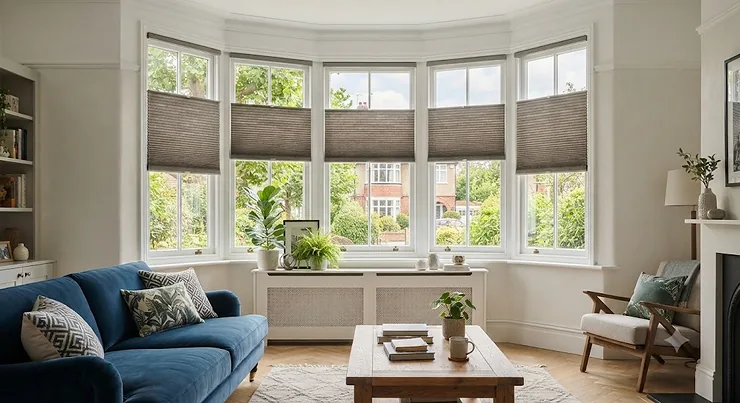
What is a pleated blind, in plain English? It’s a single sheet of crisp, accordion-folded fabric that concertinas up and down between two slim aluminium rails, rather than using slats like a Venetian or rolling onto a tube like a roller blind. Think of an old-fashioned paper fan mounted sideways in your window frame. Because there’s no bulky headrail, pleated window blinds sit almost flush against the glass — which makes them the go-to choice for tricky spaces like conservatory roofs, tilt-and-turn windows, uPVC doors, and skylights where a chunkier blind simply won’t fit.
Throughout this guide you’ll see the terms accordion window blind, fold flat blind, and concertina blind used more or less interchangeably — they all describe this same folding mechanism, just branded differently depending on where you’re shopping. We’ll flag it clearly whenever a product uses “honeycomb” or “cellular” construction instead, since that’s a genuine structural difference worth understanding before you buy. Industry safety standards for this whole category, including cord and mounting requirements, are coordinated in the UK by the British Blind and Shutter Association, whose guidance we’ll return to in the safety section further down.
Quick Comparison Table
| Product | Type | Price Range | Best For |
|---|---|---|---|
| vidaXL Pleated Blind | Standard polyester pleated | under £25 | Budget style across multiple rooms |
| Concept Crystal Honeycomb Pleated Blind | Cellular blackout, no-drill | £30-£60 range | Bedrooms needing real blackout |
| Concept Blinds Custom Pleated Blind | Made-to-measure, no-drill | £20-£45 range | Awkward or non-standard windows |
| Gardinia Plissé Solo | Suction-cup, no-drill | £15-£35 range | Renters and skylights |
| Tropik Home Pleated Blinds | Budget conservatory range | under £25 | Conservatories on a tight budget |
| Amazon Basics Cordless Pleated Blind | Own-brand, cordless | under £20 | Simple, safe, no-fuss purchase |
| Concept Blinds Honeycomb Roof Window Blind | Cellular roof-window specific | £35-£70 range | Skylights and roof windows |
Looking at the spread above, there’s a clear pattern: the deciding factor usually isn’t price at all, it’s window type. A skylight and a standard sash window have almost nothing in common structurally, which is why Concept Blinds Honeycomb Roof Window Blind and Gardinia Plissé Solo exist as near-opposite solutions to the same basic problem. Budget shoppers gravitate toward vidaXL Pleated Blind and Tropik Home Pleated Blinds, both of which keep things simple and screw-fit, while anyone chasing genuine thermal performance or blackout will want to look at the honeycomb-constructed options instead of a standard single-layer pleat.
💬 Found a comparison that actually helped? Pass it on — someone else is stuck in the same blind-shopped rabbit hole right now.
What Is a Pleated Blind? (And How It Differs From Honeycomb)
A pleated blind is a single layer of permanently creased fabric, folded into tight accordion pleats and stretched between two aluminium control rails. Pull the rails together and the fabric concertinas down into a neat stack roughly 2-3cm deep; pull them apart and it fans out to cover the glass. Because there’s no roller mechanism or box headrail, the whole thing sits closer to the pane than almost any other window covering, which is exactly why it’s the default choice for conservatory roofs and angled skylights.
A honeycomb (or cellular) blind looks similar from the front but is built from two layers of pleated fabric bonded together at the folds, forming a row of sealed air pockets — hence “honeycomb.” That trapped air layer is what gives cellular blinds a genuine, measurable edge in thermal insulation over a standard single-layer pleat, which we’ll cover properly in the long-term cost section further down. If blackout or heat retention matters to you, that structural difference is worth paying attention to before you buy pleated blinds — not just the fold pattern in the product photo.
Top 7 Pleated Blinds: Expert Analysis
1. vidaXL Pleated Blind — best all-round budget pick for standard windows
The standout feature here is simplicity: this is about as close to a “default” pleated blind as you’ll find on Amazon UK, and that’s precisely its appeal. The vidaXL Pleated Blind is a 100% polyester pleated fabric panel that mounts to the wall or window frame using either screws or clip-on clamping brackets, and it’s available across a genuinely wide spread of width and drop combinations, from compact 45cm-wide panels up to broader 95cm options.
On the spec sheet, the dual-mount system (screw or clamp) is the detail that actually matters day to day — it means the same blind works whether you’re fitting to a wooden window reveal or a uPVC frame you’d rather not drill into. vidaXL’s own fitting notes recommend adding roughly 0.6cm to your glass measurement when ordering, since the fabric itself sits slightly narrower than the overall bracket width; skip that step and you’ll end up with an annoying sliver of exposed glass at each edge.
Based on the spec comparison with pricier alternatives, what stands out about this range is how unfussy it is. There’s no made-to-measure ordering process, no waiting for a custom cut — you pick the nearest stock size and fit it the same afternoon. That makes it the natural starting point for anyone furnishing several rooms at once and not wanting to overthink each window.
Reviewers consistently note that the polyester fabric resists creasing well after repeated raising and lowering, and that the black and white colourways in particular integrate cleanly into modern interiors. A recurring theme in aggregated feedback is that the clamp-mount option, while genuinely drill-free, can feel less secure on wider windows than the screw-fit alternative — something to bear in mind if you’re covering anything beyond about 80cm.
Pros:
- ✅ Dual mounting options — screws or no-drill clamps
- ✅ Wide range of stock width and drop sizes
- ✅ Consistently praised for tidy, crease-resistant folds
Cons:
- ❌ Clamp mount feels less secure on wider spans
- ❌ Standard sizes only — no bespoke cutting service
At around £15-£25 depending on size, this sits firmly at the budget end, and for a single-layer polyester pleat with flexible fitting, that’s solid value — just don’t expect the thermal performance of a honeycomb design at this price point.
2. Concept Crystal Honeycomb Pleated Blind — best for genuine blackout and insulation
The headline feature is the double-layer cellular construction with a silver thermal coating sandwiched between the two fabric skins — this is the product that actually earns the word “honeycomb,” rather than just borrowing the aesthetic of one. It’s a no-drill design, supplied with adjustable aluminium hooks designed for windows and doors that open inwards.
Unpacking the spec a little further: the honeycomb structure isn’t just a marketing flourish. The two-layer build with a reflective thermal layer between them is specifically engineered to reduce solar heat gain and slow heat loss compared with a flat single-ply pleat, and the fabric carries an antistatic treatment that’s genuinely useful for keeping dust from clinging to the pleats — a common complaint with cheaper polyester alternatives. The adjustable top-and-bottom aluminium profiles let you slide the blind up from the bottom as well as down from the top, so you can, say, keep the top half covered for privacy while letting light in below.
What most buyers overlook about honeycomb blinds generally is that the blackout claim depends heavily on a snug frame fit — the fabric itself blocks light effectively, but gaps at the sides of an ill-fitted honeycomb blind let plenty of daylight leak around the edges regardless of how dense the fabric is. This is worth flagging honestly: the product listing is clear that installation hooks suit frames between 8mm and 28mm thick, and windows outside that range, or ones that open outwards, need a different fixing approach entirely.
Aggregated customer sentiment highlights the no-drill hook system as a genuine time-saver, with reviewers noting the full mounting kit (grips, fasteners, spacers and screws) covers everything needed bar a Phillips screwdriver. Some feedback flags that measuring for the adjustable hooks takes more care than a simple pleated blind, since a poor fit undermines the very blackout and thermal benefits you’re paying extra for.
Pros:
- ✅ Two-layer honeycomb build with thermal coating
- ✅ Adjustable up-and-down aluminium profiles
- ✅ Antistatic fabric resists dust build-up
Cons:
- ❌ Only fits frames 8-28mm thick without adaptation
- ❌ Careful measuring required or blackout performance suffers
Priced in the £30-£60 range depending on size and colour, it’s a meaningful step up from a standard pleat — but if a dark bedroom or a properly insulated conservatory door is the goal, the honeycomb construction is doing real, measurable work that a flat polyester pleat simply can’t replicate.
3. Concept Blinds Custom Pleated Blind — best for awkward or non-standard windows
The standout advantage is the made-to-measure ordering system covering an unusually wide size range — from 30cm up to 200cm in width on the XXL variant — paired with a genuine choice of around 18 fabric colours, which is considerably more than most Amazon-listed pleated ranges offer.
Here’s the practical interpretation of that spec: most stock-size pleated blinds top out around 100-110cm wide, which is fine for a typical sash window but leaves you stuck for wide patio doors, bay windows, or oversized conservatory panels. Concept Blinds’ custom-cut process closes that gap by letting you specify exact width and height, with both drilled and no-drill (adhesive fixing) versions available depending on whether you’re a homeowner or a renter who can’t touch the frame.
Based on the spec comparison with the fixed-size vidaXL range above, the trade-off is fairly straightforward: you gain precision and colour choice, but lose the same-day simplicity of buying an off-the-shelf size. Concept Blinds describes itself as manufacturing locally to order, which explains both the wider size tolerance and the slightly longer lead time compared with a stock item that ships immediately.
Reviewers consistently flag the colour range as a genuine differentiator versus cheaper alternatives — several mention matching blinds precisely to existing décor rather than settling for “the closest white available.” A common theme in feedback for the no-drill adhesive version specifically is that surface preparation (a clean, dry, dust-free frame) makes or breaks how well the adhesive fixings hold over time, which is a fair point given adhesive-mounted window products generally.
Pros:
- ✅ Made-to-measure up to 200cm wide
- ✅ 18 fabric colour options
- ✅ Both drilled and no-drill adhesive versions available
Cons:
- ❌ Longer lead time than off-the-shelf sizes
- ❌ Adhesive version sensitive to frame surface prep
Custom pricing typically lands in the £20-£45 range for standard sizes, rising for the XXL format — reasonable given you’re avoiding the compromise of forcing a stock size onto a window it wasn’t really designed for.
4. Gardinia Plissé Solo — best no-drill option for renters and skylights
The standout feature is the four-suction-cup mounting system, which genuinely allows tool-free fitting at any position on the glass — not just at the very top and bottom of the frame — and includes a specific roof-window variant sized for angled skylights.
Digging into what that means in practice: the suction cups use a click mechanism to attach and release, and Gardinia’s own product notes claim no swinging or sagging even on a tilted window pane, which is a genuinely useful detail for anyone fitting a blind to an angled Velux-style roof light rather than a vertical wall window. Because the mount doesn’t depend on the frame at all — it grips the glass directly — this is one of the few pleated designs that works equally well on frameless or narrow-profile windows where clamp or screw brackets simply have nowhere to grip.
Honest analysis here: this is squarely a rental-market product, and it’s priced and built accordingly. It’s not trying to compete with the Concept Crystal honeycomb blind on thermal performance — it’s semi-transparent by design, offering privacy and light-softening rather than blackout, which suits living rooms and kitchens better than a bedroom that needs total darkness. The 20mm pleat width is on the narrower side, giving a slightly more delicate, tightly folded look than some wider-pleat competitors.
Aggregated reviews are broadly positive on the suction system’s grip strength, with several UK buyers specifically praising the roof-window version for skylight installs where drilling simply isn’t practical. A recurring theme, particularly from apartment dwellers and students, is that this is viewed as the deposit-safe option — no holes, no adhesive residue, fully removable at the end of a tenancy.
Pros:
- ✅ Genuine no-drill suction-cup fitting
- ✅ Dedicated roof-window and skylight variant
- ✅ Fully removable — ideal for rented accommodation
Cons:
- ❌ Semi-transparent only, not a blackout solution
- ❌ Suction grip needs periodic rechecking on some glass types
At roughly £15-£35 depending on size, this is a fair price for a genuinely damage-free fitting method, though anyone wanting a dark bedroom should look at the honeycomb blackout options instead.
5. Tropik Home Pleated Blinds — best budget pick for conservatories
The headline advantage is sheer size and colour flexibility at a genuinely low price point — 18 width sizes across drops of 100cm, 150cm and 200cm, in six colourways, specifically marketed at conservatory and tilt-and-turn window fitting.
What that combination actually solves: conservatories are notoriously awkward to dress because they typically feature multiple windows of slightly different widths across the roof panels and side walls. Tropik Home’s approach of offering 18 discrete width options per colour, rather than a handful of standard sizes, means most conservatory owners can get a close match across every panel without resorting to a custom-cut service — which matters when you might need seven or eight blinds for one room, as several reviewers mention doing.
The honest trade-off, based on aggregated review analysis, is fit tolerance. Reviewers who bought this brand describe a genuinely wide size range and good value, but multiple buyers also mention the fitting hardware — particularly the small plastic operating handles — as fiddly, requiring patience and small tools rather than being a five-minute job. That’s a fair criticism to flag rather than gloss over: value pricing here comes with slightly less refined hardware than the pricier Concept Crystal range.
Aggregated customer sentiment specifically highlights installation ease as generally positive once video instructions are followed, strong appreciation for the price relative to made-to-measure competitors, and consistent praise for how the finished look transforms conservatory glare and privacy. A recurring negative theme concerns the adhesive strength of any sticky-pad fixing components, with several reviewers recommending supplementary double-sided tape for extra security on larger panels.
Pros:
- ✅ 18 width sizes across three drop lengths
- ✅ Six colourways designed for conservatory matching
- ✅ Strong value for multi-window conservatory projects
Cons:
- ❌ Small fitting handles reported as fiddly
- ❌ Adhesive fixings benefit from reinforcement on bigger panels
Priced under £25 in most sizes, and often less when buying several for one conservatory, this is hard to beat on pure cost-per-window if you’re covering a whole glazed room rather than a single opening.
6. Amazon Basics Cordless Pleated Blind — best safe, no-fuss starter pick
The standout feature is right there in the name: this is a cordless pleated design with no drilling required, positioned as Amazon’s own straightforward, no-nonsense entry into the category, available in a 90 x 130cm white format.
Interpreting that spec honestly: cordless operation isn’t just a convenience feature here — it’s a genuine safety consideration. Traditional corded blinds carry a strangulation risk for young children, which is precisely why UK regulation now requires safety devices on any blind sold with an exposed cord loop. A cordless design sidesteps that requirement altogether by removing the hazard at the design stage rather than adding a cleat or tensioner after the fact, something worth weighing heavily if you have toddlers or plan to.
Based on the spec sheet, this is a deliberately narrow, no-frills offering compared with the Concept Blinds custom range — one fixed size, one colour, own-brand simplicity. What most buyers overlook is that “basic” here isn’t a criticism so much as a description: this product exists for people who want a single reliable pleated blind for one window without navigating eighteen colour swatches or a made-to-measure order form.
Reviewer sentiment for Amazon’s own-brand blind ranges tends to praise straightforward installation and consistent quality control, benefits of buying through a single retailer with a standardised returns process rather than a smaller third-party seller. As with any cordless pleated blind, the trade-off is a narrower size range than bespoke competitors, and buyers with windows outside the stock 90 x 130cm dimension will need to look elsewhere or accept some excess fabric at the fold.
Pros:
- ✅ Cordless design removes child-safety cord risk
- ✅ No-drill fitting
- ✅ Straightforward Amazon-brand purchase and returns process
Cons:
- ❌ Limited to one fixed size and colourway
- ❌ Less choice than made-to-measure competitors
At under £20, this is genuinely one of the cheapest ways into a safe, no-drill pleated blind, and the cordless design specifically earns its place on a safety-conscious shortlist for family homes.
7. Concept Blinds Honeycomb Roof Window Blind — best for skylights and loft conversions
The standout feature is that this is a honeycomb-specific design built for roof windows, combining the thermal benefits of cellular construction with adjustable up-and-down operation and a drilled fixing method engineered for angled glazing, across seven fabric colours.
Unpacking why that combination matters: skylights and roof windows lose and gain heat more aggressively than vertical wall windows, because they face the sky directly rather than being partially shaded by eaves or overhangs — a loft conversion bedroom with an uninsulated skylight can swing from freezing to uncomfortably warm within the same 24 hours. Pairing honeycomb cellular insulation with a roof-window-specific fixing kit addresses that directly, rather than forcing a vertical-window blind to work at an angle it wasn’t designed for.
Honest analysis: this is a premium, specialist product, and the price reflects that specialism. It sits at the opposite end of the range from the Gardinia Plissé Solo’s suction-cup approach — where Gardinia trades performance for install-anywhere flexibility, this Concept Blinds model trades flexibility for maximum thermal and blackout performance on a fixed, drilled installation. If your loft conversion gets genuinely uncomfortable in summer or freezing in winter, that trade-off is very likely worth making.
Aggregated review sentiment for the wider Concept Blinds honeycomb range consistently highlights the adjustable up-and-down mechanism as genuinely useful for roof windows specifically, since it lets you shade the sun-facing upper section while still seeing sky through the lower half. Buyers researching this category should note that, as with any roof-window product, precise measurement before ordering is non-negotiable — an ill-fitting cellular blind on an angled pane loses most of its thermal advantage through edge gaps.
Pros:
- ✅ Honeycomb cellular build for genuine thermal performance
- ✅ Purpose-built for angled roof windows and skylights
- ✅ Adjustable up-and-down light control
Cons:
- ❌ Premium pricing versus standard pleated ranges
- ❌ Drilled fitting only — not renter-friendly
Typically priced in the £35-£70 range depending on size, this is the specialist pick of the seven — not the cheapest, but arguably the one solving the most genuinely difficult window problem on this list.
Top 7 Products: Specs & Value Comparison
| Product | Construction | Mounting | Colours | Price Range | Best For |
|---|---|---|---|---|---|
| vidaXL Pleated Blind | Single-layer polyester | Screw or clamp | 2-3 | under £25 | Standard windows, multi-room jobs |
| Concept Crystal Honeycomb Pleated Blind | Honeycomb, thermal coating | Adjustable hooks, no-drill | 6 | £30-£60 | Bedrooms, blackout needs |
| Concept Blinds Custom Pleated Blind | Single-layer, made-to-measure | Drilled or adhesive | 18 | £20-£45 | Oversized/awkward windows |
| Gardinia Plissé Solo | Single-layer polyester | Suction cups | 3 | £15-£35 | Renters, skylights |
| Tropik Home Pleated Blinds | Single-layer polyester | Screw-fit brackets | 6 | under £25 | Conservatories, multi-window jobs |
| Amazon Basics Cordless Pleated Blind | Single-layer, cordless | No-drill | 1 | under £20 | Families, safety-first buyers |
| Concept Blinds Honeycomb Roof Window Blind | Honeycomb, roof-specific | Drilled | 7 | £35-£70 | Loft conversions, skylights |
The value picture here isn’t about which blind is cheapest in isolation — it’s about matching construction to window type. Concept Crystal Honeycomb Pleated Blind and Concept Blinds Honeycomb Roof Window Blind cost roughly double a standard pleat, but that premium buys a measurable thermal and blackout advantage that a single-layer fabric simply cannot deliver, regardless of colour or brand. For a standard living-room window with no particular insulation demands, vidaXL Pleated Blind or Tropik Home Pleated Blinds deliver most of the aesthetic benefit for a fraction of the outlay.
✨ Don’t Miss These Exclusive Deals!
🔍Take your window dressing project to the next level with these carefully selected picks. Click on any highlighted item to check current pricing and availability. These blinds will help you create a genuinely comfortable, well-finished home your family will actually notice and appreciate!
Benefits vs Traditional Alternatives
| Feature | Pleated Blinds | Venetian Blinds | Curtains |
|---|---|---|---|
| Fits angled/skylight windows | Yes, purpose-built | Rarely | No |
| Bulk when fully open | Minimal (2-3cm stack) | Moderate | High |
| Thermal insulation (honeycomb) | Strong | Weak | Strong (lined) |
| Typical UK price range | £15-£70 | £15-£50 | £30-£150+ |
Pleated blinds win decisively on any window where physical space is the constraint — skylights, conservatory roofs, and tilt-and-turn frames simply can’t accommodate a bulky Venetian headrail or a full curtain track without obstructing the opening mechanism. Where thick, lined curtains still have the edge, according to the Energy Saving Trust, is overall draught-proofing on standard vertical windows, since fabric that extends well beyond the frame and reaches the floor creates a more complete air seal than any blind mounted flush to the glass. For anyone weighing this trade-off room by room, a honeycomb pleated blind on a problem skylight paired with lined curtains on a standard living-room window is a genuinely sensible hybrid approach.
Practical Usage Guide: Setup, Care and Common First-Fit Mistakes
Getting a pleated blind fitted well on day one saves a surprising amount of frustration later, so it’s worth doing properly rather than rushing the job during a Saturday-afternoon DIY sprint.
Before anything else, measure the glass — not the frame — and note whether you’re mounting inside the recess or on the surrounding frame. Almost every stock-size pleated blind assumes you’ll add a small allowance (often around 0.5-1cm) to account for the fabric sitting slightly narrower than the full bracket width; skip that step and you’ll end up with an irritating gap of visible glass down each side that no amount of adjusting will fix afterwards.
For no-drill clamp or suction-cup models, clean the frame or glass surface thoroughly before fitting — dust, grease from cooking (particularly relevant in kitchens), or residual cleaning product film will all reduce grip strength over time, and several reviewers across the products above specifically flagged adhesive or suction failures traceable to a poorly prepped surface rather than a faulty product.
Once fitted, the first 30 days are when most avoidable damage happens. New pleats benefit from being fully extended and gently “worked” through their full range of motion a few times in the first week, which helps set the fold pattern evenly rather than leaving a slight kink where the fabric sat folded in its packaging. Avoid yanking the pull cord or handle at an angle — straight up-and-down tension keeps both aluminium rails level and prevents the fabric stretching unevenly on one side.
For ongoing maintenance, a soft brush or the brush attachment on a vacuum cleaner, run gently along the closed pleats every few weeks, keeps dust from settling into the folds where it’s harder to remove later. Polyester pleated fabric can generally handle a lightly damp microfibre cloth for spot-cleaning marks, but avoid saturating the fabric, since trapped moisture in a honeycomb blind’s internal air pockets can encourage mould over time — dry thoroughly and let the blind hang fully open until completely dry before closing it again.
Real-World Scenarios: Which Pleated Blind Suits Your Situation
Rather than talking in the abstract, it helps to picture a few common households and match them to a sensible pick from the seven above.
Take a young couple renting a one-bedroom flat with a Velux-style skylight in the bathroom and standard vertical windows in the bedroom and living room. Drilling is off the table entirely under most tenancy agreements, so the Gardinia Plissé Solo roof-window variant handles the skylight without touching the frame, while the standard suction-cup Solo covers the vertical windows just as easily — same brand, same fitting method, zero deposit risk at move-out.
Contrast that with a family who’ve just finished a loft conversion into a child’s bedroom, complete with two large roof windows that turn the room into a greenhouse by mid-morning in summer. Here, the Concept Blinds Honeycomb Roof Window Blind earns its higher price tag — the cellular construction genuinely reduces both the glare and the heat gain that a single-layer pleat simply can’t match, and because a young child will be sleeping in that room, pairing it with a cordless operation style (many honeycomb ranges offer this) removes the corded-blind safety concern discussed further down.
Finally, picture a retired couple furnishing a newly built conservatory with six window panels of slightly varying widths, working to a fixed budget. Tropik Home Pleated Blinds‘ 18-size range across each of its six colours means they can order a close match for every panel from a single supplier without paying made-to-measure premiums on each one — a sensible, budget-conscious way to dress an entire glazed room without the project spiralling in cost.
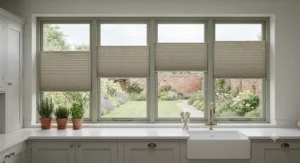
How to Choose Pleated Blinds: 6 Expert Criteria
- Match the fixing method to your tenancy status. Owner-occupiers can drill freely, but renters should default to suction-cup or adhesive no-drill designs like the Gardinia or Concept Blinds adhesive ranges to avoid deposit deductions.
- Decide if you actually need honeycomb construction. If blackout or genuine thermal performance matters — a bedroom, a loft conversion, a south-facing conservatory — the extra cost of cellular blinds over single-layer polyester is money well spent; for a hallway or kitchen, it’s often unnecessary.
- Measure twice, order once, and always check the manufacturer’s allowance. Most brands ask you to add a small margin to your raw glass measurement — get this wrong and even the best pleated blind will leave unsightly gaps.
- Consider operation type around children. Corded blinds now legally require safety devices in the UK; cordless designs remove the consideration entirely and are worth prioritising in any room a young child sleeps or plays in.
- Check fabric opacity against the room’s actual purpose. Semi-transparent pleats like the Gardinia Solo suit living areas wanting softened light, while bedrooms generally need a genuinely opaque or blackout-rated fabric.
- Factor in installation realism, not just the marketing photo. Suction cups and adhesive pads are genuinely tool-free, but they demand a clean surface and periodic rechecking, whereas a screwed bracket is a five-minute job once but essentially permanent.
Common Mistakes When Buying Pleated Blinds
The single most common error is ordering by the window frame’s outer dimension rather than the actual glass measurement, which almost always results in a blind that’s too wide or too narrow for the recess it’s meant to fit. A close second is assuming every “pleated” listing on Amazon is equivalent — as this guide has shown, a £15 single-layer polyester pleat and a £50 honeycomb thermal blind look superficially similar in a thumbnail photo but perform very differently in practice.
Another frequent mistake, particularly with no-drill suction or adhesive designs, is fitting onto a cold, damp, or slightly greasy surface straight after cleaning, without allowing it to fully dry first — this is a leading cause of the “it fell off after a week” complaints that show up in aggregated review data for almost every adhesive-mount product on the market, not just the ones featured here. Finally, many buyers overlook cord safety entirely until after purchase; checking whether a blind is cordless, or comes with a compliant safety device fitted as standard, is worth doing before you order rather than retrofitting a tensioner afterwards.
What to Expect: Real-World Performance
On paper, a pleated blind’s specification sheet tells you fabric type, pleat width, and mounting method — but it’s worth translating that into what actually happens in daily use. A standard single-layer polyester pleat, fully closed, offers meaningful privacy and softens direct sunlight, but it won’t achieve true blackout; expect a soft, diffused glow through the fabric even at midday, which is entirely fine for a living room but frustrating for shift workers needing daytime sleep. Honeycomb variants close that gap substantially, blocking the large majority of ambient light when properly fitted, though even the best cellular blind will leak some light at the edges if the frame fit isn’t snug.
Thermally, expect a honeycomb pleated blind to noticeably reduce the “cold radiating off the glass” sensation you get sitting near a single-layer window on a winter evening, even if it won’t match the insulation of a fully sealed double-glazed unit on its own. Noise-wise, don’t expect meaningful sound dampening from any pleated blind — the fabric is too thin and the fit too close to the glass to meaningfully absorb sound waves the way heavy lined curtains can.
Safety, Regulations and Compliance Guide
This is genuinely one of the most important sections in this guide, so it’s worth reading properly rather than skimming. UK safety standard BS EN 13120 sets out the safety requirements for internal blinds, and related standards EN 16433 and EN 16434 collectively govern how manufacturers must design and label corded window coverings sold in the UK. Since 2014, any newly sold blind with a looped cord or chain must include a safety device — a cleat, tensioner, or breakaway connector — either pre-fitted or supplied for installation, specifically to prevent the strangulation risk that looped cords pose to young children.
According to RoSPA, nine children in the UK died from blind cord strangulation between April 2019 and March 2022 alone, with at least 33 such deaths recorded over the preceding twenty years. That’s a sobering statistic, and it’s precisely why several products on this list — notably the Amazon Basics Cordless Pleated Blind — are worth prioritising in any household with young children, since a cordless design removes the hazard at source rather than mitigating it after the fact. If you’re inheriting older blinds in a rented property, RoSPA’s guidance is clear that pre-2014 blinds without a safety device should either be retrofitted with one or replaced outright, since the strangulation risk applies just as much to an inherited blind as a newly bought one.
Beyond child safety, it’s worth noting that pleated blinds themselves carry no specific fire-rating requirement for domestic use, though anyone fitting blinds in a rented HMO or commercial-adjacent space should check with their landlord or local authority regarding any additional fire-safety fabric standards that might apply.
Long-Term Cost & Maintenance: Is Honeycomb Worth the Premium?
It’s tempting to default to the cheapest pleated blind on the list, and for plenty of windows that’s genuinely the right call. But it’s worth running the numbers properly for anyone weighing a standard pleat against a honeycomb equivalent for a room where heating costs matter.
According to the Energy Saving Trust, upgrading single-glazed windows to A-rated double glazing can save around £85 a year on energy bills in a typical Great Britain home — and while a blind obviously isn’t a substitute for proper glazing, the same principle of reducing heat loss at the window applies on a smaller scale. Separately, the Trust’s guidance notes that draught-proofing around windows and doors can save roughly £30 a year in a typical gas-heated semi-detached home. A well-fitted honeycomb blind, sealing snugly against the frame, contributes to that same category of saving, even if it won’t match dedicated draught-proofing strips on its own.
Set against that, the price difference between a standard vidaXL Pleated Blind and the Concept Crystal Honeycomb Pleated Blind is roughly £15-£25 per window. For a room you heat regularly through winter — a bedroom, a home office, a loft conversion — that premium can realistically pay for itself within two or three winters through reduced heat loss, on top of the more immediate blackout and privacy benefits. For a spare room or a hallway that barely gets heated anyway, the honeycomb premium is much harder to justify, and a standard pleat remains the sensible choice.
Maintenance costs across both types are minimal and roughly equivalent — occasional dusting, the odd damp-cloth wipe, and eventual replacement of pull cords or handles if they wear out, which typically runs to a few pounds for spare parts rather than a full blind replacement.
Features That Actually Matter (And Those That Don’t)
Cutting through the marketing language on most pleated blind listings, a handful of features genuinely affect day-to-day performance, and several are largely cosmetic. The pleat width — typically 20-25mm across the products in this guide — has a minor visual effect but negligible impact on light control or insulation; don’t let it be a deciding factor. Mounting flexibility (screw vs clamp vs suction vs adhesive), by contrast, matters enormously and should be one of the first things you check, since the wrong method for your window and tenancy situation can undermine the whole purchase.
Colour range sounds like a nice-to-have until you’re trying to match six conservatory panels, at which point a brand offering 18 colours (like Concept Blinds) versus two or three (like most budget ranges) becomes a genuinely practical advantage rather than a cosmetic one. Cord versus cordless operation is not a marketing detail — as covered above, it’s a real safety consideration worth weighing seriously in any home with children. Finally, “honeycomb” or “cellular” branding is worth taking seriously rather than dismissing as upsell language; the double-layer air-pocket construction is a genuine engineering difference from a single-layer pleat, not just a fancier name for the same product.
Pleated Blinds for Renters vs Homeowners
Anyone renting in the UK faces a specific set of constraints that homeowners simply don’t, and it’s worth addressing directly rather than assuming one buying guide fits everyone. Most tenancy agreements either explicitly prohibit drilling into window frames or make it a condition that any damage must be made good before the deposit is returned, which rules out the screw-fit vidaXL and drilled Concept Blinds Honeycomb Roof Window Blind options for a large chunk of renters.
For that situation, the Gardinia Plissé Solo‘s suction-cup system and the adhesive-fixing version of the Concept Blinds Custom Pleated Blind are the two standout choices on this list — both are designed to be fully removed at the end of a tenancy without leaving marks, screw holes, or residue behind. Homeowners, by contrast, have the freedom to prioritise performance over reversibility, which is where the drilled honeycomb options genuinely shine, particularly in a permanent loft conversion or a conservatory that’s staying put for the long haul.

Frequently Asked Questions
❓ What's the difference between pleated blinds and honeycomb blinds?
❓ Can I fit pleated blinds without drilling?
❓ Are pleated blinds safe for homes with young children?
❓ How do I measure my window for a pleated blind?
❓ Do pleated blinds work on skylights and roof windows?
Conclusion
If there’s one takeaway from all seven products above, it’s that “best” genuinely depends on the window you’re dressing, not a single universal winner. For a straightforward vertical window on a modest budget, the vidaXL Pleated Blind or Tropik Home Pleated Blinds will serve you well without overcomplicating things. For a bedroom or loft conversion where blackout and thermal performance genuinely matter, the honeycomb options — Concept Crystal Honeycomb Pleated Blind and Concept Blinds Honeycomb Roof Window Blind — earn their higher price tags through measurable, real-world performance rather than marketing gloss. Renters should lean toward the Gardinia Plissé Solo or adhesive Concept Blinds Custom Pleated Blind, and any household with young children should weight cordless designs like the Amazon Basics Cordless Pleated Blind more heavily than price alone might suggest.
Whichever you land on, measure carefully, check the mounting method against your own situation, and don’t assume every pleated blind is fighting for the same job — because as this guide has hopefully shown, they really aren’t.
Recommended for You
- Thermal Roman Blinds UK: 7 Best Warm ; Cosy Picks for 2026
- Best Blackout Roman Blinds UK 2026: 7 Top Picks
- Easy Fit Roman Blinds UK: 7 Genius No-Drill Picks for 2026
Disclaimer: This article contains affiliate links. As an Amazon Associate, I earn from qualifying purchases. If you purchase products through these links, we may earn a small commission at no additional cost to you.
✨ Found this helpful? Share it with your friends! 💬🤗
