
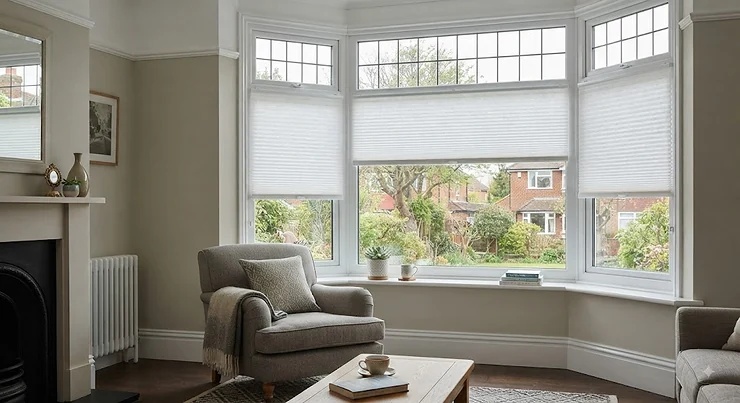
In This Article
Here’s a scene that plays out in flats across Britain every single week: you’ve just signed a tenancy agreement, the landlord’s inspection checklist is longer than your arm, and there — right there in bold — is the clause about “no alterations to fixtures without written consent.” Meanwhile, your bathroom window is basically a fishbowl for the neighbours. This is exactly the gap that no drill pleated blinds were invented to fill. A no drill pleated blind is a concertina-folded window covering that fits using tension rods, adhesive pads, magnets, or spring-loaded brackets instead of screws — meaning no holes, no plaster dust, and (crucially) no argument with your landlord over the deposit. They’ve become the go-to option for renters, students, and anyone who’d rather not touch a power drill on a Sunday afternoon.

What makes this category genuinely interesting, rather than just a workaround for people who can’t be bothered to drill a hole, is how far the engineering has come. What started as flimsy paper accordion blinds has evolved into proper made-to-measure pleated shades with honeycomb insulation, cordless safety mechanisms, and colour ranges that wouldn’t look out of place in a professionally decorated home. We’ve spent time digging through real Amazon UK listings, manufacturer specifications, and aggregated customer feedback to work out which no drill pleated blinds genuinely earn their keep — and which ones are, frankly, glorified sticky paper.
This guide walks through seven real products spanning budget, mid-range, and premium territory, breaks down exactly how to measure and fit them, and tackles the practical questions that Amazon’s product pages never quite answer: will the adhesive actually survive a British summer, do these things insulate as well as drilled blinds, and what happens when your window sill isn’t quite the standard shape. If you’re weighing up easy fit pleated blinds on Amazon, self adhesive pleated blinds, or anything marketed as tool free, this is the comparison you actually need before you spend your money.
Quick Comparison Table
| Blind | Fitting Method | Best For | Price Range |
|---|---|---|---|
| Concept Blinds XXL Made to Measure Pleated Blind | No-drill adhesive/clip mount | Large or oddly-sized windows | Roughly £35-£65+ depending on size |
| Concept Crystal Honeycomb Pleated Blind | No-drill clip mount | Thermal insulation on a budget | Around £25-£45 |
| Amazon Basics Cordless Pleated Window Blind | No-drill clip mount | First-time renters wanting a trusted name | Around £12-£22 |
| Tropik Home Pleated Blinds | No-drill clip fitting (inward-opening windows) | Conservatories and budget multi-room jobs | Under £15 in most sizes |
| UrMoon No Tools No Drill Cellular Shades | Spring-tension, no drill | Deep recesses needing top-down/bottom-up control | Roughly £20-£45 |
| FURNISHED Blackout Blinds Stick On | Self-adhesive, fully portable | Total blackout in seconds, house shares | Under £20 |
| BKSAI Magnetic Blackout Blinds | Magnetic, traceless | Awkward frames, temporary lets | Around £15-£30 |
Looking at the spread above, there’s a clear pattern: the cheapest options ask you to trade some polish for pure functionality, while the made-to-measure and cellular picks cost more but genuinely rival drilled blinds for insulation and light control. If your priority is simply “get something up before the weekend,” the Tropik Home or Amazon Basics options make sense; if you’re planning to live somewhere for a year or more, the custom-sized honeycomb picks pay that extra cost back in warmth and durability.
💬 Just one click — help others make better buying decisions too!😊
Top 7 No Drill Pleated Blinds: Expert Analysis
Choosing between seven very different products gets easier once you know what each one is actually built for. Below, we’ve broken down the real specs, who each blind genuinely suits, and what reviewers consistently flag — good and bad — so you’re not relying on marketing copy alone.
1. Concept Blinds XXL Made to Measure Pleated Blind — best for oversized or awkward windows
The standout feature here is sheer range: this pleated blind can be custom-ordered anywhere from 20cm to 200cm wide and 20cm to 260cm tall, which covers everything from a tiny bathroom porthole to a floor-to-ceiling patio door. That’s a genuinely unusual spread for a no-drill product — most competitors cap out well under 150cm width.
Constructed with an aluminium top and bottom rail sandwiching the pleated fabric, the blind ships with a full adhesive fixing kit rather than screws, and buyers choose from around 22 fabric colours to match existing décor. Because it’s made to your exact measurements rather than trimmed down from a stock size, there’s no leftover slack fabric bunching at the edges — a common complaint with generic “cut to size” alternatives.
Based on the spec comparison with the rest of this list, this is squarely the premium pick for anyone whose window doesn’t fit neat, standard proportions — think bay windows, French doors, or loft conversions with unusual dimensions. Reviewers consistently report that the made-to-measure sizing is the main draw, with several noting they’d previously struggled to find any no-drill option wide enough for patio doors. A recurring theme in feedback is that the adhesive mounts hold firmly on painted wood and uPVC but need a genuinely clean, dry surface to bond properly — skipping the surface prep step is the most common cause of disappointment.
Pros:
- ✅ Custom sizing up to 200cm wide covers awkward windows
- ✅ 22 colour options blend into most interiors
- ✅ No leftover fabric slack thanks to made-to-measure cut
Cons:
- ❌ Custom orders take longer to arrive than stock sizes
- ❌ Adhesive needs a genuinely clean surface to bond well
Given the made-to-measure manufacturing and wider colour range, Concept Blinds XXL Made to Measure Pleated Blind sits at the higher end of this list’s price range, but for anyone who’s been unable to find a no-drill blind that actually fits their window, that premium buys a real solution rather than a compromise.

2. Concept Crystal Honeycomb Pleated Blind — best thermal performance without drilling
What immediately sets this one apart is the honeycomb cell structure — rather than a single flat pleat, the fabric forms enclosed air pockets that trap a layer of insulating air against the glass, similar in principle to the cellular shades favoured by energy-conscious homeowners.
The blind is made to measure between 50cm and 149cm in height, available in six fabric colours with a choice of aluminium profile finishes, and — importantly for this list — installs entirely without drilling using an included clip and adhesive mounting kit. Because the honeycomb structure traps still air rather than just blocking light, it does more work against heat loss than a single-layer pleated fabric of similar thickness, which matters more than most buyers initially assume when picking a window covering for a draughty period property.
This is honestly the pick for anyone who cares about their heating bill as much as their privacy — students in older housing stock, or renters in properties where the landlord hasn’t got round to double glazing yet. Aggregated customer sentiment is notably positive on the fitting process, with multiple reviewers describing the assembly as “genuinely doable in twenty minutes without help,” though a smaller number mention that very tall drops (close to the 149cm maximum) can feel slightly less taut than shorter versions.
Pros:
- ✅ Honeycomb cells add real thermal insulation value
- ✅ Six colours plus profile choices for interior matching
- ✅ Widely reported as straightforward to self-assemble
Cons:
- ❌ Maximum height of 149cm rules out very tall windows
- ❌ Taller drops reported as slightly less taut than shorter ones
If insulation is genuinely on your mind — not just privacy — the Concept Crystal Honeycomb Pleated Blind earns its mid-to-premium price range through function rather than just fabric choice.
3. Amazon Basics Cordless Pleated Window Blind — best for first-time renters wanting a trusted name
The standout feature is right there in the name: this is a cordless pleated blind from Amazon’s own house brand, which for a lot of first-time buyers translates into a level of trust that smaller marketplace sellers simply don’t have yet.
Fitting is achieved with two supplied clips per side rather than drilled brackets, and the blind is genuinely cordless — meaning no dangling pull cord, which matters more than people initially think if there are children or pets in the property (more on the regulatory side of that shortly). Sizes run from compact bathroom widths up to around 120cm, and the height is adjustable by clipping the fabric at your preferred drop.
What most buyers overlook about this model is that “pleated” doesn’t mean “pre-stretched” — Amazon’s own product notes explain the fabric is folded flat for shipping and needs a gentle stretch after unboxing before it hangs evenly, a step that catches out anyone expecting it to look showroom-ready straight from the packet. Reviewers consistently note it as excellent value for the price bracket, with the main recurring criticism being that the semi-sheer fabric on some colourways lets in more light than expected for anyone hoping for a genuinely dark bedroom.
Pros:
- ✅ Trusted own-brand quality control and returns process
- ✅ Fully cordless design, useful where children are present
- ✅ Straightforward two-clip no-drill fitting
Cons:
- ❌ Needs manual stretching after unboxing to sit flat
- ❌ Lighter colourways offer limited blackout performance
For anyone nervous about buying window coverings online for the first time, the Amazon Basics Cordless Pleated Window Blind offers a lower-risk entry point — familiar returns policy, predictable sizing, and a price range that won’t sting if it’s not quite right.
4. Tropik Home Pleated Blinds — best budget pick for conservatories and multi-room jobs
The immediate standout is the sheer breadth of stock sizes — eighteen width options and six colourways mean there’s a strong chance a ready-made size fits your window without any custom order or wait time at all.
Constructed as a classic plisse (accordion-pleat) blind stretched between two aluminium rails, it’s fitted using clips that slot onto inward-opening window frames — genuinely no drilling required, though the brand is upfront that this fitting method suits windows that open inward rather than sliding sashes. Drops run up to 200cm, which comfortably covers most conservatory panels and standard domestic windows in one purchase.
Here’s what the spec sheet won’t tell you, but user reports suggest: because this is a stocked, mass-produced size rather than made-to-measure, getting a flush, gap-free fit depends more than usual on accurate measuring beforehand — a few millimetres out and you’ll either have a visible gap or excess bunching fabric at the sides. The brand has operated since 2013 and built a loyal following doing exactly this one product well, which shows in the volume of repeat-purchase reviews from people kitting out multiple windows in the same property.
Pros:
- ✅ Eighteen stock sizes usually mean no custom-order wait
- ✅ Genuinely budget-friendly for outfitting several windows
- ✅ Clip fitting suits inward-opening and conservatory frames
Cons:
- ❌ Not suited to outward-opening or sliding sash windows
- ❌ Fit quality depends heavily on precise measuring
If you’re furnishing an entire conservatory or several small windows on a tight budget, Tropik Home Pleated Blinds is the practical, no-nonsense choice — just measure twice before you order.
5. UrMoon No Tools No Drill Cellular Shades — best for deep recesses needing precise light control
What jumps out immediately is the fitting mechanism itself: rather than clips or adhesive, this blind uses a spring-loaded tension system at both ends of the top rail, gripping the inside of the window recess purely through friction — genuinely no tools of any kind required, provided the recess depth is at least 3.5cm.
The cellular (honeycomb) construction gives it a meaningful edge on both insulation and sound dampening compared with flat pleated fabric, and the top-down/bottom-up design means you can drop the top of the blind for privacy while still letting light in underneath, or vice versa — a level of control that most no-drill blinds simply don’t offer. Custom sizing and both blackout and light-filtering fabric options are available, alongside a genuinely cordless mechanism.
Based on the spec comparison, this is the pick for anyone who wants their no-drill blind to behave like a proper made-to-measure product rather than an obvious workaround — the top-down/bottom-up function in particular is the kind of feature you’d normally only find on drilled, professionally fitted shades. Reviewers who’ve fitted these into deep Victorian or Edwardian recesses report a genuinely tight, secure hold; the more common complaint concerns shallower or uneven modern uPVC recesses, where the tension mechanism has less surface to grip and can shift over time.
Pros:
- ✅ Top-down/bottom-up control rare among no-drill blinds
- ✅ Honeycomb build adds insulation and noise reduction
- ✅ Genuinely tool-free spring-tension fitting
Cons:
- ❌ Needs at least 3.5cm recess depth to fit securely
- ❌ Shallower or uneven recesses can loosen the tension grip
For period properties with generous window recesses, UrMoon No Tools No Drill Cellular Shades delivers a level of control that easily justifies sitting in the mid-to-premium price range on this list.

6. FURNISHED Blackout Blinds Stick On — best for instant, fully portable blackout
The headline feature is right there in the name — this is a genuinely portable, stick-on blackout blind that can be applied and removed from any window shape in minutes, without measuring templates, clips, or fixed hardware of any kind.
Unlike the other entries on this list, it isn’t a traditional rigid pleated blind with aluminium rails; instead it’s a flexible blackout material with an adhesive edge, designed to be trimmed or folded to fit non-standard shapes including car windows, skylights, and irregular panes that made-to-measure pleated blinds simply can’t accommodate. That flexibility is the entire point — this is a product built for people who move frequently or need a solution today, not next week.
What most buyers overlook here is that “removable” doesn’t automatically mean “reusable indefinitely” — the adhesive is genuinely residue-free on most painted and glass surfaces for a single application cycle, but repeatedly peeling and reapplying to the same spot does reduce stickiness over time, based on the honest pattern in aggregated review sentiment. It’s best understood as a temporary or semi-permanent solution rather than a long-term fixture, which is exactly why it suits shift workers, students in short lets, or anyone who just needs total darkness for a specific period rather than a permanent décor choice.
Pros:
- ✅ Fits any window shape without measuring or hardware
- ✅ Genuinely portable between properties or rooms
- ✅ Fastest possible setup of anything on this list
Cons:
- ❌ Adhesive weakens with repeated reapplication
- ❌ Lacks the finished, made-to-measure look of rigid blinds
When speed and total blackout matter more than aesthetics, FURNISHED Blackout Blinds Stick On is the sensible, low-commitment budget pick.
7. BKSAI Magnetic Blackout Blinds — best for awkward frames and short-term lets
The standout advantage is the magnetic fitting system itself — twelve magnets hold the blackout material against a metal or metal-backed frame, meaning genuinely traceless application and removal with none of the adhesive residue risk that comes with sticky-backed alternatives.
Made from a water-resistant blackout material, it’s designed to fit any shape and size window by trimming to size, and because the magnets simply detach rather than peel, it can be taken down and reinstalled elsewhere far more times than most adhesive competitors before performance drops off. It’s a genuinely different fixing philosophy to every other entry on this list — no clips, no adhesive, no tension springs, just magnetic contact.
Here’s what the spec sheet doesn’t spell out clearly: magnetic fitting only works where there’s a magnetic (typically steel) frame or fixture to grip, which rules it out on plain uPVC or wooden frames unless you first add a magnetic strip — a step some first-time buyers miss when ordering. Reviewers consistently flag it as excellent for metal-framed period or industrial-style windows and for anyone in short-term accommodation who values genuinely zero-trace removal above almost everything else, with the main criticism being that magnetic hold can weaken slightly on very large panes where the material’s own weight works against the magnets at the edges.
Pros:
- ✅ Fully traceless magnetic fixing, no adhesive residue
- ✅ Reusable across multiple installations more reliably
- ✅ Effective water-resistant blackout material
Cons:
- ❌ Requires a magnetic or metal-backed frame to work
- ❌ Large panes can strain the magnetic hold at the edges
For metal-framed windows specifically, BKSAI Magnetic Blackout Blinds solves a fitting problem that clips and adhesives genuinely can’t, sitting comfortably in the mid price range for what it offers.
Practical Usage Guide: Fitting Your No Drill Pleated Blind
Getting a no-drill blind to sit flush rather than lopsided comes down almost entirely to preparation, not the product itself. Start by cleaning the mounting surface thoroughly with a mild detergent and drying it completely — every adhesive and clip-based option on this list performs worse on a dusty or greasy frame, and this single step accounts for most of the “it fell down” complaints found in review sections. Next, measure three times: width at the top, middle, and bottom of the recess, then use the smallest figure, since window frames are rarely perfectly square even in newer builds.
For the first thirty days, resist the temptation to fully load the blind with heavy curtains or additional weight on top — let the adhesive or tension mechanism cure and settle into its final grip strength first, which for most sticky-mount systems takes around 24-48 hours to reach full bond strength. A common early mistake is pulling the pleats too tight when first hanging the fabric, which stresses the mounting points before they’ve properly set; a gentle, even stretch is enough. If you’re using a clip-fit system on an inward-opening window, double-check the window still closes and locks fully with the blind fitted — a handful of buyer photos show blinds mounted slightly too far forward, catching on the handle.
Ongoing maintenance is refreshingly low. A soft brush attachment on a vacuum, run gently along the folds every few weeks, keeps dust from settling in the pleats where it’s otherwise fiddly to reach. For any fabric that isn’t marked machine washable, a damp microfibre cloth handles most marks without disturbing the pleat structure or the mounting adhesive.
✨ Don’t Miss These Exclusive Deals!
🔍 Take your window styling to the next level with these carefully selected picks. Click through to check current pricing and availability, and give your rented flat the finished look it deserves without touching a single screw!
Real-World Scenarios: Who Actually Needs These Blinds
Picture a second-year university student moving into a shared house for exactly one academic year. Their landlord has explicitly banned drilling in the tenancy agreement, the budget is tight, and they’ll be gone by June regardless. For this scenario, the Tropik Home Pleated Blinds or Amazon Basics Cordless Pleated Window Blind make the most sense — low cost, stock sizes that fit standard bedroom windows without customisation delays, and genuinely nothing left behind on moving-out day.
Now picture a young professional in a one-year corporate let, working night shifts, who needs the bedroom completely dark by 9am regardless of the time of year. Here the FURNISHED Blackout Blinds Stick On or BKSAI Magnetic Blackout Blinds earn their place — near-instant fitting, genuine blackout performance, and the flexibility to reposition if the desk or bed layout changes during the tenancy.
Finally, consider a family in a Victorian conversion flat with deep original sash recesses and a landlord who’s happy with no-drill solutions but expects a polished finish, since the flat is professionally managed and inspected regularly. This is exactly the situation the UrMoon No Tools No Drill Cellular Shades or Concept Blinds XXL Made to Measure Pleated Blind were built for — the recess depth suits the spring-tension fitting perfectly, and the made-to-measure sizing avoids the slightly improvised look that stock sizes can carry in a period property with non-standard proportions.
Problem → Solution: Common No Drill Blind Fitting Issues
Problem: The blind keeps sliding down or falling off within days. This is almost always down to inadequate surface prep or fitting during humid conditions, since most adhesive bonds cure poorly in damp air. Solution: clean and fully dry the surface, fit on a mild, dry day, and avoid touching the mount for the first 24 hours.
Problem: There’s a visible gap of a centimetre or more down one side. This typically means the smallest of your three width measurements wasn’t used, or the frame itself is slightly out of square. Solution: remeasure at all three heights and, for stock-size products like the Tropik Home Pleated Blinds, size down to the nearest smaller option rather than up.
Problem: The blind won’t stay taut and sags in the middle. With tension-fit products like the UrMoon No Tools No Drill Cellular Shades, this points to insufficient recess depth or an uneven recess surface reducing the spring’s grip. Solution: measure recess depth against the manufacturer’s minimum before ordering, and consider a clip or adhesive alternative if the recess is shallower than 3.5cm.
Problem: A magnetic blind won’t attach at all. This means the frame simply isn’t magnetic. Solution: test with a fridge magnet before buying, or add a thin adhesive-backed steel strip to create a magnetic surface for products like BKSAI Magnetic Blackout Blinds.
Problem: Fabric looks crumpled rather than crisply pleated after installation. Freshly unpacked pleated fabric is folded flat for shipping. Solution: gently stretch the fabric top to bottom by hand and leave it under light tension for a few hours — most folds relax out naturally within a day, as also noted for the Amazon Basics Cordless Pleated Window Blind.
How to Choose No Drill Pleated Blinds
- Confirm your window’s opening direction first. Inward-opening casement windows suit clip-fit blinds; sliding sashes or windows with deep recesses generally suit tension-fit or made-to-measure adhesive designs better.
- Measure the recess depth, not just the width and drop. Tension-mounted cellular shades typically need a minimum depth of around 3.5cm to grip securely — anything shallower rules that fitting method out.
- Decide whether blackout or insulation matters more than pure privacy. Honeycomb and cellular constructions outperform single-layer pleats on both thermal retention and noise, at a higher price point.
- Check whether your frame is metal-backed. This single detail determines whether magnetic options like easy fit pleated blinds on Amazon with magnetic mounts are even viable before you spend a penny.
- Weigh stock sizing against made-to-measure. Stock sizes ship faster and cost less; made-to-measure removes guesswork on unusual or oversized windows but adds lead time and cost.
- Read the fine print on reusability. If you expect to move the blind between properties, self adhesive pleated blinds with limited reapplication cycles may cost more over time than a magnetic or clip-based alternative.
- Factor in child or pet safety from the outset, particularly around cord-operated variants — covered in more detail in the safety section below.
Common Mistakes When Buying Pleated Blinds With No Fixing
The single most frequent mistake is ordering based on the outer window frame measurement rather than the actual recess or glass measurement, which leads to a blind that’s either too wide to fit inside the recess or leaves an awkward overhang outside it. A close second is assuming every “no drill” product uses the same fitting method — clip, adhesive, magnetic, and tension systems all behave differently, and a product description that simply says pleated blinds no fixing doesn’t tell you which mechanism you’re actually getting until you read the detail.
Buyers also frequently underestimate how much surface condition matters for adhesive and clip-based products; a chipped or uneven frame edge will undermine even a well-reviewed blind. Finally, a surprisingly common mistake is not checking whether the window still opens and closes properly once the blind is fitted — inward-opening casements in particular can catch on clips positioned too far into the frame, a detail that’s easy to miss until it’s already installed.
No Drill Pleated Blinds vs Traditional Screw-Fit Blinds
| Factor | No Drill Pleated Blinds | Traditional Screw-Fit Blinds |
|---|---|---|
| Wall/frame damage | None to minimal | Permanent screw holes |
| Deposit risk (rented property) | Very low | Higher, subject to landlord agreement |
| Installation time | Typically 10-30 minutes | Often 45+ minutes, tools required |
| Long-term stability | Good, varies by fitting method | Excellent, rarely shifts |
| Portability between homes | High, especially magnetic/stick-on types | None, blind stays with the property |
| Custom sizing availability | Available on premium models like Concept Blinds XXL Made to Measure Pleated Blind | Widely available across most retailers |
The trade-off in this table boils down to permanence versus flexibility: screw-fit blinds hold their position more reliably over years of daily use, but they’re a one-way commitment that most renters simply can’t make. No drill pleated blinds close most of that stability gap — particularly the tension and made-to-measure adhesive options like the UrMoon No Tools No Drill Cellular Shades — while keeping the door open to take the blind with you when you move. For anyone who owns their home outright and never plans to move, traditional screw-fit remains marginally more robust; for everyone else, the no-drill category has genuinely closed most of the practical gap.
What to Expect: Real-World Performance of Self Adhesive Pleated Blinds
On paper, self adhesive pleated blinds sound almost too convenient — no tools, no measuring templates, stick and done. In everyday use, the picture is a little more nuanced. Initial adhesion is typically strong within the first hour, but full bond strength on most products takes a day or two to develop fully, meaning a blind fitted on a Friday evening will feel noticeably more secure by Sunday than it did straight out of the box. Temperature and humidity both affect performance: adhesive mounts fitted in a cold, damp bathroom generally hold less well than the same product fitted in a warm, dry living room, which is worth bearing in mind if you’re tackling several rooms in one weekend.
Reviewers consistently note that surfaces matter enormously — painted wood and smooth uPVC give the best results, while textured or recently painted surfaces (where paint hasn’t fully cured) tend to produce weaker bonds. The realistic expectation, based on aggregated feedback across this category, is that a well-fitted self-adhesive pleated blind will comfortably last the duration of a standard twelve-month tenancy without needing reapplication, provided it isn’t repeatedly removed and reattached in the meantime.
Tool Free Pleated Blinds for Renters
For anyone renting under a standard assured shorthold tenancy in England, the appeal of a genuinely tool free pleated blind isn’t just convenience — it’s financial protection. Landlords are only permitted to make deposit deductions for damage that goes beyond fair wear and tear, and unauthorised drill holes in a frame or wall are a textbook example of exactly the kind of damage that can trigger a legitimate deduction; official guidance on what counts as damage versus normal wear is available directly from GOV.UK’s private renting guidance.
Choosing a genuinely tool-free fitting method — magnetic, tension, or a well-applied adhesive kit — sidesteps that risk entirely, provided the blind is removed carefully at the end of the tenancy. A sensible habit is photographing the window frame both before fitting and immediately after removal, giving you evidence should any dispute arise. It’s also worth checking your tenancy agreement’s specific wording before assuming any no-drill product is automatically permitted; some agreements still restrict adhesive products on painted surfaces even where drilling is the primary concern, so a quick message to the landlord or agent before ordering avoids any awkward conversations later.
Long-Term Cost & Maintenance
Judged purely on upfront price, the cheapest entries on this list — Tropik Home and the stick-on or magnetic blackout options — look like the obvious value picks. Judged over a two-to-three-year horizon, that calculation shifts. A £12-£20 stock-size blind that needs replacing after each move works out more expensive over several tenancies than a £35-£65 made-to-measure honeycomb blind that can be carefully removed and refitted in a new property, provided the new windows are a similar size.
Maintenance costs across this category are genuinely low regardless of price point — there are no motors, batteries, or moving mechanical parts to fail on any of the seven products covered here, unlike motorised or corded alternatives. The main ongoing cost consideration is replacement adhesive strips or clips, which most manufacturers sell separately for a few pounds when the originals wear out, extending the working life of an otherwise sound blind well beyond its first fitting.
Features That Actually Matter (And Those That Don’t)
Genuinely useful: recess depth compatibility, because a blind that can’t physically grip your window is worthless regardless of how it looks in photos. Genuinely useful: honeycomb or cellular construction if insulation or noise reduction matters to you, since the difference in thermal performance versus flat pleated fabric is measurable rather than marketing spin. Genuinely useful: a cordless mechanism, both for child safety and because it simply looks tidier without a dangling pull cord.
Less important than the marketing suggests: an enormous colour range. Most buyers settle on white, grey, or a neutral tone regardless of how many options are listed, so a smaller but well-made range shouldn’t be a dealbreaker. Also less critical than it first appears: branding. Some of the strongest performers on this list, like Tropik Home and UrMoon, aren’t household names, yet their aggregated review sentiment holds up well against bigger brands — a recognisable logo doesn’t guarantee a better fit for your specific window.
Safety & Regulations Guide for No Screw Pleated Blinds
Blind cord safety is a genuinely serious issue in the UK, not a box-ticking formality. Under British Standard BS EN 13120, blinds sold with looped operating cords must include a safety device to prevent the loop forming a strangulation hazard, and the Royal Society for the Prevention of Accidents (RoSPA) has documented multiple child fatalities linked to unsecured blind cords over the past two decades — a sobering reminder of why this matters, particularly in households with young children or regular visits from them. Fortunately, most no screw pleated blind products, including several featured in this guide, are cordless by design, sidestepping the issue entirely rather than relying on an add-on safety clip.
Beyond cord safety, it’s worth noting that landlords in England have a duty of care to ensure any blinds already fitted in a rented property meet current safety standards, regardless of who installed them. If you’re adding your own no-drill blind on top of an existing corded blind, check that the original cord is properly secured or removed rather than simply hidden behind the new fitting.
On the energy side, thermal performance is a genuine, measurable consideration rather than a nice-to-have extra. According to the Energy Saving Trust’s guidance on windows and doors, windows are responsible for a meaningful share of a typical home’s heat loss, which is exactly why honeycomb and cellular no-drill blinds — despite costing more upfront — can make a genuine difference to a draughty rental over a full winter.
FAQ
❓ Do no drill blinds actually stay up long term?
❓ Can I get no drill pleated blinds made to measure?
❓ Are no drill blinds suitable for bathrooms and kitchens?
❓ Will my landlord accept adhesive pleated blinds instead of drilled ones?
❓ What's the difference between clip-fit and tension-fit no drill blinds?
Conclusion
No drill pleated blinds have genuinely moved past being a compromise solution for people who can’t drill into a wall — the better products on this list rival drilled alternatives on insulation, light control, and finish, while completely sidestepping deposit risk and landlord disputes. The right pick really does depend on your specific window and situation: stock-size budget options like the Tropik Home Pleated Blinds or Amazon Basics Cordless Pleated Window Blind suit fast, low-cost jobs across several rooms, while made-to-measure and cellular picks like the Concept Blinds XXL Made to Measure Pleated Blind or UrMoon No Tools No Drill Cellular Shades reward the extra spend with a noticeably better long-term fit and thermal performance.
Whichever route you take, the fundamentals stay the same: measure carefully, check your recess depth and frame material before choosing a fitting method, and factor in whether you’ll want to take the blind with you when you eventually move. Get those basics right, and a no-drill pleated blind can genuinely look — and perform — like it was fitted by a professional, without a single hole in the frame.
✨ Don’t Miss These Exclusive Deals!
🔍 Ready to sort your windows out this weekend? Click through to check current pricing and availability on today’s picks, and enjoy a genuinely finished-looking home without touching a drill!
Recommended for You
- Best Pleated Blinds UK 2026: 7 Top Picks Compared
- Thermal Roman Blinds UK: 7 Best Warm ; Cosy Picks for 2026
- Best Blackout Roman Blinds UK 2026: 7 Top Picks
Disclaimer: This article contains affiliate links. As an Amazon Associate, I earn from qualifying purchases. If you purchase products through these links, we may earn a small commission at no additional cost to you.
✨ Found this helpful? Share it with your friends! 💬🤗
