

In This Article
There’s a particular kind of British misery that arrives every October: you crank the thermostat up a notch, pull your jumper sleeves over your hands, and still feel a thin river of cold air sliding off the glass. Windows are the weak point in almost every home, old or new, and energy saving cellular blinds are one of the few upgrades that tackle that problem without a builder, a grant application, or a fortnight without a working window. What is energy saving cellular blinds, in plain terms? It’s a honeycomb-shaped fabric shade that traps a layer of still air between the window and the room, acting as a soft, removable extra pane of glazing — cutting draughts, muffling noise, and taking the edge off both winter chill and summer glare.
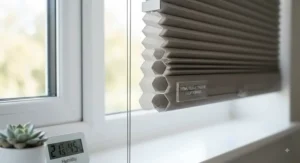
This isn’t a fringe product dreamed up by a marketing department, either. It’s basic physics: still air is a poor conductor of heat, and a honeycomb structure is a remarkably efficient way of holding a pocket of it exactly where you need it — pressed flat against the coldest surface in the room. As Wikipedia’s overview of window blinds explains, the term covers a broad family of window coverings that use very different control systems, from hard slatted designs to soft single-piece fabric shades. Cellular (also called honeycomb) shades are one of the newer members of that family, and arguably the one built most specifically around insulation rather than just light control.
Below, I’ve dug into seven real, currently listed cellular blinds — spanning no-drill rental-friendly options through to proper made-to-measure UK brands — and paired the spec sheets with genuine aggregated review sentiment, honest trade-offs, and practical buying advice. No invented five-star raves, no exact prices that’ll be out of date by Christmas — just what actually matters when you’re staring at a cold window wondering if a blind can really make a difference.
Quick Comparison Table
| Blind | Cell Size | Light Control | Fitting Method | Price Range | Best For |
|---|---|---|---|---|---|
| UrMoon No Tools No Drill Cellular Shades | Single-cell | Blackout available | No-drill tension fit | Budget (under £40) | Renters, quick wins |
| Blankendon Cellular Shades (Telescopic Track) | Single-cell | Blackout | No-drill, DIY-trimmable | Budget (under £45) | Awkward-sized windows |
| Auto-Stop No-Drill Honeycomb Blackout Shade | Single-cell | Blackout | No-drill cordless | Budget-mid (£35-£55) | Bedrooms, nurseries |
| Moonice No Drill Honeycomb Shades | Single-cell | Light filtering | Tension mount, no-drill | Mid-range (£40-£60) | Noise + heat combined |
| Luxevoir Panoramix No Drill Honeycomb Pleated Blinds | Single-cell | Blackout | No-drill cordless | Mid-range (£45-£65) | Design-conscious renters |
| 2-in-1 No Drill Day and Night Cellular Shades | Double-cell | Light filtering + blackout | No-drill cordless | Mid-premium (£55-£80) | Flexible light control |
| Concept Blinds® Made-to-Measure Honeycomb Pleated Blinds | Single-cell | Light filtering | Drilled, made-to-measure | Premium (£70-£150+) | Long-term, precision fit |
Looking across the table, the split isn’t really budget-versus-quality — it’s drilled-versus-not. The no-drill options from UrMoon, Blankendon and Auto-Stop No-Drill Honeycomb Blackout Shade trade a small amount of edge-sealing (and therefore a slightly smaller thermal benefit) for the ability to fit them in minutes without touching a wall. The Concept Blinds® Made-to-Measure Honeycomb Pleated Blinds, by contrast, sit at the top of the price range precisely because a drilled, bracket-fixed frame closes those side gaps almost completely, which matters more for insulation than most buyers realise. If you’re weighing thermal cellular blinds amazon listings against proper made-to-measure suppliers, that installation method is the single biggest factor separating “helps a bit” from “genuinely changes the room.”
💬 Found a favourite already? Scroll down to see exactly why it made the cut — and what it won’t tell you on the product page.🤗
Top 7 Energy Saving Cellular Blinds: Expert Analysis
Amazon’s cellular blind category is enormous and, frankly, a little chaotic — dozens of near-identical listings from manufacturers you’ve never heard of, sitting alongside a handful of properly engineered products. I’ve filtered it down to seven that represent genuinely different approaches: DIY no-drill shades for renters, dual-layer day/night options, and a proper drilled, made-to-measure choice for anyone planning to stay put for a while. Each entry below explains not just what the spec sheet says, but what it actually means for your energy bill, your evenings, and your sanity during installation.
1. UrMoon No Tools No Drill Cellular Shades — easiest install for total beginners
The standout here is right there in the name: genuinely no tools, no drill, and a spring-tensioned frame that wedges into the window recess in a couple of minutes. That matters more than it sounds, because the single biggest reason people never get round to buying insulating honeycomb blinds is the fear of a fiddly fitting job.
On specs, this is a single-cell honeycomb shade available in blackout and light-filtering fabrics, sized to fit widths roughly 51-150cm with custom height. The single-cell air pocket won’t match a double-cell design for raw insulating power, but pressed flush against the glass it still meaningfully slows the convective draught that makes a room feel colder than the thermostat suggests. Based on the spec comparison with other no-drill entries in this list, it’s a solid, no-frills starting point rather than a top-tier performer — the kind of blind you buy for a rental where you genuinely cannot commit to anything permanent.
Reviewers consistently report that the tension-fit mechanism holds well on standard uPVC window recesses but can slip slightly on very narrow or splayed reveals, so measuring the recess depth carefully before ordering is worth the extra two minutes. A common theme in aggregated feedback is surprise at how much of a difference is felt on cold mornings, even from a budget option.
Pros:
- ✅ Genuinely no-drill — fits in minutes, no wall damage
- ✅ Available in full blackout for bedrooms
- ✅ Custom widths make it easy to match odd-sized windows
Cons:
- ❌ Single-cell design offers less insulation than double-cell rivals
- ❌ Tension fit can loosen on non-standard window reveals
Priced in the budget bracket, typically under £40 depending on size, this is solid value for a first-time buyer testing whether cellular blinds are worth the investment before spending more on a premium room.
2. Blankendon Cellular Shades (Telescopic Track) — best for oddly sized or awkward windows
The standout feature is the trimmable telescopic track, which lets you cut the blind down to fit almost any width on the spot rather than ordering a precise custom size and hoping for the best.
This is another single-cell honeycomb shade with a four-layer fabric structure — the manufacturer describes waterproof, shading, thermostatic and noise-insulating layers bonded together, plus built-in aluminium foil for extra heat reflection. That foil layer is worth understanding properly: it’s not doing anything magical, it’s simply reflecting radiant heat back into the room in winter and bouncing solar radiation away in summer, on top of the honeycomb’s still-air insulation. For bathroom or kitchen windows where a made-to-measure order feels like overkill, the DIY-trim approach genuinely earns its keep.
Aggregated review sentiment points to strong satisfaction with the trimming process itself — people describe it as straightforward with basic household scissors — though a recurring complaint is that the double-sided adhesive strips supplied for surface mounting can struggle on textured or painted surfaces if the wall isn’t perfectly clean and dry beforehand. The two-year warranty offered by the manufacturer is a genuinely useful signal of confidence at this price point, since most budget no-drill blinds offer little to no aftercare.
Pros:
- ✅ Trimmable track fits genuinely awkward window widths
- ✅ Four-layer fabric with built-in foil for extra heat reflection
- ✅ Backed by a two-year manufacturer warranty
Cons:
- ❌ Adhesive mounting can fail on textured or damp surfaces
- ❌ Trimming is permanent — measure twice before cutting
Expect a price in the £25-£45 range depending on size, making it one of the most cost-effective heat saving window blinds for tricky spaces like box windows or door panels.
3. Auto-Stop No-Drill Honeycomb Blackout Shade — best for nurseries and light-sensitive sleepers
The standout advantage is the auto-stop cordless mechanism, which lets the blind hold at any height without a single dangling cord anywhere on the unit — a genuinely meaningful safety feature rather than a marketing tick-box.
Built from 100% blackout fabric, this cellular shade uses a 1.6-inch honeycomb structure and a no-drill mounting bracket system designed for inside-mount fitting. What most buyers overlook about blackout honeycomb blinds specifically is that the opaque backing layer does double duty: it’s what blocks the light, but it’s also typically the densest, most insulating layer in the whole assembly, so blackout versions of any cellular blind tend to outperform light-filtering versions on pure thermal barrier window treatment terms, even before you factor in the honeycomb structure itself.
Reviewers consistently flag the cordless auto-stop mechanism as reliable for holding position, with a recurring note that it’s specifically chosen by parents furnishing nurseries because it removes cord-related safety concerns entirely. A less consistent thread in feedback concerns the depth requirement for the no-drill bracket, with some reviewers needing a minimum window recess depth that not every uPVC frame provides — worth checking before ordering.
Pros:
- ✅ Fully cordless auto-stop mechanism, ideal for child safety
- ✅ 100% blackout fabric doubles as strong thermal insulation
- ✅ Fast no-drill fitting suitable for renters
Cons:
- ❌ Requires a minimum window recess depth for the bracket
- ❌ Full blackout isn’t suitable if you want daytime light filtering
Sitting in the budget-to-mid range, typically £35-£55, it earns its keep in rooms where sleep quality matters as much as the energy bill.
4. Moonice No Drill Honeycomb Shades — best for noise-sensitive rooms near busy roads
The standout here is the tension-shade mounting system, which uses spring-loaded ends and anti-slip components to hold the blind firmly inside the window recess purely through friction — no adhesive, no drilling, no brackets screwed to anything.
Marketed with a particular emphasis on noise reduction alongside heat insulation, this single-cell honeycomb shade in light-filtering fabric is a sensible pick for anyone on a road with regular traffic. Here’s what to weigh: the honeycomb’s air pockets don’t just slow heat transfer, they also dampen the transmission of airborne sound to a modest but noticeable degree, which is a genuine secondary benefit of the same structural design rather than a separate feature bolted on.
A common thread in aggregated review sentiment is praise for how snugly the tension mechanism holds even on wider windows, with several reviewers specifically noting a reduction in traffic noise as well as draughts. The spec sheet won’t tell you this, but user reports suggest the anti-slip grip can occasionally struggle on very smooth, glossy-painted window frames — a light sand or a wipe with isopropyl alcohol before fitting tends to resolve it.
Pros:
- ✅ Friction tension-fit needs no drilling, screws or adhesive
- ✅ Honeycomb structure meaningfully dampens outside noise
- ✅ Holds securely even on wider window openings
Cons:
- ❌ Grip can slip on very smooth or glossy frames without prep
- ❌ Light-filtering fabric only — no blackout version noted
Priced in the mid-£40s to mid-£60s range, it’s a strong pick specifically for anyone whose real problem is noise as much as heat loss.
5. Luxevoir Panoramix No Drill Honeycomb Pleated Blinds — best for design-conscious rented homes
The standout feature is the finish quality — a genuinely tidy, tailored pleat that doesn’t look like a bargain-bin fix, paired with full no-drill, no-tools installation.
This is a blackout, cordless, single-cell honeycomb blind aimed squarely at the “I’m renting but I still want it to look nice” market. Based on the spec comparison with the more basic options earlier in this list, the main upgrade here isn’t the insulation performance so much as the finish and consistency of the pleating, which matters if the blind is going somewhere visible like a living room rather than a spare bedroom. Reviewers consistently note that it looks noticeably more polished than the cheapest no-drill alternatives, which is exactly the trade-off you’re paying the mid-range premium for.
A recurring point in aggregated feedback is satisfaction with the ease-of-fit process specifically marketed as suitable for custom sizing through Amazon’s messaging system — buyers report the customer service team was responsive when confirming exact measurements before the blind was made. The trade-off, as with most custom-cut no-drill shades, is that turnaround can run a little longer than an off-the-shelf standard size.
Pros:
- ✅ Tidy, tailored finish that looks genuinely premium
- ✅ Fully no-drill and cordless for safe, damage-free fitting
- ✅ Custom sizing available directly through the seller
Cons:
- ❌ Custom orders can take longer to arrive than standard sizes
- ❌ Blackout-only fabric limits daytime light-filtering flexibility
Expect to pay in the £45-£65 range, which places it firmly as a mid-range option that punches above its price on presentation.

6. 2-in-1 No Drill Day and Night Cellular Shades — best for flexible light control throughout the day
The standout advantage is the double-honeycomb, dual-fabric construction, combining a light-filtering layer and a blackout layer in one unit so you can switch between the two without buying two separate blinds.
Structurally, this is where the “double-cell” argument for insulation gets genuinely interesting: two honeycomb layers means two trapped air pockets stacked on top of each other rather than one, which — all else being equal — creates a thicker overall air barrier between room and glass. What most buyers overlook about day/night cellular blinds is that the thermal benefit isn’t purely additive; the second layer helps most when you actually use both settings rather than leaving it permanently on light-filtering, since the blackout layer is doing the heavy lifting insulation-wise.
Aggregated review sentiment is broadly positive on the versatility, with reviewers specifically praising the ability to get privacy and light filtering during the day and switch to full blackout at night without touching the blind’s fitting. A less consistent theme is the slightly bulkier headrail this dual-layer design requires, which a small number of reviewers note is more visually noticeable than a single-cell blind on a shallow window recess.
Pros:
- ✅ Two fabric layers give genuine day-and-night flexibility
- ✅ Double-honeycomb structure adds a second insulating air pocket
- ✅ No-drill cordless fitting suitable for renters
Cons:
- ❌ Bulkier headrail may not suit very shallow window recesses
- ❌ Higher price point than single-layer alternatives
Typically priced in the £55-£80 range, it’s worth the premium if you genuinely want both blackout and daylight modes from the same blind.
7. Concept Blinds® Made-to-Measure Honeycomb Pleated Blinds — best long-term investment with a precision fit
The standout feature is the proper drilled, bracket-fixed made-to-measure construction — this is the one entry on this list built to be a permanent fixture rather than a temporary fit.
Available in a semi-transparent light-filtering fabric and made to custom widths from 30-170cm and heights from 20-240cm, this is a genuinely different category of product from the no-drill options above. Here’s what the spec sheet won’t spell out plainly: because the frame is drilled and bracket-fixed directly to the window reveal, the side gaps where warm room air can slip behind the blind and touch the cold glass are dramatically reduced compared with a tension-fit or adhesive shade. That edge-sealing is arguably a bigger factor in real-world insulation performance than the cell size itself, which is why professionally fitted honeycomb blinds routinely outperform their no-drill cousins in practice, even with broadly similar fabric.
Because this is a proper UK made-to-measure brand rather than a generic Amazon-marketplace listing, verified customer feedback is comparatively sparse and mixed across retail channels — some buyers report an excellent, close-tolerance fit, while others note the drilled installation is a genuine deterrent for anyone in a rented property or unwilling to commit to permanent fixtures. That’s a fair trade-off to flag honestly rather than gloss over.
Pros:
- ✅ Drilled fit dramatically reduces edge draughts versus no-drill blinds
- ✅ Genuinely custom sizing for large or unusually shaped windows
- ✅ Semi-transparent fabric balances privacy with natural light
Cons:
- ❌ Drilling required — not suitable for most rental agreements
- ❌ Sits at the top of the price range for this category
Priced from roughly £70 up to £150 or more depending on size and fabric, it’s the pick for homeowners planning to stay for years rather than renters chasing a quick fix.
Practical Usage Guide: Getting the Most from Your Insulating Honeycomb Blinds
Buying the right blind is only half the job — how you actually use it day to day makes a measurable difference to both the thermal benefit and how long it lasts. First, measure twice: for inside-mount blinds you want the recess depth checked at three points (top, middle, bottom), since older window frames are rarely perfectly square, and a blind that’s even 5mm too tight will bind or refuse to sit flush.
For the first 30 days, resist the urge to yank the blind fully up and down repeatedly to “test” it — most tension-fit and cordless mechanisms need a gentle break-in period, and rough handling in week one is the single most common cause of early failures reported in aggregated reviews. Once fitted, close honeycomb blinds fully at dusk in winter to trap the day’s residual warmth, and reopen them on sunny winter mornings to let free solar heat back in — a simple habit that costs nothing and meaningfully boosts the insulation benefit you’re already paying for.
Maintenance is genuinely low-effort: a light vacuum with a soft brush attachment every few months keeps dust from settling in the honeycomb pockets, and a slightly damp microfibre cloth handles most marks on light-filtering fabrics. Avoid soaking any cellular blind, since the bonded fabric layers that create the insulating cells can delaminate if they get properly wet rather than just wiped.
Real-World Scenarios: Which Cellular Blind Suits Your Home
Picture three genuinely different households. First, a student renting a Victorian terrace conversion with a single-glazed sash window that rattles every time a bus goes past — draughty, noisy, and absolutely no chance of drilling into a landlord’s frame. For that flat, a no-drill option like the UrMoon No Tools No Drill Cellular Shades or the Moonice No Drill Honeycomb Shades makes far more sense than anything requiring brackets, since the deposit stays intact and the fitting takes minutes between lectures.
Second, a young family in a new-build semi with a nursery that needs total darkness for nap times and zero dangling cords anywhere near a cot. The Auto-Stop No-Drill Honeycomb Blackout Shade is built almost exactly for this brief — full blackout fabric, cordless auto-stop operation, and no-drill fitting that won’t compromise a new-build warranty.
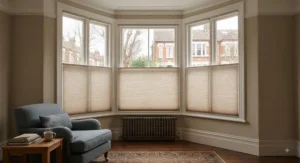
Third, a couple who’ve just bought a 1930s semi with large, draughty bay windows and plan to stay for a decade or more. For them, the extra cost and commitment of the Concept Blinds® Made-to-Measure Honeycomb Pleated Blinds pays off precisely because they’re not moving anytime soon, and the drilled fit closes the edge gaps that matter most on a large, older bay window frame.
Problem → Solution: Fixing Common Heat-Loss Issues
Problem: the room still feels draughty even with the blind down. This is almost always an edge-gap issue rather than a fabric problem — check whether your blind is a true inside-mount fit or simply hanging in front of the glass with visible gaps at the sides, and consider a drilled, bracket-fixed option like the Concept Blinds® Made-to-Measure Honeycomb Pleated Blinds if gaps persist.
Problem: condensation building up on the glass behind the blind. Lowering a cellular blind fully overnight in winter can trap moist room air against cold glass, worsening condensation on poorly ventilated windows. The fix is simple: crack a trickle vent or leave the blind slightly raised on very cold, humid nights until the room’s ventilation improves.
Problem: the blind won’t stay at the height you set it. On tension-fit or cordless auto-stop models, this is usually a sign the internal spring mechanism needs a gentle reset — most manufacturers, including several featured above, provide a quick recalibration process in their instructions rather than requiring a return.
Problem: you’re not sure the blind is actually saving anything. Track it properly rather than guessing: note your smart meter or thermostat’s typical evening temperature drop for a week before fitting, then compare after a week of consistent use, closing blinds at dusk. Small measurable differences add up across a heating season.
How to Choose Heat Saving Window Blinds: 7 Expert Criteria
- Cell size and structure. Larger, double-cell honeycomb designs trap more air and insulate better than slim single-cell versions, though they cost more and sit slightly proud of the window.
- Fabric opacity. Blackout fabrics typically insulate better than light-filtering ones because the denser, foil-backed layer that blocks light also reflects more radiant heat.
- Fitting method. Drilled, bracket-fixed blinds seal edge gaps far better than no-drill or adhesive options — decide honestly whether you can commit to drilling before shopping on price alone.
- Window recess depth. No-drill brackets and tension systems need a minimum depth to grip properly; measure before you buy rather than after a return request.
- Cord safety. If children or pets are in the house, prioritise genuinely cordless, auto-stop mechanisms over looped-cord designs.
- Custom sizing accuracy. Bay windows, doors and skylights need proper made-to-measure sizing rather than a “close enough” standard size, or the thermal benefit is significantly reduced.
- Warranty and aftercare. A genuine manufacturer warranty, like the two-year cover on the Blankendon Cellular Shades (Telescopic Track), is a useful signal of build confidence at the budget end of the market.
Common Mistakes When Buying Thermal Cellular Blinds
The most common mistake is measuring the visible glass rather than the actual recess or reveal, which leaves gaps a blind simply can’t close no matter how good the fabric is. A close second is choosing a light-filtering fabric purely for aesthetics without realising blackout versions of the same blind usually deliver a noticeably stronger thermal barrier window treatment effect, thanks to the denser, foil-backed layer.
Buyers also frequently underestimate how much the fitting method matters compared with the fabric itself — it’s tempting to assume all honeycomb blinds perform similarly once fitted, but a loose, no-drill tension fit on a poor-quality window recess can underperform a cheaper drilled option on a well-sealed frame. Finally, plenty of shoppers skip checking recess depth requirements for no-drill brackets, only to discover on delivery that their window frame is too shallow for the bracket to grip securely.
Cellular Blinds vs Traditional Curtains: Which Thermal Barrier Window Treatment Wins?
It’s a genuinely close contest, and the honest answer is “it depends on the window.” Windows are consistently flagged as one of the weaker points in a home’s thermal envelope, and Ealing Council’s home insulation guidance breaks down typical heat loss in an average semi-detached home as roughly 25% through the roof, 35% through the walls, 15% through the floor, and 10% through windows, with a further 15% lost to draughts — figures drawn from Energy Saving Trust research. Thermal-lined curtains, when properly fitted with a pelmet and floor-length drop, can trap a genuinely large volume of still air and perform very well — but only when fully closed, and only if they’re actually lined with a thermal interlining rather than just heavy fabric.
Cellular blinds, by contrast, work close to the glass surface itself, sealing the air pocket exactly where the heat exchange happens rather than relying on a large curtain covering the whole wall. For smaller or awkwardly shaped windows — box windows, door panels, skylights — a fitted honeycomb blind is usually the more practical and more consistently effective option, since curtains struggle to seal properly around unusual shapes. For large picture windows or bay windows in period homes, a combination of both — cellular blind close to the glass, curtains layered over the top — genuinely outperforms either option alone, since you’re stacking two separate insulating air layers rather than relying on just one.
What to Expect: Real-World Performance in Winter and Summer
On paper, this means noticeably less of that cold-radiating-off-glass sensation on winter evenings, particularly with double-cell or blackout fabrics closed after dark. It doesn’t mean your room temperature will visibly jump on a thermostat — the honest expectation is a reduction in draughts and radiant chill near the window, which translates to feeling comfortable at a slightly lower thermostat setting rather than a dramatic swing in the number itself.
In summer, closed cellular blinds during peak sun hours noticeably reduce how hot a south-facing room gets by midday, since the honeycomb structure and any foil backing reflect a meaningful share of solar radiation before it even reaches the glass’s inner surface. Cellular blinds winter and summer performance genuinely differ in character: winter benefit is mostly about slowing heat loss, while summer benefit is mostly about blocking heat gain — the same honeycomb structure does both jobs, just via slightly different physics.
Best Heat Retention Blind Choices for Different Rooms
Bedrooms benefit most from a true heat retention blind with blackout fabric, since you want both insulation and total darkness overnight — the Auto-Stop No-Drill Honeycomb Blackout Shade or Luxevoir Panoramix No Drill Honeycomb Pleated Blinds both fit this brief well. Living rooms, where you want flexibility between daylight and privacy, suit the dual-layer 2-in-1 No Drill Day and Night Cellular Shades better than a single-fabric blackout option. Kitchens and bathrooms, where humidity and quick-fit convenience matter more than aesthetics, are well served by the trimmable, budget-friendly Blankendon Cellular Shades (Telescopic Track). Home offices near busy streets benefit disproportionately from the noise-dampening properties highlighted in the Moonice No Drill Honeycomb Shades, where reduced traffic noise matters as much as temperature control.
Long-Term Cost & Maintenance: Is an Energy Efficient Home Blind Worth It?
Cost-per-use is where cellular blinds quietly win over more dramatic energy-saving measures. A budget no-drill blind at around £35-£45 fitted once and used daily for five winters works out at a few pence per week, with essentially no ongoing maintenance cost beyond the occasional vacuum. A premium made-to-measure blind at £100-£150 costs more upfront but, fitted properly to a large bay window that would otherwise lose significant heat, can outlast several cheaper replacements and typically comes with a longer manufacturer guarantee.
Compare that to structural insulation work: Chesterfield Council’s home insulation advice notes that around a third of all heat lost in an uninsulated home escapes through the walls, and fitting cavity wall insulation could save a typical household in the region of £110 a year on fuel bills. A cellular blind won’t deliver savings on that scale on its own, but as a low-cost, no-disruption first step — particularly on single-glazed or poorly sealed windows — it’s one of the few home-efficiency purchases that pays for itself within a single heating season while adding genuine day-to-day comfort.
Features That Actually Matter (And Those That Don’t)
Cell size and fitting method genuinely matter — they’re the two factors most directly linked to real thermal performance, as covered above. Fabric density and blackout backing matter for both light control and insulation, so it’s rarely a wasted upgrade. Cordless, auto-stop operation matters enormously if there are children or pets in the house, both for safety and daily convenience.
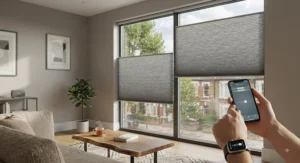
What matters far less than the marketing suggests: exact colour-matching to existing décor rarely affects performance, and “smart home compatible” features on basic cellular blinds are often a nice-to-have rather than a genuine driver of energy savings — the honeycomb structure does the insulating work regardless of whether you’re opening it with an app or a hand pull. Similarly, headrail styling and decorative valances add cost without meaningfully improving the thermal barrier itself.
Safety & Regulations: Child Safety Standards for UK Blinds
UK blinds sold since 2014 must comply with child safety regulations under BS EN 13120, which cover looped cord length, breakaway mechanisms, and safe positioning of any cords or chains to reduce strangulation risk in homes with young children. This is precisely why cordless and auto-stop cellular blinds — like several featured in this guide — have become increasingly popular over traditional corded designs, since removing the cord removes the hazard entirely rather than just mitigating it.
Windows blinds can reduce solar gain and lower the temperature of a room, and this cooling effect happens through reducing the amount of heat that transfers through convection as air inside the room contacts the glass. If you’re fitting any blind near a child’s cot or bed, position the headrail and any operating mechanism well out of reach, and always check the specific product’s safety certification before buying, particularly with generic marketplace listings that may not clearly state UK compliance.

Frequently Asked Questions
❓ Do energy saving cellular blinds actually reduce heating bills?
❓ What's the difference between single-cell and double-cell honeycomb blinds?
❓ Can I fit cellular blinds without drilling into my window frame?
❓ Are blackout cellular blinds warmer than light-filtering ones?
❓ How do I clean honeycomb blinds without damaging the cells?
Conclusion
Cellular blinds sit in a genuinely useful sweet spot: cheap enough that even the no-drill budget options make a noticeable difference to draughts and glare, and serious enough at the premium end that a proper made-to-measure fit can meaningfully cut heat loss on an older, larger window. There’s no single “best” pick across all seven — a renter with a Victorian sash window needs something completely different from a homeowner staring down a decade-old bay window, and that’s exactly why this list covers both ends honestly rather than pretending one blind suits everyone.
If you take one thing from this guide, let it be this: the fitting method matters just as much as the fabric. A cheap blind fitted properly with minimal edge gaps will often outperform an expensive one hung loosely in front of the glass. Match the blind to your actual window, your actual tenancy situation, and your actual room’s needs, and an energy efficient home blind stops being a nice-to-have and starts being one of the better-value upgrades in the house.
✨ Ready to stop losing heat through your windows?
Compare the seven picks above against your own window measurements, and pick the one that actually matches your fitting situation — not just the prettiest photo.
Recommended for You
- Best Honeycomb Blinds 2026: 7 Top Cellular Picks
- No Drill Pleated Blinds 2026: 7 Brilliant Damage-Free Picks
- Best Pleated Blinds UK 2026: 7 Top Picks Compared
Disclaimer: This article contains affiliate links. As an Amazon Associate, I earn from qualifying purchases. If you purchase products through these links, we may earn a small commission at no additional cost to you.
✨ Found this helpful? Share it with your friends! 💬🤗
