
In This Article
Curtains for bay windows are curtains hung on a bendable track, a hinged pole or three separate poles, so the fabric follows the angled or curved shape of the bay and covers every pane without gaps. Choosing the right hardware, width and length matters far more than the fabric itself.
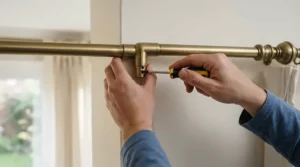
A bay window is the show-off of the British living room. It pushes out into the garden, drinks in the light and gives you a spot for the armchair. Then you try to dress it, and the show-off turns into a geometry puzzle. A straight pole cuts across the opening like a bowstring. A pair of curtains won’t turn a 135-degree corner by good intentions alone. Get it wrong and you end up with gaps at the angles, a draught at the glass and a saggy centre.
The good news is that this is a solved problem. Bays have been a feature of British housing for centuries, and the history of the bay window explains why they come in so many shapes: canted (angled), box (square) and bow (curved). Each shape suits a different kind of hardware. UK retailers and designers largely agree on the broad answer, and I’ve pulled their advice together with real product specifications.
This guide covers seven real products, the maths behind curtain length for bay windows and bay window curtain width, how to handle corner curtain overlap, and how to avoid the most common mistakes. Availability on Amazon UK can vary by seller, so always check the live listing.
Quick Comparison: Curtains for Bay Windows at a Glance
Here is the short version before the deep dive. The load figures come from manufacturer or retailer listings, and prices are brackets only, so check current price before buying.
| Product | Type | Stated Load Limit | Best For |
|---|---|---|---|
| Hallis Hudson Sologlyde | PVC bendable track | Up to 8kg | Tight budgets, curved bays |
| Hallis Hudson Deluxe | PVC bendable track | Up to 10kg | Pinch-pleat curtains, forward bends |
| Swish Aluglyde | Aluminium bendable track | Up to 8kg | Boxy bays needing reverse bends |
| New Edge Blinds Fineline | Aluminium bendable track | Light to heavy fabrics | Wide bays, heavier drapes |
| Swish Elements Belgravia 3-Sided Bay Pole | Hinged metal pole kit | Not stated for the kit | Gentle canted bays, a pole look |
| Tinsmiths Bendable Square Track | Metal track with finials | Not stated | A pole-style finish on a track |
| Direct Fabrics Square30 Wave Track | Bendable wave track | 50kg total | Wave headings, heavy drapes |
Looking at the table, the Hallis Hudson Sologlyde and Hallis Hudson Deluxe are the budget gateway, while the Swish Aluglyde adds reverse-bend flexibility for boxy bays. The Swish Elements Belgravia 3-Sided Bay Pole is the only true pole here, and it comes with caveats on square corners. Anyone with heavy or wave-headed curtains should look at the Direct Fabrics Square30 Wave Track, whose 50kg rating dwarfs the others.
💬 Just one click — help others make better buying decisions too!😊
Top 7 Tracks and Poles for Curtains for Bay Windows: Expert Analysis
Every pick below is real hardware. The analysis is reasoning from published specifications and from what reviewers say on retailer pages. I haven’t tested any of it myself, and I’ve flagged where I couldn’t verify reviews.
1. Hallis Hudson Sologlyde — easiest bending for curved bays
This white PVC track (formerly sold under the Swish name) flexes into position almost by itself. That is its real selling point, because curved and shallow canted bays don’t need force or tools.
According to the retailer listing, it carries medium-weight curtains up to 8kg and arrives in one piece. The gliders have hooks that push straight into the curtain heading, which hides the track. Practically, 8kg is plenty for a lined pair on a standard bay, but a wide bay with interlined drapes could push it. Because the listing says it bends backwards and forwards, it also copes with the inward corners of a box bay.
My read is that this suits renters and first-time buyers who want a tidy result without paying premium prices. Reviewers on the retailer’s page mention using it for replacements and for bay windows, though the review pool is small, so treat that as light evidence.
Pros:
- ✅ Bends by hand in both directions
- ✅ One-piece lengths, so no joins to snag
- ✅ Hooked gliders hide the track cleanly
Cons:
- ❌ 8kg limit rules out heavy drapes
- ❌ PVC feels less premium than metal
Price bracket: budget. I couldn’t confirm a stable live price, so check current price. Value verdict: the best entry point for ordinary bays.
2. Hallis Hudson Deluxe — strongest PVC option for pinch pleats
If your curtains are pinch-pleated, this is the interesting one. It’s a PVC track rated for up to 10kg, and its rear channel carries underslung gliders so the curtains hang neatly beneath it. That gives a more defined heading and a tighter stack-back than the hooked-glider tracks.
The catch is direction. The listing says it bends forward into the room, so it suits canted and curved bays, but it will not reverse bend. On a box bay with inward returns, that is a deal-breaker. Lengths run from roughly 125cm to 275cm and can be cut down with a fine-toothed saw, so a wide bay needs joining.
This is for homeowners with traditional pleated curtains and a bay that bulges outward rather than squares off. On paper, the extra 2kg over the Sologlyde is modest, and the heading style matters more than the number.
I couldn’t verify real customer reviews for this product, so I won’t characterise sentiment. Look at recent buyer feedback before ordering.
Pros:
- ✅ Underslung gliders give crisp pinch-pleat headings
- ✅ 10kg rating handles heavier lined curtains
- ✅ Cut-to-size design for tricky measurements
Cons:
- ❌ Forward bends only, no reverse
- ❌ Wide bays require extra joiners
Price bracket: budget to lower-mid. Check current price. Value verdict: strong if your bay and heading style match.
3. Swish Aluglyde — reverse-bendable aluminium for boxy bays
Aluminium changes the feel of a track, and the Swish Aluglyde is the cheerful middle child. It’s white-coated aluminium, rated up to 8kg, and the listing states it bends backwards and forwards for curves and multiple bends. That makes it one of the few budget-friendly tracks that suits a box bay.
The gliders hook into the curtain heading, so the track hides behind the fabric. Aluminium holds a bend better than PVC does, so a bay that needs crisp angles keeps its shape. The brackets are universal for wall or ceiling fixing, and I’d always choose ceiling fixing in a bay for the cleaner light seal.
Reviewers on the retailer page are warm about it. They call it a good solution for bay windows, and one praises the reverse-bend ability as rare. One reviewer shares a practical tip: if the glide gets sticky, wipe the track with multi-surface cleaner and polish it off.
Pros:
- ✅ Bends both ways for box and canted bays
- ✅ Aluminium keeps its shape better than PVC
- ✅ Reviewers praise its bay window performance
Cons:
- ❌ 8kg cap limits very heavy drapes
- ❌ Can stick without occasional cleaning
Price bracket: budget to lower-mid. Check current price. Value verdict: my default for most UK bays.
4. New Edge Blinds Fineline — heavy-duty bendable aluminium
This one is for bays where the fabric is serious. The New Edge Blinds Fineline is described as a flexible, heavy-duty aluminium track with smooth-glide technology, bendable by hand and trimmable, for light to heavy fabrics. The retailer listing I found sells it in lengths from 70cm up to 370cm.
The practical details matter. Tracks over 200cm come in two pieces with a connector, so check the joint sits on a straight section, not at a corner. The kit includes wall supports and gliders, and you must remove the bending inserts after forming the track, which is a step people skip. Because it’s trimmable, you can order slightly long and cut to fit, which is forgiving when measurements are tight.
I’d point wide bays and blackout-lined curtains at this track, since the listing positions it for heavier fabrics. I didn’t find verified customer reviews for this exact listing, so I won’t summarise sentiment.
Pros:
- ✅ Rated for light to heavy fabrics
- ✅ Trimmable, so measuring errors are survivable
- ✅ Lengths up to 370cm cover wide bays
Cons:
- ❌ Joins needed beyond 200cm
- ❌ Bending inserts must be removed afterwards
Price bracket: lower-mid, varying with length. Check current price. Value verdict: good value for heavy curtains.
5. Swish Elements Belgravia 3-Sided Bay Pole — the genuine pole option
If you want the look of a proper pole, this is the kit that does it. The Swish Elements Belgravia 3-Sided Bay Pole (28mm, 400cm) includes poles, passing rings and passing brackets so a pair of curtains can travel from the side windows to the centre.
Here’s what the listings say, and it’s worth reading twice. A single hinge joint flexes to meet the angles of a bay, from straight (180 degrees) to a right angle (90 degrees). But the same listing warns that curtains will struggle to pull around a true right-angle (square) bay. The sweet spot is a canted bay with obtuse angles, like the typical Victorian three-sider. Wall-fix and ceiling-fix versions exist, and a separate bend kit returns the pole to the wall.
Retailer feedback is positive but thin. The page shows seven reviews with 86% saying they’d recommend it, and one reviewer calls the poles beautiful. That’s small evidence, so don’t over-read it.
Pros:
- ✅ Authentic pole look with finials
- ✅ Passing rings let one pair travel the bay
- ✅ Wall and ceiling versions available
Cons:
- ❌ Struggles around square right-angle corners
- ❌ Larger bays may need a bigger kit
Price bracket: mid-range. Check current price. Value verdict: fine for canted bays, wrong for box ones.

6. Tinsmiths Bendable Square Track — pole looks on a track
This is the clever compromise. The Tinsmiths Bendable Square Track is a metal track you bend on site, with a pair of finials (cap or ball), so it looks like a pole while behaving like a track. The retailer describes forward bends, reverse bends or a continuous curve, and wall-fixed or ceiling-fixed options.
It also solves the join problem. Because the track is square-section, it can be joined to unlimited length without the gliders hitting joins or brackets, per the listing. Tracks of 3.6m and over are supplied in two pieces, and 7.2m and over in three. There’s also a wave-heading option on request.
My view is that this suits owners of a large or awkwardly shaped bay who want the finial look without the corner problem. It’s the dearer route, but a single pair of curtains can glide the whole bay.
I found no customer reviews for it, so I can’t report sentiment. A specialist supplier would be a good place to ask about your specific bay shape.
Pros:
- ✅ Pole-style finials on a bendable track
- ✅ Joins won’t obstruct the gliders
- ✅ Bends forward, reverse or in a curve
Cons:
- ❌ Pricier than PVC or standard aluminium tracks
- ❌ Specialist supplier, so check lead times
Price bracket: premium, starting at around £90 and rising with length. Check current price. Value verdict: worth it for large or fussy bays.
7. Direct Fabrics Square30 Wave Track — heavyweight wave heading
Wave headings, the soft S-curve that looks so good in a modern bay, need a track built for it. The Direct Fabrics Square30 Wave Track is a bendable track rated to 50kg total curtain weight, with sections that join for any bay size.
The retailer’s guide has an unusual instruction: order your curtains to the glider count, not the track width. The total number of gliders determines how wide the curtain should be, and the 60mm gliders form the wave. You also measure the front edge of the bay recess in a straight line across each section, rather than wall to wall.
For a wave heading, that detail matters more than any spec. Get it right and the wave runs unbroken around each corner; get it wrong and it flattens at the angles. I’d recommend this for contemporary rooms with heavy, floor-length drapes.
I couldn’t verify customer reviews for this listing, so I won’t characterise them.
Pros:
- ✅ 50kg rating suits heavy curtains
- ✅ Wave heading looks sleek around corners
- ✅ Sections join for large bays
Cons:
- ❌ Needs curtains made to glider count
- ❌ Measuring process is fussier than average
Price bracket: lower-premium. Check current price. Value verdict: the choice for wave fans.
Here is the full picture side by side, for anyone comparing specifications:
| Product | Material | Bend Direction | Load Limit | Price Bracket | Best For |
|---|---|---|---|---|---|
| Hallis Hudson Sologlyde | PVC | Forward and reverse | 8kg | Budget | First-time buyers |
| Hallis Hudson Deluxe | PVC | Forward only | 10kg | Budget to lower-mid | Pinch pleats |
| Swish Aluglyde | Aluminium | Forward and reverse | 8kg | Budget to lower-mid | Box bays |
| New Edge Blinds Fineline | Aluminium | Hand bendable | Light to heavy | Lower-mid | Wide bays |
| Swish Elements Belgravia 3-Sided Bay Pole | Metal pole | Hinged | Not stated | Mid-range | Canted bays |
| Tinsmiths Bendable Square Track | Metal | Forward and reverse | Not stated | Premium | Large bays |
| Direct Fabrics Square30 Wave Track | Metal | Bendable | 50kg total | Lower-premium | Wave headings |
Reading across, the budget tracks cover most homes, and bend direction is the quiet deciding factor. The Hallis Hudson Deluxe is the only one that can’t reverse bend, which is why the Swish Aluglyde beats it for box bays despite a lower load limit. Spend more only if you need the finial look of the Tinsmiths Bendable Square Track or the 50kg capacity of the Direct Fabrics Square30 Wave Track.
Fitting Curtains Around a Bay: A Practical Step-by-Step Guide
Fitting curtains around a bay is mostly preparation. Here’s a sequence that avoids the classic mistakes.
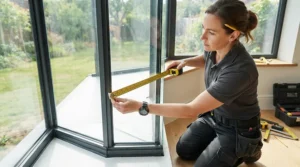
Step 1: Measure the front edge, not the walls. Run your tape in straight lines across each section of the bay recess. Add the sections together for total track length, then extend beyond the window so the curtains can stack back and let light in.
Step 2: Choose the fixing height. One UK designer quoted on Houzz suggests the best spot for a pole or track is usually midway between the top of the window opening and the ceiling coving. A ceiling-fixed track goes higher still and gives the cleanest light seal.
Step 3: Check what’s above. Make sure the wall or ceiling can hold the load. Plasterboard needs proper anchors, and heavy curtains need screws into timber or masonry.
Step 4: Bend gently. For aluminium tracks, insert the bending rods first, then shape the track around a cardboard template cut to the bay’s outline. Remove the inserts afterwards, as the New Edge Blinds Fineline instructions stress.
Step 5: Fit and test before hanging. Run a glider along the full track before the curtains go up. Snags are far easier to fix on an empty rail.
Step 6: Maintain it. If the glide gets sticky, wipe the track with a multi-surface cleaner, as one Swish Aluglyde reviewer suggests, and protect the glass with card while you do.
In the first 30 days, the common mistakes are bending too sharply at the corners, forgetting to remove the inserts and fixing the track too low. Fix those three and you’ve avoided most of the grief.
Real-World Scenarios: Matching Curtains for Bay Windows to Your Home
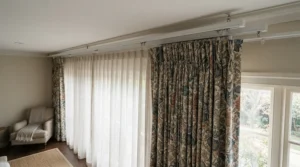
Specs mean little until they meet a real room. Here are three common situations.
The renter with a shallow canted bay. A 1930s semi-detached with a gentle three-sided bay, a modest budget and curtains to match. The Hallis Hudson Sologlyde handles the shallow curve, hides behind the heading and keeps costs low. If the landlord forbids drilling, check what fixings are allowed before ordering.
The family with a box bay and heavy lined curtains. A square bay, thermal-lined curtains and a toddler. The Swish Aluglyde handles the inward corners with its reverse bend. For heavier drapes, the New Edge Blinds Fineline is the safer load choice. Avoid cord-operated options in a child’s room (more on that below).
The design-led renovator with a large bay. A Victorian bay in a period home, with a pair of floor-length wave curtains for a sleek look. The Direct Fabrics Square30 Wave Track gives the heading and the load capacity, while the Tinsmiths Bendable Square Track gives the finial look if you prefer a more traditional finish.
In each case, the decision rule is the same. Match bay shape to bend direction first, then curtain weight to load limit, then style to budget. That’s a better order than starting with fabric and hoping the hardware cooperates.
How to Choose Curtains for Bay Windows
Follow these six steps in order, and the shortlist narrows itself.
- Identify your bay shape. Canted (angled), box (square) or bow (curved). Poles suit canted and box bays, but not true bows, according to one UK retailer’s guide.
- Decide on pole or track. Tracks bend around any shape, while poles need hinges or separate sections.
- Check bend direction. Box bays need reverse-bending tracks, like the Swish Aluglyde, not forward-only ones like the Hallis Hudson Deluxe.
- Weigh your curtains. Lined or interlined pairs for wide bays can exceed 8kg, so match the load rating.
- Pick a heading style. Hooked-glider tracks suit pencil pleats, underslung gliders suit pinch pleats and wave tracks demand wave curtains.
- Set a realistic budget. Hardware is a small share of the total cost, but a poor track ruins expensive fabric.
Curtain Pole vs Track for Bay Windows: The Honest Comparison
The curtain pole vs track for bay decision comes down to shape, weight and looks. UK designers largely favour tracks. In the Houzz piece, a designer notes that very few wooden bay poles exist because getting curtains around the corners is either expensive or unsatisfactory, and he points to bendable tracks for small bays. A specialist retailer calls a bendable track with finials its go-to solution.
| Factor | Bendable Track | Hinged Pole Kit | Three Separate Poles |
|---|---|---|---|
| Corner movement | Seamless | Limited at right angles | Curtains stop at each pole |
| Look | Discreet or finial-style | Classic pole | Traditional |
| Curved bows | Excellent | Unsuitable | Poor |
| Best For | Swish Aluglyde, Tinsmiths Bendable Square Track | Swish Elements Belgravia 3-Sided Bay Pole | Formal, separate-pair layouts |
Reading the table, tracks win on flexibility and poles win on character. If you love a pole’s look but have a box bay, the Tinsmiths Bendable Square Track gives you finials without the corner problem. If the bay is a gentle canted three-sider, the Swish Elements Belgravia 3-Sided Bay Pole earns its place.
The three-pole approach treats the bay as three separate windows: a pair of curtains in the centre and a single curtain drawing outwards on each side. It’s neat and traditional, but you lose the single sweep of fabric.
Curtain Length for Bay Windows: Sill, Apron or Floor?
Curtain length for bay windows comes down to three options, and each changes the whole room.
Sill-length curtains finish just above the sill. They’re tidy and practical, especially if there’s a radiator or window seat below. Apron-length curtains drop a few centimetres below the sill, which hides the gap and looks more generous. Floor-length curtains skim the floor with a small clearance, and they make the ceiling feel higher while giving the most cover.
For warmth, longer wins. Even a basic UK government draught-proofing factsheet lists thick curtains among the simple ways to reduce heat loss through a window. Uswitch adds a practical caution: don’t let curtains hang over a radiator, as this stops the heat reaching the room.
My rule of thumb is simple. Where a radiator or window seat sits in the bay, choose sill or apron length. Where the bay is clear, go floor-length. And fix the track higher than the window frame, since a higher fixing makes the drop longer and the room taller. Measure the drop from the fixed track or pole to your chosen finish point, not from the window top.
Bay Window Curtain Width: Getting the Fullness Right
Bay window curtain width is where good intentions meet arithmetic. The goal is simple: enough fabric to look generous when closed and stack back neatly when open.
The standard rule is fullness. For a pencil or pinch pleat, aim for roughly twice the track length in fabric, and a little more for a luxurious look. For wave headings, the rule changes. The Direct Fabrics Square30 Wave Track retailer says to order curtains to the glider count, not the track width, because the number of gliders determines the wave.
Measure the track length first, not the glass. The track should extend beyond the window so curtains stack back off the glass, and in a bay that means projecting a little past each end. The Direct Fabrics guide also says to measure along the front edge of the bay recess for each section, which captures the true length around the angles.
For a single pair across the whole bay, divide the total fabric width in half for each curtain. For the three-pole approach, work out each window separately. Remember that fabric widths are fixed, so a slightly wider bay often means adding a full extra width rather than a sliver.

Corner Curtain Overlap: Closing the Gap at the Angles
Corner curtain overlap is the detail that separates a neat bay from a draughty one. When curtains close around an angle, the fabric can pull away from the corner, exposing a slit of glass.
On a continuous bendable track, a single pair travels around the corners, so overlap is mostly about where the two curtains meet in the centre. A sensible rule of thumb is to let the leading edges overlap by a few centimetres at the centre. Some track systems let you use an overlap arm so the curtains cross at the middle.
On a three-pole layout, the corner is where the problem sits. The side curtains hang on separate poles, so choose poles that project far enough to let fabric clear the angle. On a hinged pole kit like the Swish Elements Belgravia 3-Sided Bay Pole, passing rings and brackets let curtains travel through, but the retailer warns right-angle corners are harder.
The bendable track wins here. A smooth curve means fabric follows the shape, which is why the Swish Aluglyde and Tinsmiths Bendable Square Track are so popular for fussy bays. Even so, a generous fullness reduces corner gaps more than any bracket can.
Bay Window Curtain Styling Ideas That Actually Work
Bay window curtain styling ideas should start with the room, not the catalogue.
Go ceiling-fixed and floor-length. One UK retailer calls the ceiling-mounted track a sleek, contemporary finish with a ceiling-to-floor drop. It hides the track, adds height and pairs well with a Swish Aluglyde or Direct Fabrics Square30 Wave Track.
Use a pelmet on a big bay. A specialist retailer notes pelmets work well on larger bays, where they won’t overwhelm the space. A pelmet also hides the track and cuts draughts over the top.
Layer for warmth and privacy. Voiles behind lined curtains give daytime privacy and evening warmth. A double track or a track with a second channel makes this easy.
Make the window seat part of the plan. If you’re adding a seat, choose sill or apron-length curtains so fabric doesn’t pool on the cushions.
Match metals. One UK designer suggests matching metal poles to light switches, door handles and other metalwork in the room. The Tinsmiths Bendable Square Track offers cap or ball finials for this reason.
Pick a calm fabric. In a bay, the fabric surrounds you on three sides. Busy patterns multiply, so choose solids or subtle textures if the bay is large.
Common Mistakes When Buying Curtains for Bay Windows
Most regrets come from a handful of avoidable errors.
Buying a straight pole. It won’t follow the shape, and you’ll fight the corners forever. Choose hardware designed for bays.
Ignoring bend direction. A forward-only track on a box bay will not work. Check the listing before buying.
Underestimating weight. A wide bay with thermal-lined curtains can exceed an 8kg limit. Work out the load before choosing a budget track.
Skipping the measurement. Measure the front edge of each section, not wall to wall. A tape measure takes five minutes and saves a return.
Fixing the track too low. A high fixing lengthens the drop and improves the look.
Choosing corded operation near children. RoSPA says corded curtain tracks can pose the same risks as blinds, and it advises never fitting looped cords in a child’s bedroom. The charity also says pull cords should be kept short and out of reach. Read their blind cord safety guidance before choosing a corded system. Every track in this guide is hand-drawn, which sidesteps the issue.
Forgetting the fire and fixings. Use proper anchors for your wall type and don’t exceed the load rating.
Long-Term Cost, Warmth and Value
A cheap track and a premium one differ most in lifespan and fussiness, not looks. Over ten years, the cost per year of a well-chosen budget track is trivial next to the curtains it carries. The real cost is replacing curtains that wear unevenly because the track snags.
The warmth case is stronger. According to the Energy Saving Trust, as reported by Groundwork, 18% of heat is lost through windows in an uninsulated house. The same source recommends thermal curtains and closing them at dusk to cut that loss. A bay has more glass than a flat window, so it’s the place where lined curtains pay back fastest.
Put simply, spend where it counts. A sturdy track with proper lining costs more upfront but wins on comfort and heating bills. A flimsy track with expensive curtains is the worst of both worlds. If budget is tight, the Hallis Hudson Sologlyde with good thermal lining beats a premium track with thin fabric.
Maintenance is minimal. Wipe the track occasionally, check fixings annually and avoid overloading. A well-fitted track should run for many years.
FAQ
❓ What size curtains do I need for a bay window?
❓ Can you use a straight curtain pole in a bay window?
❓ Are bendable curtain tracks strong enough for heavy curtains?
❓ Should bay window curtains touch the floor?
❓ Is it better to hang one pair of curtains or three in a bay?
Conclusion
Curtains for bay windows are a puzzle with a neat solution. Match the hardware to the bay shape first, since bend direction and load rating matter more than looks. For most UK homes, a bendable track beats a pole, and the Swish Aluglyde is the safest all-rounder. Budget buyers will be happy with the Hallis Hudson Sologlyde, while pinch-pleat fans on canted bays should look at the Hallis Hudson Deluxe.
If the bay is wide or the curtains are heavy, the New Edge Blinds Fineline and the Direct Fabrics Square30 Wave Track carry more. For the look of a pole without the corner headaches, the Tinsmiths Bendable Square Track is the clever compromise, while the Swish Elements Belgravia 3-Sided Bay Pole suits gentle canted bays.
Get the measurements right, size the fullness generously, check the corner overlap and line the curtains well. Do that, and the show-off bay becomes the best seat in the house.
✨ Ready to Finish Your Bay?
🔍 Take your bay window to the next level with these carefully selected tracks and poles. Click on any highlighted product to check current pricing and availability. These picks will help you create a warm, polished bay your whole household will love!
Recommended for You
- Net Curtains For Kitchen Windows: 7 Best Easy-Care Picks (2026)
- Eyelet Curtains For Living Room: 7 Proven UK Picks (2026)
- Thermal Curtains For Energy Saving: 7 Best Buys (2026)
Disclaimer: This article contains affiliate links. As an Amazon Associate, I earn from qualifying purchases. If you purchase products through these links, we may earn a small commission at no additional cost to you.
✨ Found this helpful? Share it with your friends! 💬🤗
