
In This Article
You hung the “blackout” curtains. You still woke at 4:47 a.m. to a laser-thin blade of sunrise slicing across the pillow. Sound familiar? Welcome to the great blackout con: plenty of curtains wear the label without earning it, and even the honest ones lose a few battles at the edges.
The best blackout curtains do two jobs at once. They stop light passing through the fabric, and they’re sized and hung so light can’t sneak round the sides. The NHS is refreshingly blunt about why this matters. Its insomnia guidance tells people to keep the bedroom dark and quiet, using curtains, blinds, an eye mask or ear plugs if needed. Darkness isn’t a luxury. It’s sleep hygiene.
So here’s the plan. I’ve compared seven real, widely sold options on amazon.co.uk, leaning towards eyelet blackout curtains because that’s what most British bedrooms actually hang. Along the way we’ll decode the jargon that decides everything: blackout curtain lining quality, light-blocking fabric weight, thermal backing and the curtain width to window ratio. There’s also a proper section on blackout curtains for large windows, because bays and patio doors punish a careless choice.
One honesty note. I haven’t hung any of these in my own home, and I won’t pretend otherwise. What follows is spec-sheet analysis plus the themes reviewers repeat, labelled as such. Prices are ranges at the time of research, so check the current price before buying.
Best Blackout Curtains at a Glance: Quick Comparison
Short on time? This table sorts the seven picks by what actually differs: how much light they claim to stop, how they’re built, and who they suit. Note the word “advertised”. Manufacturers’ blackout percentages are claims, not lab results, so I’ve kept them as claims.
| Curtain | Advertised light block | Build | Best For |
|---|---|---|---|
| PONY DANCE Double Layer 100% Blackout | 100% | Two thick layers, black lining | Large windows, light sleepers |
| Deconovo Faux Linen 100% Blackout | 100% | Linen-look face, coated back | Style-led bedrooms |
| H.Versailtex Faux Linen 100% Blackout | 100% | Linen-look face, white liner | Pale, neutral decor |
| CUCRAF 100% Blackout Linen | 100% | Three layers, light-shielding core | Tall windows, patio doors |
| John Aird Thermal Blackout Eyelet | 85-95% | Single thermal-woven layer | Winter warmth on a budget |
| NICETOWN Triple Weave | Roughly 85-99%, colour-dependent | Triple-weave polyester | Tight budgets, dark shades |
| Deconovo Super Soft Eyelet | Room darkening | Soft triple-weave | Living rooms, glare control |
Look at the pattern in the build column. The PONY DANCE Double Layer 100% Blackout and CUCRAF 100% Blackout Linen lean on dedicated light-stopping layers. The John Aird Thermal Blackout Eyelet and NICETOWN Triple Weave rely on a dense single weave with honest, lower claims. If pitch dark is non-negotiable, the first group earns the extra pounds. If you mainly want dimmer, cosier rooms, the second group is perfectly sensible.
💬 Just one click — help others make better buying decisions too!😊
What Are the Best Blackout Curtains?
The best blackout curtains are fully lined, tightly woven panels that stop virtually all daylight passing through the fabric. They’re also wide and long enough to limit leaks round the edges. Good ones add thermal insulation and some noise damping, and they suit your window’s size, pole and heading style.
Not everything sold as “blackout” fits that description. Retailers generally sort curtains into three grades: blackout (99-100% of light blocked), room darkening (about 95-99%) and light filtering (30-60%). Lab testing shows how loose the labelling can be. Consumer Reports tested 18 curtains from nine brands and found that many sold as blackout didn’t deliver blackout conditions. Some layered designs use a white inner polyester layer, and the worst performers let through so much light you’d do nearly as well with ordinary curtains.
That’s the trap. A label is a promise, not a measurement. What you can judge from a product page is construction: whether there’s a genuine light-stopping layer, how heavy the fabric is, and how much width you’re getting for your pole. Colour matters too. Pale blackout fabrics can still block most light, but dark shades win for total darkness.
Think of blackout as a system. Fabric stops light through the curtain. Fit stops light around it. You need both, and the rest of this guide shows you how to judge each.
Top 7 Best Blackout Curtains for UK Homes: Expert Analysis
Every pick below is a real, currently listed product on amazon.co.uk. Each one is analysed through its specs and the review themes buyers repeat, not through invented testing. I’ve mixed budget, mid-range and premium-ish options, and flagged where a product is really “room darkening” rather than full blackout.
1. PONY DANCE Double Layer 100% Blackout — heaviest hang for wide, bright windows
Weight is the whole story here. The 66 x 90 inch pair gives you two thick layers, a decorative face bonded to a black lining, rather than one clever weave doing everything. On paper, that means light-stopping happens in a dedicated layer, and the panels should drape like a hotel curtain rather than a shower liner.
The spec that matters most isn’t the blackout claim, it’s the width. Each panel is 66 inches (about 168cm) wide, so the pair supplies roughly 335cm of fabric. On a 1.7-metre pole that’s close to 2x fullness, the sweet spot for eyelet folds. It’s also why this is my first shortlist choice for blackout curtains for large windows. Two thick layers should trap more still air than a single weave, so it’s the most thermally credible of the seven too.
It suits night-shift workers, light sleepers and anyone facing a street lamp. Reviewers generally praise the darkness and the soft, substantial feel. One buyer noted the drop running slightly longer than the labelled 90 inches, so measure your floor gap before hanging.
Pros:
- ✅ Black lining gives genuine blackout at the fabric
- ✅ Wide 66-inch panels give generous fullness
- ✅ Heavy, hotel-style drape aids insulation
Cons:
- ❌ Heavy panels need a sturdy pole and brackets
- ❌ Drop may run slightly longer than labelled
Around £35-£50 for this size at the time of research. For real two-layer weight, that’s fair value (check current price).
2. Deconovo Faux Linen 100% Blackout — best-looking pick for style-led bedrooms
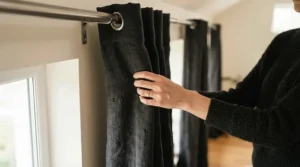
The standout feature is the disguise. Faux linen on the front gives you that rumpled, expensive, Scandi-cottage look, while a coated back layer does the dirty work of stopping daylight. Deconovo sells this range in eyelet form across sizes such as 46 x 54 and 52 x 63 inches, with a soft-touch, triple-weave build.
What does “coated back” mean in practice? A thin film physically blocks light instead of relying purely on dark yarn density. That’s why it copes better with pale shades like khaki or taupe than an uncoated weave would. The trade-off, in my reading of the spec, is a slightly stiffer hand and a fussier wash. Coated backs generally dislike hot cycles and tumble dryers, so follow the care label to the letter.
This is for anyone who wants blackout curtains that pass for ordinary lounge curtains, say a sitting room that doubles as a daytime sleep room. Amazon UK shows thousands of ratings across the range, and buyers tend to mention softness and value. As with any ready-made pair, expect some edge glow unless you hang wide and high.
Pros:
- ✅ Coated back suits paler colours
- ✅ Linen look hides its blackout job
- ✅ Wide choice of sizes and shades
Cons:
- ❌ Coated backs need gentle washing
- ❌ Narrow sizes leave edge gaps
Around £25-£40 depending on size. Strong value if looks matter as much as darkness (check current price).
3. H.Versailtex Faux Linen 100% Blackout — white liner that looks tidy from the street
The hook is the backing. H.Versailtex makes a point of its pure white liner, unlike the dull greyish backs on many rivals, and pairs it with a textured faux linen face and anti-rust eyelets. There’s also a W66 x L54 inch option, useful for wider windows with a shorter drop.
Why care about liner colour? From the street, a white back looks neater, especially if your curtains show at the window during the day. Paler backings also reflect more solar heat, which helps a room stay cooler when the sun bakes the glass. The brand claims 100% blackout and energy-saving insulation, and says its materials carry SGS testing. That’s a brand claim rather than something I could verify independently.
I couldn’t find a robust body of independent UK review themes for this exact listing, so treat the numbers as advertised, not proven. The blackout curtain lining quality looks sound on paper. My advice is to check the returns policy and do the torch test described later before you trim any labels.
Pros:
- ✅ White liner looks neat from outside
- ✅ Paler backing reflects summer heat
- ✅ Textured linen look suits neutral rooms
Cons:
- ❌ Independent UK review evidence is thin
- ❌ Brand claims remain unverified by me
Around £30-£45 depending on size. Reasonable value, provided you’re comfortable trusting the spec sheet (check current price).
4. CUCRAF 100% Blackout Linen — long drops for patio doors and tall windows
The standout is length. This linen-look eyelet range comes in 84 and 90 inch drops, which many ready-made ranges skimp on. The construction is three layers of faux linen with a light-shielding film in the middle, according to the seller’s description.
That layered core matters for blackout curtain lining quality. A separate film layer stops light more reliably than dense yarn alone, so pale colours shouldn’t be the weak link. Care is straightforward but strict: machine wash below 30°C, no bleach and no tumble drying. A light iron removes transit creases.
It’s a sensible shout for blackout curtains for large windows, especially tall patio doors. One reviewer said they’d struggled to find an 84-inch drop for their doors until these arrived, and another praised how dark the room got. The honest downside: at least one buyer reported the width wasn’t true to size across two pairs. Measure the flat panel width, not just the label.
Pros:
- ✅ 84 and 90 inch drops suit tall windows
- ✅ Light-shielding film core for solid darkness
- ✅ Straightforward machine-washable care
Cons:
- ❌ Some buyers report widths under stated size
- ❌ No tumble drying or bleach
Around £25-£40 depending on drop. Good value for length, but always measure carefully (check current price).
5. John Aird Thermal Blackout Eyelet — warmest budget option with tie-backs and big sizes
The hook here is a British heritage brand (John Aird & Co has been trading since 1896) selling a broad size range with matching tie-backs. Sizes run from 46 x 54 inches up to 90 x 108 inches, so it’s one of the few ready-made ranges that scales to bays and wide windows.
Now the honest spec reading. The maker advertises 85-95% blackout, says darker colours work best, and describes a single fabric layer with a thermal interwoven lining. That isn’t a double-layer system, so paler shades won’t reach true darkness. But it’s an eyelet blackout curtain with genuine insulation aims, and it’s cheap enough to layer with a blind.
Thousands of Amazon UK reviews across the range average roughly 4.5 to 4.6 stars at the time of research. The recurring theme is “not total blackout, but very good”, plus praise for easy hanging and a decent weight. A UK lifestyle magazine’s blackout round-up also picked a John Aird eyelet set as its best thermal option.
Pros:
- ✅ Sizes up to 90 x 108 inches
- ✅ Thermal backing lining plus included tie-backs
- ✅ Consistently strong review sentiment
Cons:
- ❌ Not true 100% blackout in pale shades
- ❌ Single layer lighter than double-layer rivals
Around £20-£45 depending on size. Excellent value if you choose a dark colour (check current price).

6. NICETOWN Triple Weave — the budget blackout many buyers start with
The standout is the triple-weave construction: a coloured face, a black-yarn middle layer that does the light-blocking, and a backing layer. NICETOWN’s ring-top range on Amazon UK comes in many colours and sizes, and the brand is famous for shifting huge volumes.
Advertised light blocking sits roughly between 85 and 99%, and it depends heavily on colour. That’s the crucial reading of the spec sheet: dark charcoal, navy and black should approach true blackout, while pale shades let more through. A US review site noted the same, saying some buyers found lighter colours “room darkening” rather than blackout. NICETOWN also claims noise reduction, which is plausible for a dense weave but modest compared with a heavier lined curtain.
Buy this if budget is tight and you’re happy to choose a dark shade. Reviewers consistently mention value, while those wanting absolute darkness sometimes report residual glow.
Pros:
- ✅ Triple weave with black-yarn light blocker
- ✅ Huge colour and size choice
- ✅ Strong value for money
Cons:
- ❌ Performance varies with curtain colour
- ❌ Pale shades read as room darkening
Around £20-£35 depending on size. Good value when paired with a dark shade (check current price).
7. Deconovo Super Soft Eyelet — the crowd favourite, best for gentle darkening
The hook is sheer popularity: on one UK size and colour listing alone, ratings run well into five figures. It’s listed as thermal insulated and room darkening, and note the wording. This is not sold as full blackout.
For context, one US testing site measured a Deconovo thermal curtain at roughly 75-80% light blocking, though that was a different product. My reading of the spec: this suits living rooms, home offices and TV rooms where you want glare cut and warmth retained, not a bedroom where a 5 a.m. sunrise is the enemy. In pale beige it will dim, not darken.
I’m including it deliberately as the honest contrast to the full-blackout picks. It’s soft, widely reviewed and cheap, and it can suit a family room beautifully. Just don’t buy it for a night-shift bedroom.
Pros:
- ✅ Soft, easy-drape fabric
- ✅ Large review base to check
- ✅ Very affordable ready-made sizing
Cons:
- ❌ Room darkening, not full blackout
- ❌ Pale shades let noticeable light through
Around £20-£35 depending on size and colour. Fine value for a living room, weak for a bedroom (check current price).
Top 7 Compared Side by Side
| Curtain | Notable sizes | Price range | Standout trait | Best For |
|---|---|---|---|---|
| PONY DANCE Double Layer 100% Blackout | 66 x 90″ pair | Around £35-£50 | Two thick layers, black lining | Large windows, night sleepers |
| Deconovo Faux Linen 100% Blackout | 46 x 54″ to 52 x 63″ and up | Around £25-£40 | Coated back, linen look | Style-led bedrooms |
| H.Versailtex Faux Linen 100% Blackout | 66 x 54″ and others | Around £30-£45 | White liner | Pale, neutral decor |
| CUCRAF 100% Blackout Linen | 46 x 54″ to 52 x 84″, 46 x 90″ | Around £25-£40 | Long drops | Patio doors, tall windows |
| John Aird Thermal Blackout Eyelet | 46 x 54″ to 90 x 108″ | Around £20-£45 | Tie-backs, big size range | Winter warmth, budgets |
| NICETOWN Triple Weave | 42 x 84″ and others | Around £20-£35 | Triple weave, many colours | Tight budgets, dark shades |
| Deconovo Super Soft Eyelet | 66 x 90″ and others | Around £20-£35 | Soft, very popular | Living rooms, glare |
Looking at the comparison above, the PONY DANCE Double Layer 100% Blackout and CUCRAF 100% Blackout Linen justify a slightly higher spend if darkness is the goal. The John Aird Thermal Blackout Eyelet wins on size range and warmth per pound. Budget buyers should note that the NICETOWN Triple Weave and Deconovo Super Soft Eyelet reward dark colours and sacrifice total blackout in pale shades.
How to Choose the Best Blackout Curtains
Choosing the best blackout curtains comes down to seven checks, in this order. Each takes a minute, and together they weed out most disappointments.
- Read the claim critically. “100% blackout” and “85-95% blackout” are different products. Decide whether you need pitch dark or merely dim.
- Inspect blackout curtain lining quality. Look for a separate black layer, a coating or a film core, and check the listing says how it’s built.
- Check light-blocking fabric weight. Around 230-260 GSM is typical for UK ready-mades, but weight helps drape and insulation more than darkness.
- Pick the heading. Eyelet blackout curtains slide easily and look modern; pencil pleat suits tracks.
- Do the curtain width to window ratio maths. Aim for 1.5-2x fullness relative to your pole.
- Decide on thermal backing. If you heat a draughty room, a thermal layer earns its keep.
- Check the care label. Coated and lined panels usually want cool washes and no tumble dryer.
Colour is the eighth, unofficial rule: darker wins for total darkness. Most ready-mades will need a sizing check against your pole length before you click buy.

Eyelet Blackout Curtains: Pros, Pitfalls and Poles
Eyelet blackout curtains are the default British choice for good reason. Metal rings are sewn straight into the fabric, so you slide the panel onto a pole with no hooks, no tape and no fiddling. The eyelets also force even, tidy folds, which is why they look so crisp. UK lifestyle press regularly notes that clean lines make rooms feel more spacious.
But eyelets have pitfalls. First, poles: eyelet diameters vary, so check the inner diameter against your pole. Some sets, such as PONY DANCE Double Layer 100% Blackout eyelets at about 1.6 inches inside, suit poles up to roughly 1.5 inches. Second, the gap above the pole leaks light, because eyelet curtains hang from the pole rather than a track, leaving a strip above the fabric. Third, heavy blackout panels sag onto thin poles, so buy a robust pole with a middle bracket on wider spans.
Rings also need width. Eyelet headings look best at around 1.5-2x the pole width, so buying too narrow a pair makes eyelet blackout curtains look flat and lets light leak between panels. The Deconovo Faux Linen 100% Blackout and H.Versailtex Faux Linen 100% Blackout ranges both use eyelets, so the same rules apply.
Practical fix: mount the pole 10-15cm above the frame and let the panels overlap in the centre.
Blackout Curtains for Large Windows: Bays, Patio Doors and Floor-to-Ceiling Glass
Big glass exposes weak curtains. Blackout curtains for large windows must be wider, longer and stronger than ordinary panels, and here the ready-made range narrows fast.
Start with the drop. Standard 54 or 72 inch panels leave a gaping strip above a patio door, so target 84, 90 or 108 inch drops. The CUCRAF 100% Blackout Linen offers 84 and 90 inch drops, and the John Aird Thermal Blackout Eyelet stretches to 108 inches. Then width: a 66-inch panel like the PONY DANCE Double Layer 100% Blackout gives a pair around 335cm of fabric, and a 90-inch panel from the John Aird Thermal Blackout Eyelet range gives even more for very wide spans.
Weight is the next problem. Blackout-lined panels are heavier than regular curtains, so use a substantial pole with a centre bracket beyond roughly 1.5 metres. Bays need either a flexible track or separate poles per section. For extreme glass, layer a blackout roller blind behind the curtains: the blind handles the top and sides, the curtains give insulation and looks. Finally, keep the panels floor-length or hovering about a centimetre above the floor so light can’t pool underneath.
Blackout Curtain Lining Quality: What to Look For
Marketing copy loves the word “lined”, but blackout curtain lining quality varies wildly. There are three main constructions, and knowing them lets you decode a listing in seconds.
Coated back. A thin acrylic-style film is applied to the reverse. It’s excellent at stopping light and forgiving of pale colours, but it can feel stiffer and dislikes heat. The Deconovo Faux Linen 100% Blackout uses this approach.
Triple weave. Three layers of woven polyester, with black yarn in the middle, block light without a separate film. Breathable and soft, but colour-dependent, as with the NICETOWN Triple Weave and the John Aird Thermal Blackout Eyelet.
Separate lining or film core. A dedicated light-stopping layer, like the black lining in the PONY DANCE Double Layer 100% Blackout or the film core in the CUCRAF 100% Blackout Linen, generally gives the darkest result.
Test any pair with a phone torch in a dark room, the same flashlight-style test lab reviewers use. Shine it through the fabric from behind and look for pinpricks around eyelets and seams, because needle holes let through light. Check stitching, check that the coating isn’t flaking, and don’t tumble dry anything with a coated back. Better blackout curtain lining quality costs a little more, and you’ll feel it every dawn.
Light-Blocking Fabric Weight: Does GSM Really Matter?
GSM (grams per square metre) is the number everyone quotes and nobody explains. One retailer listing for a PONY DANCE blackout range advertises 260 GSM, noting that typical microfibre blackout curtains in the UK market sit around 230-240 GSM. That gives you the realistic band: roughly 230-260.
So does light-blocking fabric weight equal darkness? Not directly. Darkness comes from the black-yarn layer, coating or film, and from colour. Weight helps in three other ways. It improves drape, so panels hang straight and gap less at the sides. It adds thermal mass, so heavier curtains insulate better. And it reduces flutter in draughts.
Think of it like a winter coat: thickness helps warmth, but the windproof layer decides whether the wind gets through. A heavy, cheap curtain with no true light-stopping layer will still leak. A lighter curtain with a proper film core can outperform it.
Where light-blocking fabric weight matters most is on wide spans. Lighter fabrics can billow near vents or open windows and open gaps at the sides. My rule: choose weight for hang and warmth, but choose lining for darkness.
Thermal Backing: Is It Worth It in the UK?
Thermal backing is the padded or interwoven insulating layer that turns a blackout curtain into a heat barrier too. In a country where heating bills sting, it’s worth understanding.
Start with the context. Windows are a weak spot. Historic England notes that about one-fifth of a home’s heating is lost through windows, and the Energy Saving Trust’s windows and doors guide lists heavy thermal curtains among the ways to cut that loss. Thermal curtains aren’t magic and they won’t replace double glazing, but they help, especially on single-glazed or older windows.
Now the money. One charity guide suggests good thermal curtains cost £90-£100 on average, or £50-£60 from cheaper outlets. The picks above sit lower, in the £20-£50 range. Spread a £40 pair over five winters and you’re paying roughly £8 a year. If the curtains shave even a little off heating, and keep the room cooler on hot summer afternoons, the maths stack up.
Use them properly. Close them at dusk, open them when the sun’s out to gain free heat, and never drape them over a radiator, which traps warmth behind the fabric. Of the seven, the PONY DANCE Double Layer 100% Blackout and John Aird Thermal Blackout Eyelet have the strongest thermal stories, and thermal backing is the reason they’re my winter shortlist.
Curtain Width to Window Ratio: Getting the Maths Right
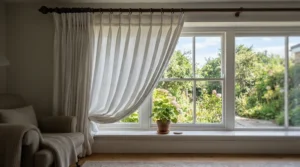
This is the most overlooked factor in buying the best blackout curtains. The curtain width to window ratio, also called fullness, decides whether curtains look rich or sad and whether light leaks between the panels.
Here’s the key point: fullness is measured against your pole or track width, not the window itself. Retailers typically make eyelet and pencil-pleat curtains to about 2x fullness, and 1.5x-2x is the usual eyelet range. Too little fullness leaves curtains flat, thin and gappy.
Worked example. Your window is 150cm wide. Your pole runs 200cm, extending about 25cm past each side. At 1.5x you need 300cm of total fabric, at 2x you need 400cm.
- A pair of 46-inch panels (about 234cm total) gives just 1.2x on that pole. Too flat, and light leaks through the gaps.
- A pair of 66-inch panels, like the PONY DANCE Double Layer 100% Blackout (about 335cm), gives roughly 1.7x. Ideal.
- A pair of 90-inch panels (about 458cm) gives around 2.3x, which is generous but great for bay spans.
Drop matters as well: aim for around 1cm above the floor, or 4cm below the sill on shorter windows. Get the curtain width to window ratio right and even a budget pair performs like a bespoke one.
Blackout Curtains vs Blinds: Which Blocks More Light?
Blackout blinds are the classic alternative, and they’re brilliant in the right place. But when it comes to sheer darkness, the fit matters more than the fabric, and this is where curtains and blinds differ.
| Option | Edge light leaks | Insulation | Typical cost range | Best For |
|---|---|---|---|---|
| Blackout curtains (eyelet, thermal) | Low if wide and hung high | Good | Around £20-£50 a pair | Bedrooms, all-rounders |
| Blackout roller blind | Medium (side gaps in the recess) | Modest | Around £10-£40 | Small windows, renters |
| Standard lined curtains | Medium to high | Fair | Around £30-£80 | Living rooms |
A blind sits inside the reveal, so gaps appear at both sides where the frame doesn’t meet the blind. Curtains overhang the frame and can wrap the wall, which is why wide, high-hung panels win on total darkness. Blinds win on tidiness and cost for small windows.
The smartest approach is often both. A blackout blind handles the reveal, while curtains like the CUCRAF 100% Blackout Linen or NICETOWN Triple Weave cover the edges and add insulation. For bedrooms, curtains alone are usually enough; for bays and patio doors, layering is the pro move.
Practical Guide: Hanging Blackout Curtains for Zero Light Leak
You can spend £50 on great curtains and £0 on hanging them well, and still lose the war at the edges. Here’s a setup routine that closes the gaps.
Set the pole high and wide. Mount it 10-15cm above the frame and extend it 15-20cm beyond each side, so the fabric overlaps the wall. That wide overhang is what stops the sunrise leaking round the sides.
Use return brackets. Brackets that curve the pole back to the wall let the last fold sit against the plaster, shutting the side gap.
Overlap in the middle. Where two panels meet, let them overlap by a few centimetres, or use a magnet or clip.
Choose your hem. Hover about a centimetre above the floor, or run just past the sill. Any longer and dust collects; any shorter and light pools.
First 30 days. Fluff and set the folds by hand, air out packaging creases, and iron only at low heat if the care label allows. Vacuum monthly with a brush attachment and wash cool, following the label. Coated backs need extra care, so skip the tumble dryer.
Curtains also help draught control. Historic England’s draught-proofing guidance says shutters or thick curtains can help reduce heat loss through windows, and a snug hang works for warmth as well as darkness.
Real-World Scenarios: Which Pair Suits Which Room?
Specs are abstract. Here are three plausible situations, with the choice and the reasoning behind each.
The night-shift nurse in a south-facing flat. Budget around £40, one 1.6-metre window, mid-morning glare. The PONY DANCE Double Layer 100% Blackout in a dark shade makes sense: a black lining, generous fullness on a 1.7-metre pole, and thermal weight for hot afternoons. Add a blackout blind if any light still creeps in.
The family with a bay and patio doors. They need tall drops and wide spans, and warmth in winter. The CUCRAF 100% Blackout Linen in 84 or 90 inch drops covers the patio doors, while the John Aird Thermal Blackout Eyelet in a large size can dress the bay. Measure the curtain width to window ratio for each opening separately.
The renter with a streetlamp outside. Tight budget of around £25 and a deposit to protect. A dark NICETOWN Triple Weave pair on a tension pole keeps costs low. Choosing charcoal or navy pushes blocking towards the upper end of its range.
Match the room to the fabric, not the other way round.
✨ Don’t Miss These Exclusive Deals!
🔍 Take your bedroom to the next level with these carefully selected curtains. Click on any highlighted item to check current pricing and availability. These picks will help you create the deep, dark, calm nights your whole household will love!
Common Mistakes When Buying the Best Blackout Curtains
Most blackout disappointments come from the same handful of errors. Here they are, with the fix for each.
Trusting “up to 100%” wording. It’s a ceiling, not a guarantee, and colour changes it. Check the lining construction as well as the claim.
Buying too narrow. A pair that’s only 1.2x your pole leaves gaps and looks skimpy. Work out the curtain width to window ratio before you click.
Ignoring the drop. Short panels leave a bright strip below or above. Choose 84 or 90 inch drops for tall windows.
Choosing pale colours for total darkness. Even good pale blackouts let a little through. Dark colours win.
Overlooking blackout curtain lining quality. Coating that flakes or seams that leak undo the whole purchase.
Judging by light-blocking fabric weight alone. Heavy is nice, but a film core matters more.
Skipping thermal backing where it counts. In a draughty, single-glazed room, a thermal layer is the difference between cosy and shivery.
Forgetting the pole. Heavy eyelet curtains on a thin pole sag and open gaps. Buy a robust pole and a centre bracket.
FAQ
❓ Do eyelet blackout curtains block light at the top?
❓ Can I use blackout curtains in a south-facing bedroom?
❓ Can blackout curtains go in the washing machine?
❓ Are ready-made blackout curtains good enough for renters?
❓ How much should the best blackout curtains cost in the UK?
Conclusion
So, which of these is the best blackout curtains pick? It depends on the fight you’re in.
If you want maximum darkness and generous fullness, the PONY DANCE Double Layer 100% Blackout is my top spot, thanks to its black lining and wide panels. If looks matter as much as blackout, the Deconovo Faux Linen 100% Blackout blends in as ordinary linen. Tall windows and patio doors point to the CUCRAF 100% Blackout Linen, while the John Aird Thermal Blackout Eyelet wins on winter warmth and size range for the money. The NICETOWN Triple Weave works when the budget is tight and you pick a dark shade, and the H.Versailtex Faux Linen 100% Blackout suits neutral, pale rooms. Finally, the Deconovo Super Soft Eyelet is a gentle darkener for living rooms, not bedrooms.
Whichever you choose, remember the rules that actually decide darkness: real blackout curtain lining quality, sensible light-blocking fabric weight, thermal backing where you need it, and the right curtain width to window ratio. Hang them high and wide, and let the folds overlap.
Recommended for You
- Blackout Curtains For Nursery: 7 Best Safe Picks (2026)
- Pencil Pleat Curtains: 7 Brilliant UK Picks For 2026
- Best Curtain Poles UK: 7 Top Picks That Won’t Let You Down (2026)
Disclaimer: This article contains affiliate links. As an Amazon Associate, I earn from qualifying purchases. If you purchase products through these links, we may earn a small commission at no additional cost to you.
✨ Found this helpful? Share it with your friends! 💬🤗
