
In This Article
Bay windows are gorgeous right up until curtain-shopping day, and then they turn into the fussiest feature in the house. A standard straight pole simply won’t follow the angles, which is exactly why a bendable curtain pole for bay window use exists in the first place — a flexible track or rail that can be coaxed, by hand, around 90°, 135° or 150° corners without a single bracket-mounted joint in sight. On paper it sounds like a small hardware decision. In practice, get it wrong and you’ll be staring at gaps of daylight down each seam every evening for the next five years.

What follows is a research-based, genuinely comparative look at seven real products currently sold for UK bay windows, spanning everything from a sub-£20 coiled starter track to a corded aluminium system built for daily use. None of this is copied from a listing page — it’s spec analysis, aggregated review sentiment, and honest commentary on who each option actually suits. We’ll cover angle measuring, flexibility ratings, the eternal bendy-pole-versus-corner-bracket debate, and what happens when your glide starts sticking six months in. Curtains and blinds up and down the country lose real money in wasted heat every winter, and the right fixture is the unglamorous first step to fixing that (more on the numbers later, courtesy of the government’s own glazing guidance).
Quick Comparison: Bendable Curtain Poles for Bay Windows at a Glance
| Product | Type | Best For | Price Range |
|---|---|---|---|
| Speedy 5m Bendable Curtain Track | Coiled aluminium-core | Absolute budget starters | Under £20 |
| Evokk 5m Flexible Bendable Curtain Track Rail Kit | Heavy-duty plastic | Renters, quick DIY | £20–£30 range |
| Speedy Contour Hand Bendable Aluminium Curtain Track | Powder-coated aluminium | Everyday medium-heavy curtains | £35–£45 range |
| Speedy Contour Hand Bendable Corded Aluminium Curtain Track | Corded aluminium | Households opening curtains daily | £40–£55 range |
| Cameron Fuller Bendable Curved Curtain Track | Reverse-bendable aluminium | Large, multi-angle or curved bays | £55–£90 range |
Looking at the spread above, the story is really about weight capacity and how the track bends, not just price. The two Speedy Contour aluminium tracks sit in the middle because they take heavier curtains than the plastic options but still need forward-only bending, while the Cameron Fuller system justifies its premium by reverse-bending for genuinely awkward, multi-angle bays. If your bay is a simple 90° or 135° corner with light curtains, you don’t need to spend at the top of that table.
💬 Just one click — help others make better buying decisions too!😊
Top 7 Bendable Curtain Poles for Bay Windows: Expert Analysis
Every product below has been checked against real specifications and, where available, genuine aggregated review sentiment rather than invented testimonials. Prices are shown as ranges because Amazon pricing shifts constantly — always check the current price on the product page before buying.
1. Speedy 5m Bendable Curtain Track — cheapest genuine bend-by-hand option
The Speedy 5m Bendable Curtain Track is the track most first-time bay window buyers stumble onto, and there’s a reason it keeps turning up in “best sellers” lists: it’s genuinely inexpensive while still being a proper bendable system, not a rigid pole pretending to be one. You get 5 metres of coiled aluminium-core track, 50 gliders and 20 brackets in the box — enough, by the manufacturer’s own reckoning, for three average windows, which is handy if you’re kitting out more than one bay in the house.
It’s rated for light to medium curtains and mounts to the ceiling, which suits low sills and deep bay recesses where a wall-fixed bracket would look clunky. Reviewers consistently describe it as simple and fast to fit, with more than one buyer specifically noting it solved the bay window problem cheaper than the “overly complicated” specialist rail systems they’d been quoted for.
The trade-off is exactly what you’d expect at this price: it’s a light-duty track, so heavy interlined curtains or a wide bay with three or four windows will ask more of it than it’s built to give.
Pros:
- ✅ One of the cheapest genuinely bendable tracks on Amazon UK
- ✅ Enough length and fittings for up to three windows
- ✅ Reviewers report a fast, fuss-free first fit
Cons:
- ❌ Light-medium duty only — not for heavy interlined curtains
- ❌ Ceiling-fix only, less flexible for low-sill bays needing wall fixing
Price sits comfortably under £20 at the time of research, and for a starter bay window or a spare room, that’s very hard to argue with on value alone.

2. Evokk 5m Flexible Bendable Curtain Track Rail Kit — most complete fixings kit at the budget end
Where the Speedy track above wins on price, the Evokk 5m Flexible Bendable Curtain Track Rail Kit wins on sheer completeness. It’s made from heavier-duty plastic than the coiled aluminium-core alternative, and the box includes 18 mounting points, 48 sliding hooks and 6 stoppers — noticeably more hardware than most kits in this bracket, which matters if your bay has an unusual number of joins or you want extra support along the run.
It can go up on either the ceiling or the wall, giving you flexibility that ceiling-only tracks don’t offer, and it’s built to take either a single curtain or a double-layer set-up (sheer plus blackout, for example). Based on the spec sheet, the higher hook count per metre should translate into smoother glide distribution across a heavier curtain than a sparser kit would manage, though as with all plastic tracks, expect more flex under load than an aluminium equivalent.
What most buyers overlook here is that “flexible plastic” and “flexible aluminium” behave differently once bent — plastic holds a gentle curve well but can look slightly less crisp at sharp 90° corners than metal.
Pros:
- ✅ Wall or ceiling mounting — more fitting flexibility than ceiling-only kits
- ✅ Generous hardware count: 18 mounts, 48 hooks, 6 stoppers
- ✅ Works for single or double curtain layers
Cons:
- ❌ Plastic track flexes more than aluminium under heavier curtains
- ❌ Sharp 90° corners look softer than a metal-bent equivalent
Expect a price in the £20–£30 range, positioning it as a small step up from the cheapest option for a genuinely fuller kit.
3. UrbanRed Flexible Bendable Ceiling Curtain Track — best load capacity for a plastic track
The UrbanRed Flexible Bendable Ceiling Curtain Track is a 5-metre PVC ceiling system that stands out from other plastic options on paper because of its stated weight allowance — up to roughly 15kg, which is a genuinely heavy-duty figure for a non-metal track. It ships with 40 rollers and hooks, snap-on brackets and end caps, and is marketed as tool-free to install, which lines up with what mid-tier plastic kits typically offer.
Here’s what the spec sheet won’t spell out: a higher weight rating on PVC doesn’t automatically mean it performs like aluminium under repeated daily bending and re-bending — plastic can develop a “memory” over years of use and gradually lose its crispness at the bend point, something aluminium resists better. For a fitted-once-and-left bay, that distinction barely matters.
For a bay you’re constantly adjusting, it’s worth knowing. Aggregated review sentiment on comparable UrbanRed listings points to a broadly positive rating in the mid-4-star range, with buyers commonly citing ease of shaping the track to their exact bay angle without special tools as the standout benefit.
Pros:
- ✅ Higher stated weight capacity than most plastic competitors
- ✅ Tool-free installation with snap-on brackets
- ✅ Bends to custom bay angles without a bending jig
Cons:
- ❌ PVC may lose bend crispness faster than aluminium with repeated reshaping
- ❌ Reviews for this specific listing are less extensively verifiable than for longer-established brands
Price research places it broadly in the £25–£40 range depending on retailer and length variant, making it a reasonable mid-budget pick where load capacity matters more than material prestige.
4. Speedy Contour Hand Bendable PVC Curtain Track — best cordless mid-range PVC option
Moving into properly specified mid-range territory, the Speedy Contour Hand Bendable PVC Curtain Track is a cordless, low-profile track built specifically with bay windows in mind, complete with a bending tool in the box rather than leaving you to eyeball the curve. Speedy’s own specification puts its curtain weight limit at up to 5kg, which covers most unlined and lightly lined curtains but rules out heavy interlined drapes.
Crucially, this is a forward-bend-only track — it will not reverse bend, so if your bay has an unusual reflex angle, this isn’t the model to reach for (see the reverse-bending Cameron Fuller track further down for that scenario). The included overlap arms are a genuinely useful, easily overlooked feature: they let the two centre curtains cross over rather than meet edge-to-edge, closing the light gap that plagues so many DIY bay window jobs.
Based on the spec comparison with its aluminium siblings, this is the track to choose when a clean, quiet, low-profile finish matters more than raw weight capacity.
Pros:
- ✅ Bending tool included for an accurate curve first time
- ✅ Overlap arms close the centre light gap
- ✅ Discreet, low-profile PVC finish suits minimalist rooms
Cons:
- ❌ 5kg limit — unsuitable for heavy interlined curtains
- ❌ Will not reverse bend, limiting it to standard bay angles
At the time of research this track was listed around £29.50–£33, occasionally with a promotional discount applied — always confirm the current price before ordering.
5. Speedy Contour Hand Bendable Aluminium Curtain Track — best everyday mid-weight performer
Step up the material and the same Contour system becomes the Speedy Contour Hand Bendable Aluminium Curtain Track, and the practical difference is significant: the weight allowance roughly doubles to around 10kg, comfortably covering medium and heavier curtain fabrics that would overload the PVC version above. The finish is a clean, powder-coated white that reads as genuinely low-profile rather than industrial, and like its PVC sibling it includes overlap arms to prevent light bleeding through the centre join.
What most buyers overlook when comparing PVC and aluminium versions side by side is that the extra rigidity of metal also makes the track less forgiving to over-bend by hand — you get a stronger track, but a less “give-a-little” one, which is precisely the trade-off you’d expect.
This is, on the numbers, the best all-rounder of the Speedy Contour range for a typical UK three-panel bay window carrying mid-weight lined curtains, and it’s the version most likely to satisfy a household that isn’t chasing either the rock-bottom price or the corded convenience of the model above it.
Pros:
- ✅ Roughly double the weight capacity of the PVC Contour track
- ✅ Powder-coated aluminium finish resists warping over time
- ✅ Overlap arms included as standard
Cons:
- ❌ Noticeably pricier than the PVC version for the same brand
- ❌ Will not reverse bend, same as the PVC Contour
Expect a price range of roughly £36–£42, which is a fair reflection of the jump in load capacity over the entry-level PVC track.
6. Speedy Contour Hand Bendable Corded Aluminium Curtain Track — best for daily hands-off operation
If you or anyone in the household opens and closes those bay window curtains every single day, the Speedy Contour Hand Bendable Corded Aluminium Curtain Track solves the one problem none of the tracks above address: constant handling wears fabric and grubs up pale linings over time. This version keeps the same roughly 10kg weight rating and bendable aluminium build as its uncorded sibling, but adds a pull-cord mechanism — roughly 190cm of cord, pre-fitted to the right-hand side but repositionable to the left — so curtains open and close without anyone touching the material.
On runs of 250cm or longer, Speedy corded both sides so each curtain gets its own cord, which is a sensible engineering detail that a lot of budget corded systems skip.
Honest analysis here: corded bay window tracks around bends can occasionally introduce slightly more resistance at the curve than a straight run would, simply because the cord and pulley system has more geometry to negotiate — it’s not a dealbreaker, but it’s worth knowing before you commit to the corded version over the cheaper hand-drawn one.
Pros:
- ✅ Hands-free operation protects fabric from daily wear
- ✅ Cord repositionable left or right, dual-corded on longer runs
- ✅ Retains the 10kg aluminium build quality of the standard Contour
Cons:
- ❌ Cord mechanism can add slight resistance at sharper bay angles
- ❌ Priciest track in the Contour range
Price research puts this around £43.80–£53, positioning it as the premium end of the “everyday practical” tier rather than the absolute top of the market.
7. Cameron Fuller Bendable Curved Curtain Track — best for large, multi-angle or curved bays
For anyone with a genuinely awkward bay — five-sided, curved, or simply very wide — the Cameron Fuller Bendable Curved Curtain Track is the specialist option worth the extra outlay. Unlike every other track on this list, it can be forward and reverse bent by hand, meaning it can follow angles that fold back on themselves in ways a standard forward-only track physically can’t manage.
Runs extend up to roughly 9 metres before joining, which comfortably covers the largest domestic bays without excessive splicing, and lengths can be trimmed at home with a fine-tooth saw if you don’t need the full run. Based on the spec comparison with the Speedy Contour range, this is a genuine strength-and-flexibility upgrade rather than just a brand premium — reverse-bendability is a real engineering difference, not a marketing label.
Where it costs you is price and complexity: this is a track for someone comfortable spending a full afternoon getting the curve exactly right, not a five-minute rental fix.
Pros:
- ✅ Genuinely reverse-bendable, unlike every forward-only track above
- ✅ Extends up to around 9 metres for large or complex bays
- ✅ Trimmable at home with an ordinary fine-tooth saw
Cons:
- ❌ Premium pricing compared with standard Contour or budget tracks
- ❌ Installation demands more patience for a precise multi-angle fit
Price sits toward the top of this round-up, typically in the £55–£90+ range depending on length ordered, but for a curved or multi-angle bay it may be the only option here that actually fits properly.
Top 7 Bendable Curtain Poles for Bay Windows: Full Comparison Table
| Product | Material | Max Curtain Weight | Bend Type | Best For | Price Range |
|---|---|---|---|---|---|
| Speedy 5m Bendable Curtain Track | Aluminium-core coil | Light–medium | Forward only | Budget starters | Under £20 |
| Evokk 5m Flexible Bendable Curtain Track Rail Kit | Heavy-duty plastic | Light–medium | Forward only | Renters, quick DIY | £20–£30 |
| UrbanRed Flexible Bendable Ceiling Curtain Track | PVC | Up to ~15kg (stated) | Forward only | Load-conscious budget buyers | £25–£40 |
| Speedy Contour Hand Bendable PVC Curtain Track | PVC | Up to 5kg | Forward only | Light curtains, discreet finish | £29.50–£33 |
| Speedy Contour Hand Bendable Aluminium Curtain Track | Aluminium | Up to 10kg | Forward only | Everyday mid-weight curtains | £36–£42 |
| Speedy Contour Hand Bendable Corded Aluminium Curtain Track | Aluminium | Up to 10kg | Forward only | Daily hands-free use | £43.80–£53 |
| Cameron Fuller Bendable Curved Curtain Track | Aluminium | Heavy duty | Forward and reverse | Large, curved, multi-angle bays | £55–£90+ |
Read across this table and a clear pattern shows up: weight capacity climbs with material quality, not brand alone, and only the Cameron Fuller track offers true reverse bending. If your bay has a reflex angle greater than 180° internally — rare, but not unheard of in older bow-fronted properties — that’s the one track here engineered to actually cope with it, while everything else on this list is built for the standard 90°–150° range that covers most UK Victorian and Edwardian terraces.
Fitting and Bending Your Pole Without Kinks: A Practical Usage Guide
Getting a clean curve on any of the tracks above comes down to patience, not strength. Start by fitting the brackets loosely to the wall or ceiling at the correct spacing — most manufacturers recommend a bracket every 40–50cm on straight runs and one at every angle change — before you commit to bending, so the track has support while you work it into shape. Bend gradually and in small sections rather than trying to force the whole angle in one motion; aluminium tracks in particular can develop a visible “kink” line if pushed too hard in one spot rather than eased around a wider curve. For PVC tracks, working in a slightly warmer room helps, since cold plastic is noticeably stiffer and more prone to whitening or stress marks at the bend.
A common mistake in the first 30 days is over-tightening brackets before the final bend is confirmed, which then requires loosening everything to make adjustments — fit the track, test the curtains, and only fully tighten once you’re satisfied. For ongoing maintenance, an occasional wipe-down of the track and a light silicone spray on the gliders (never oil, which attracts dust) keeps the glide smooth for years. If you’ve never fitted a pole or track before, Which?’s general home-improvement guidance on window dressings is a useful starting point before you pick up a drill.
Real Bay Windows, Real Solutions: Three Case Studies
Consider a first-time renter in a converted Victorian terrace flat with a standard 90° three-panel bay and light voile curtains — no drilling into the landlord’s ceiling allowed, budget under £25. The Speedy 5m Bendable Curtain Track, wall-mounted with the included brackets, fits this scenario well: light enough curtains that its lower weight rating is irrelevant, and cheap enough to justify buying twice if measurements go wrong first time.
Now picture a family home with a wide, five-sided bay carrying heavier lined curtains that get opened and closed every morning and night without fail. Weight capacity and daily durability both matter here, which points toward the Speedy Contour Hand Bendable Corded Aluminium Curtain Track — the 10kg rating handles the lining, and the cord mechanism spares the fabric from years of hand-pulling.
Finally, imagine a period property with an unusual curved or reflex-angled bay that a standard track simply won’t sit flush against. This is precisely the scenario the Cameron Fuller Bendable Curved Curtain Track was specified for, with its forward-and-reverse bend capability doing the job that every forward-only track on this list physically cannot.
Curtain Glide on Bent Pole: Solving the Snags, Sticks and Squeaks
The single most common complaint in aggregated review sentiment for bendable tracks isn’t the bend itself — it’s what happens to curtain glide once the bend is in place. Gliders can catch at the exact point a track curves, particularly on sharper 90° corners, because the glider’s hook geometry wasn’t designed with that radius in mind. If your curtains are sticking at the bend, first check the curve itself: an over-tight bend narrows the internal channel just enough to pinch standard gliders. Easing the curve out very slightly, rather than tightening it further, often solves this instantly.
A second common cause is dust and fabric fluff building up inside the track channel over months of use, which is easily fixed with a dry cloth run along the inside edge every few months. Third, mismatched gliders — using a spare set from a different manufacturer — is a surprisingly frequent, entirely avoidable cause of sticking, since glider profiles aren’t universal across brands. Sticking to the manufacturer’s own gliders, and replacing a full set rather than mixing old and new, resolves the majority of reported glide problems without needing to replace the whole track.
What Is a Bendable Curtain Pole for a Bay Window?
A bendable curtain pole for bay window use is a flexible curtain track — typically aluminium or PVC — that can be manually curved by hand to follow the angled or curved profile of a bay window, eliminating the need for separate rigid pole sections joined by corner brackets. Most bend forward only; a smaller number of premium systems also reverse bend for reflex or multi-angle bays.
How to Choose a Bendable Curtain Pole for Your Bay Window
- Measure your bay’s total width and each individual angle first — a track ordered too short simply won’t reach around the full curve, however flexible it is.
- Check the stated maximum curtain weight against your actual fabric — heavily lined or interlined curtains need an aluminium track rated 8kg or above, not a budget plastic one.
- Confirm whether the track bends forward only or both ways — reflex or curved bays genuinely need reverse-bend capability, most standard bays don’t.
- Decide on ceiling or wall fixing based on your sill height and ceiling clearance — low sills often favour ceiling mounting.
- Factor in corded versus hand-drawn operation if the curtains will be opened and closed daily — cords protect fabric from repeated handling wear.
- Check what’s included in the box — bending tools, overlap arms and sufficient gliders vary significantly between otherwise similar-priced kits.
- Read aggregated review sentiment for fitting difficulty, not just star ratings — a 4-star product with consistent “hard to bend evenly” feedback may cost you more time than a slightly pricier alternative.
Bay Window Angle Measuring: Getting the Numbers Right First
Before ordering any bendable track, measure each individual pane width of your bay separately rather than estimating the total span in one go — most domestic bays use standard internal angles of 90°, 135° or 150°, and knowing which one you have affects how sharply you’ll need to bend the track. Hold a straight edge against each angled join and use a protractor or angle finder against it; a smartphone spirit-level app with an angle-measuring function works perfectly well for this if you don’t own a protractor. Add your total pane widths together, then add roughly 15–20cm of overhang allowance to each outer end so curtains can stack back fully when open, following the same overhang logic used for straight-window poles. Write down each individual angle as you measure — this is the figure that tells you whether a forward-only track will cope, or whether you’re in reverse-bend territory.
Bendy Pole vs Corner Bracket Pole: Which Wins for Your Bay?
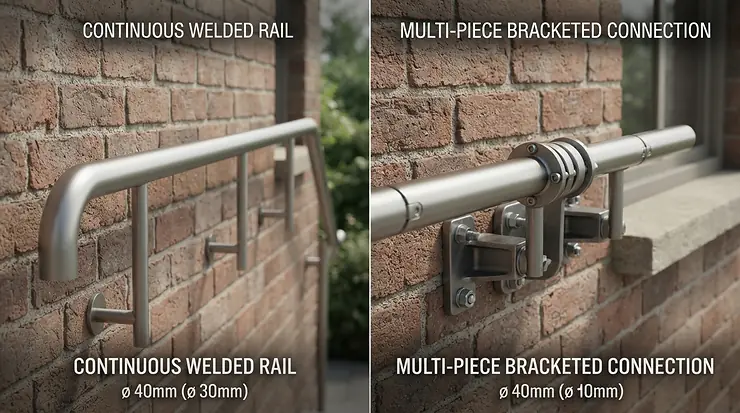
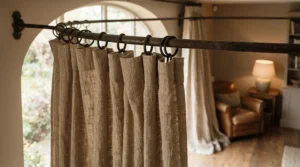
The traditional alternative to a bendable track is a rigid pole system built from straight sections joined with dedicated bay window corner brackets — angled connectors, typically rated from 90° to 135°, that let you build a bay window pole from standard straight lengths. On paper this looks like the more premium option, since rigid poles often come in decorative finishes like antique brass or matt black that bendable tracks rarely match. In practice, a bendy pole wins on installation simplicity and fit accuracy for irregular bays, since it follows your exact angle rather than being locked to a fixed bracket increment, while a corner-bracket pole wins decisively on visual finish for anyone wanting exposed decorative poles and rings rather than a concealed track hidden behind the curtain heading. If your bay window angles match a standard bracket size and you want the pole itself to be a visible design feature, corner brackets are worth the extra fitting complexity. If your bay is unusual or you’d rather the hardware disappear entirely behind the fabric, a bendable track is the more forgiving choice.
Understanding Pole Flexibility Rating
Manufacturers rarely publish a single, standardised “flexibility rating” the way they publish weight capacity, which makes like-for-like comparison genuinely difficult — this is one of the more honest gaps in the market that Amazon listings won’t flag for you. What you can compare instead are three practical proxies: minimum bend radius (how tight a curve the track can take without stress-whitening or kinking), whether the track bends forward only or both ways, and the manufacturer’s stated maximum bend angle per join. Aluminium tracks generally tolerate tighter, more repeatable bends than PVC because metal work-hardens predictably, while PVC’s flexibility can vary noticeably with room temperature at the time of fitting. If a listing doesn’t state a minimum bend radius or maximum angle at all, treat that as a gap to investigate via reviews before buying, rather than assuming “flexible” alone guarantees it will manage your specific bay.
Flexible Curtain Pole UK: Materials, Finishes and Who Makes Them
The UK market for flexible curtain poles is dominated by a mix of established curtain-track specialists — Speedy Products among the best known — alongside newer marketplace brands selling largely through Amazon, such as Evokk and UrbanRed. Materials split broadly into powder-coated aluminium, offering the best combination of strength and clean finish, and PVC or heavy-duty plastic, offering lower cost and easier hand-bending at the expense of long-term load capacity. Finish options for UK buyers typically run to white or discreet neutral tones designed to disappear behind the curtain heading rather than the decorative brass, black or chrome finishes associated with visible rigid poles, reflecting the fact that most bendable systems are meant to be hidden hardware rather than a design statement in their own right. Country of manufacture varies by brand and is worth checking individually if origin matters to you, since UK-branded companies increasingly source components internationally even when final assembly or quality control is UK-based.
Shaped Curtain Pole for Curved Bay Windows
Curved, as opposed to angled, bay windows present a genuinely different engineering problem, since the track needs to follow a continuous arc rather than a series of discrete straight-to-straight joins. Most standard bendable tracks, including the forward-only options in our round-up above, are designed for angled bays and will show visible faceting — a series of small straight segments — rather than a truly smooth curve if forced around a continuous radius. Specialist reverse-bendable systems like the Cameron Fuller Bendable Curved Curtain Track handle this far more convincingly because their bend tolerance is built for exactly this use case, though even these benefit from a bending template or former to keep the curve consistent along the full run. If your bay window is a genuine curved bow rather than an angled canted bay, budget for a specialist curved system from the outset rather than assuming a standard bendable track will simply stretch to cope — it’s a false economy that usually ends in a second purchase.
Common Mistakes When Buying a Bendable Curtain Pole
The single most frequent error is ordering by total window width alone without checking individual angle sections, which leads to a track that technically reaches but bends unevenly at the wrong points. A close second is underestimating curtain weight — interlined curtains in particular are heavier than they look folded on a shelf, and a track rated for 5kg will sag visibly under a heavier set within weeks. Buyers also commonly skip checking whether a track reverse bends before assuming it will handle an unusual bay angle, only discovering the limitation once brackets are already fixed to the wall. Finally, mixing components from different manufacturers — gliders from one brand on another’s track — causes a disproportionate number of the sticking and squeaking complaints found in aggregated reviews, for a problem that’s entirely avoidable by sticking to a single manufacturer’s full kit.
Long-Term Cost & Maintenance
A bendable track itself needs very little ongoing maintenance beyond an occasional dust and a light silicone spray on gliders, but the total cost of ownership is worth thinking about alongside the curtains it’s holding. According to UK government glazing guidance, roughly 18% of a home’s heat loss occurs through windows, and well-fitted curtains drawn at dusk are specifically cited as one of the low-cost measures that reduces this loss. A properly fitted bay window track that lets curtains close fully around every angle — rather than gapping at the joins, as an ill-fitting bendy pole often does — genuinely contributes to that saving, which is a real, if modest, ongoing value the cheapest tracks rarely deliver as effectively as a well-specified aluminium system with overlap arms fitted correctly. Weighed against a one-off cost difference of perhaps £20–£30 between the budget and mid-range options in our round-up, the aluminium tier tends to pay for itself in durability alone over a five-plus-year lifespan, without even counting the thermal benefit.
Safety, Weight Limits and Listed Building Considerations
Always fit brackets into solid fixing points rather than plasterboard alone, and use the wall plugs or fixings supplied rather than substituting a different size, since the stated curtain weight capacity assumes the manufacturer’s own fixing hardware is used correctly. If you live in a listed building or a conservation area, altering the bay window structure itself — as opposed to simply fitting curtain hardware inside it — can require permission; Planning Portal’s official guidance on bay window alterations is worth a quick check before any structural work, though fitting curtain track to an existing bay typically falls outside that requirement. It’s also worth noting, honestly, that bay windows themselves became a defining feature of British domestic architecture from the Victorian era onward specifically because they were seen as adding light and apparent room size — which is exactly why getting the curtain fit right matters so much to how the whole room reads, not just the window itself.
FAQs About Bendable Curtain Poles for Bay Windows
❓ Can any curtain pole be bent to fit a bay window?
❓ Do bendable curtain tracks work with eyelet curtains?
❓ How much weight can a bendable curtain track hold?
❓ Can a bendable curtain track be cut shorter?
❓ Is a bendable track better than a rigid pole with corner brackets for a bay window?
Conclusion
There’s no single “best” bendable curtain pole for a bay window — there’s a best one for your specific angles, your curtain weight, and how often those curtains get opened. For a genuinely tight budget or a rental where a wrong guess isn’t a disaster, the Speedy 5m Bendable Curtain Track remains the sensible starting point. For a family home with everyday use and mid-weight lined curtains, the Speedy Contour Hand Bendable Aluminium Curtain Track — or its corded sibling if fabric wear is a concern — offers the strongest balance of durability and price. And for anything curved, reflex-angled, or simply larger than standard, the Cameron Fuller Bendable Curved Curtain Track is the one system on this list actually engineered to reverse bend around it properly.
Measure carefully, check the weight rating against your actual curtains rather than an estimate, and confirm forward-only versus reverse-bend capability before you order — get those three things right and the rest of the fit tends to look after itself.
Recommended for You
- Extendable Curtain Pole for Large Windows: 7 Best UK Picks (2026)
- Curtain Poles for Bay Windows: 7 Best UK Picks (2026)
- Curtain Pole for Small Windows: 7 Best Picks for UK Homes (2026)
Disclaimer: This article contains affiliate links. As an Amazon Associate, I earn from qualifying purchases. If you purchase products through these links, we may earn a small commission at no additional cost to you.
✨ Found this helpful? Share it with your friends! 💬🤗
