
In This Article
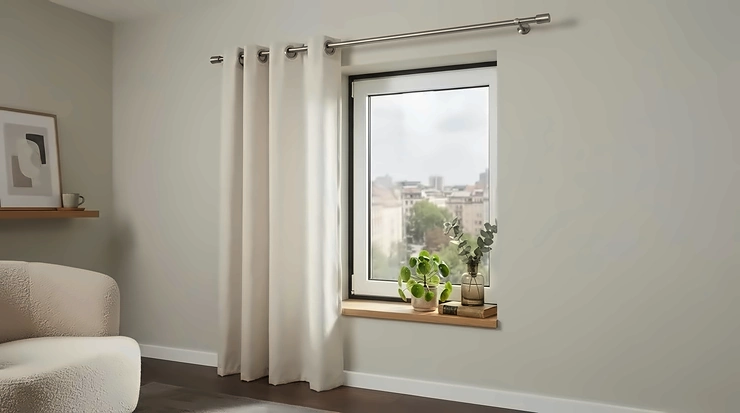
Small windows have a way of making a room feel like an afterthought, and half the time it’s not the window’s fault — it’s whatever’s hanging above it. A curtain pole for small windows that’s too chunky, too long, or fitted with finials the size of doorknobs will swamp a compact frame before the curtain’s even gone up. Get the proportions right, though, and a modest window can look properly considered rather than apologised for.

This guide walks through seven genuinely available options on amazon.co.uk, from pocket-money tension rods to a British-made premium pick, and explains what actually matters when the window in question is on the smaller side: pole diameter, bracket projection, ring count, and whether you’re allowed to drill a hole in the wall in the first place. A curtain pole, for context, is simply a rod — usually metal, wood or plastic — from which curtains hang via rings or eyelets, as opposed to a track, which conceals the fixing behind the fabric; you can find a fuller technical rundown on Wikipedia’s curtain rod entry. We’ll cover diameter, finials, affordable ring sets and rental-friendly fixings in dedicated sections below, alongside honest, sourced analysis rather than a rehashed spec sheet.
Quick Comparison Table
| Product | Diameter | Fixing Type | Price Range | Best For |
|---|---|---|---|---|
| Amazon Basics Extendable Curtain Pole with Round Finials | 19mm | Wall-fixed, drilled | Under £20 | Tightest budgets |
| Amazon Basics No-Drill Tension Curtain Rod | ~19mm | Tension, no drill | Under £15 | Renters, quick fixes |
| Home Harmony Caprice Diamante Curtain Pole Set | 16–19mm | Wall-fixed, drilled | £15–£25 range | Rings included on a budget |
| Rothley Klick-Fit Curtain Pole Kit with Rings | 25mm | Wall-fixed, hidden bracket | £25–£45 range | Clean, professional finish |
| Swish Elements Belgravia Curtain Pole Set | 28mm | Wall-fixed, drilled | £30–£50 range | Heavier curtains, classic look |
| John Lewis Select Curtain Pole with Ball Finial | 25mm | Wall-fixed, drilled | £45–£65 range | Made-in-UK quality |
| Umbra Chroma Tension Rod | ~19mm | Tension, no drill | £25–£40 range | Design-led rental solution |
Looking at this snapshot, the split is really between drilled poles, which give you the widest choice of finials and the sturdiest hold, and tension rods, which trade a little rigidity for the ability to move house without leaving a single hole behind. If your small window is in a rented flat, that distinction matters more than diameter or finish. For everyone else, it’s mostly about matching the pole’s visual weight to the window’s actual size — a theme we’ll come back to repeatedly.
💬 Found your shortlist already? Click through on any pick above to check the current price and availability before you decide.
Top 7 Curtain Poles for Small Windows: Expert Analysis
Small windows punish poor proportions more than any other type. A pole that would look perfectly reasonable over a bay window can dwarf a narrow bathroom or box-room window, so the seven below were chosen specifically for how they behave at shorter lengths — typically anywhere from 60cm to around 120cm — rather than for how they perform at their maximum extension.
1. Amazon Basics Extendable Curtain Pole with Round Finials — best all-rounder for pocket-money prices
The standout here is the price-to-reliability ratio: this is one of the best-selling curtain poles on amazon.co.uk for a reason. At 19mm diameter and extendable between roughly 92cm and 183cm, it’s slim enough to disappear visually above a small window rather than dominate it. The steel construction keeps flex to a minimum even at shorter lengths, and the round finials are unobtrusive rather than decorative statements, which suits a pole that’s meant to recede into the background.
Based on the spec sheet, the 19mm bore is best matched to light or medium curtains — voiles, unlined cottons, that sort of thing — rather than heavyweight blackout fabric, where a thicker pole would carry the load more comfortably. Reviewers consistently note that it’s simple to extend and lock at the right length, and with tens of thousands of ratings averaging around 4.6 stars, the aggregated sentiment is unusually reliable for a budget product; the recurring complaint, where it exists, tends to be about finial finish rubbing off over time on the nickel variant.
Pros:
- ✅ Genuinely low price point for a drilled, extendable pole
- ✅ 19mm diameter suits small windows without visual bulk
- ✅ Very large base of aggregated positive reviews
Cons:
- ❌ Nickel finish can show wear on the finials over years
- ❌ Not rated for heavy or blackout-weight curtains
Price sits comfortably under £20 at the time of research, and for a first curtain pole in a spare room or small bedroom window, it’s difficult to argue with the value.
2. Amazon Basics No-Drill Tension Curtain Rod — best for zero-damage rental fixing
The advantage here is right there in the name: this rod grips the window recess through spring tension alone, so nothing gets drilled, plugged or permanently fixed. What that means in practice is you can fit it in about a minute and remove it just as fast when you move out, which is precisely the brief for a small window in a rented room. The adjustable range of roughly 24–36 inches (about 61–91cm) puts it squarely in small-window territory, and the classic finial caps give it a slightly more finished look than the bare rubber-ended rods you’ll find at the very bottom of the market.
What most buyers overlook about tension rods generally is that their holding strength depends entirely on how snugly they wedge into the recess — a slightly bowed or uneven window frame can undermine the grip regardless of brand. Aggregated review sentiment for no-drill tension rods in this category consistently flags that lightweight curtains or café-style panels perform best; heavier fabric increases the risk of slow slippage over weeks rather than an outright fall.
Pros:
- ✅ Zero drilling, fully reversible, ideal for tenancy agreements
- ✅ Fits inside recessed small windows neatly
- ✅ Installs in minutes with no tools required
Cons:
- ❌ Holding strength depends on frame evenness and fit
- ❌ Not suited to heavyweight or blackout curtain fabric
At under £15 in most listings, it’s a sensible stopgap or a permanent fixture for anyone who simply isn’t allowed to touch the wall.
3. Home Harmony Caprice Diamante Telescopic Curtain Pole Set — best affordable pole with rings included
The standout feature is that the full set — pole, rings, brackets and diamante-style finials — turns up in one box for a genuinely modest outlay, which isn’t always the case with budget poles sold bare. At 16–19mm diameter and available from 180cm down through shorter telescopic ranges, it suits a decorative small window where you want visible rings and a bit of sparkle without paying premium prices. In practice, the diamante finial does more visual heavy lifting than the pole itself, which is worth knowing if you were expecting a plain, minimalist look — this is a pole for someone who wants their small window to make a small statement.
Based on the telescopic design, expect a small amount of flex at full extension, which is standard for lightweight extendable poles in this price bracket and rarely an issue once curtains are hung and the pole is under light, even load. Aggregated feedback on similar Home Harmony ranges tends to praise the finish quality against the price, while noting that the rings can feel slightly plasticky compared with metal-ringed premium alternatives.
Pros:
- ✅ Full ring set and brackets included in the box
- ✅ Decorative diamante finial adds character cheaply
- ✅ Telescopic sizing suits several small-window widths
Cons:
- ❌ Rings feel lighter-duty than metal alternatives
- ❌ Some flex noticeable at maximum extension
Typically found in the £15–£25 range, this is the pick if “affordable curtain pole with rings” is your literal shopping brief.
4. Rothley Klick-Fit Curtain Pole Kit with Rings — best hidden-bracket finish
What sets this apart is Rothley’s patented Klick-Fit bracket system, which snaps into place and hides the fixings almost entirely, so the finished look is noticeably cleaner than a standard exposed-bracket pole — a genuine point of difference rather than marketing polish. The 25mm pole comes with rings already fitted, meaning it’s ready to hang curtains on straight from the box rather than requiring you to thread dozens of rings on individually, which is a small but real time-saver on a small window where every extra step feels disproportionate.
The brand offers this kit pre-cut to popular small-window lengths, and Rothley notes the pole can also be trimmed down further for a genuinely bespoke fit — useful if your window falls between standard sizes. Here’s what to weigh: the hidden-bracket design that makes fitting look effortless does add a small learning curve to actually clicking the brackets home correctly the first time, something worth watching a fitting video for rather than guessing.
Pros:
- ✅ Hidden Klick-Fit brackets give a professional finish
- ✅ Rings pre-attached, ready to hang straight away
- ✅ Available in five finishes to match most décor
Cons:
- ❌ Bracket clip mechanism takes a moment to learn
- ❌ Pricier than basic drilled poles of similar diameter
Prices generally sit in the £25–£45 range depending on finish and length, positioning it as a solid mid-range step up from bare-bones budget poles.
5. Swish Elements Belgravia Curtain Pole Set — best classic metal pole with premium finials
Swish has been making curtain hardware for the UK market for decades, and the Belgravia range’s standout is its 28mm diameter — noticeably chunkier than most of the poles on this list, which sounds counterintuitive for a small window until you consider heavier curtain fabric. What that thicker bore means in practice is significantly more resistance to sagging under the weight of lined or interlined curtains, something the slimmer 16–19mm poles above simply aren’t built for.
The complete metal construction and satin steel or antique brass finish options give it a traditional, weighted look that suits period-property small windows — box rooms in Victorian terraces, for instance — better than a minimalist modern rod would. Aggregated customer sentiment on the wider Swish range consistently flags sturdiness and finish quality as strengths, with the main friction point being that fitting a full metal bracket set is a more involved job than a lightweight telescopic pole, particularly if the wall isn’t straightforward masonry.
Pros:
- ✅ 28mm diameter comfortably supports heavier curtains
- ✅ Traditional metal finish suits period small windows
- ✅ Established UK brand with decades of track record
Cons:
- ❌ Bulkier profile than slimline options on tiny windows
- ❌ Fitting brackets is more involved than telescopic poles
At around £30–£50 depending on finish and finial choice, it sits mid-to-upper market but earns that position on build quality.

6. John Lewis Select Curtain Pole with Rings and Ball Finial — best British-made premium pick
The headline feature is provenance: John Lewis’s Select range is designed and manufactured in the UK from high-quality steel and aluminium, and it shows in the fit and finish rather than in flashy marketing claims. At 25mm diameter with sizing available from 1m upward in 10cm increments, it’s genuinely possible to get a length that suits a small window almost exactly, rather than extending an oversized telescopic pole down to fit and hoping the excess doesn’t look awkward. On paper, this means less compromise on proportion than almost anything else on this list — you’re buying closer to a bespoke length without paying bespoke prices.
The ball finial is a classic, unfussy shape that won’t date, and John Lewis offers matching finishes across up to four finial styles and five powder-coated colours, so it’s straightforward to coordinate with existing ironmongery. Genuine customer reviews on the John Lewis site average around 4.4 out of 5 and repeatedly describe the pole as “classy” and well made, though a handful of reviewers note that measuring correctly for the fixed-length format matters more here than with a forgiving telescopic pole.
Pros:
- ✅ Designed and made in the UK to a high spec
- ✅ Precise 10cm size increments suit small windows exactly
- ✅ Strong, consistently positive aggregated review sentiment
Cons:
- ❌ Fixed lengths require accurate measuring beforehand
- ❌ Premium pricing compared with mass-market alternatives
Typically priced in the £45–£65 range, this is the pole for someone who wants their small window treated as seriously as a large one.
7. Umbra Chroma Tension Rod — best design-led no-drill pole
Umbra’s standout is bringing genuine design sensibility to a category — tension rods — that’s usually purely functional and, frankly, a bit ugly. The Chroma is made from high-quality steel, mounts entirely through tension with no tools or drilling required, and is rated to support light-to-medium curtains up to around 15lbs (roughly 6.8kg), which covers most unlined or lightly lined small-window curtains comfortably. What most buyers overlook about tension rods as a category is that they’re not just a compromise for renters — Umbra’s positioning here treats “no drilling required” as a design feature in its own right, useful for anyone who simply doesn’t want to commit to a fixed bracket position.
Reviewers of Umbra’s tension rod range consistently describe the finish as noticeably more premium-looking than typical spring rods, closer in appearance to a proper drilled pole than a bathroom-style tension bar. As with any tension fixing, aggregated feedback flags that performance depends on the recess being reasonably square and the curtain weight staying within the stated limit.
Pros:
- ✅ No-drill tension fixing with a genuinely premium look
- ✅ Rated up to roughly 6.8kg for light-medium curtains
- ✅ Modern finishes that don’t scream “temporary fix”
Cons:
- ❌ Weight limit rules out heavier lined curtains
- ❌ Performance depends on how square the recess is
Expect to pay somewhere in the £25–£40 range, which is a premium over basic tension rods but buys a noticeably better-looking result.
Full Spec Comparison: The 7 Curtain Poles for Small Windows
| Product | Diameter | Weight Capacity | Fixing | Price Range | Best For |
|---|---|---|---|---|---|
| Amazon Basics Extendable Curtain Pole | 19mm | Light–medium | Drilled | Under £20 | Budget bedrooms |
| Amazon Basics No-Drill Tension Rod | ~19mm | Light | Tension | Under £15 | Fast rental fixes |
| Home Harmony Caprice Diamante | 16–19mm | Light–medium | Drilled | £15–£25 | Rings on a budget |
| Rothley Klick-Fit Kit with Rings | 25mm | Medium | Drilled, hidden bracket | £25–£45 | Clean finish |
| Swish Elements Belgravia | 28mm | Medium–heavy | Drilled | £30–£50 | Heavier curtains |
| John Lewis Select with Ball Finial | 25mm | Medium–heavy | Drilled | £45–£65 | Made-in-UK quality |
| Umbra Chroma Tension Rod | ~19mm | Up to ~6.8kg | Tension | £25–£40 | Design-led rentals |
The pattern across this table is fairly clear: diameter tracks weight capacity almost exactly, so if your small window carries anything heavier than a light voile, the 25–28mm options — Rothley, Swish Elements Belgravia and John Lewis Select — are the safer long-term bet even though they cost more upfront. Conversely, if the window is dressing a lightweight panel purely for privacy or light diffusion, the 19mm budget and tension options do the job without overspending on capacity you’ll never use.

Practical Usage Guide: Fitting Your Curtain Pole Without the Stress
Getting a small-window curtain pole right is less about the product and more about the 20 minutes before you pick up a drill. First, measure the window’s actual width, then add roughly 15–20cm on a small window (proportionally less than the 25cm typically recommended on larger windows, since a full 50cm of overhang either side can look absurd on a 60cm frame). Mount the pole 8–12cm above the top of the window frame rather than hard against it — this small gap lets curtains stack back cleanly when opened rather than bunching against the wall.
For drilled poles, mark bracket positions with a spirit level before committing to holes, and use the correct wall plug for your surface — stud walls, brick and old lath-and-plaster all behave differently under load. In the first 30 days, the most common mistake is under-tightening bracket screws because the pole “feels” secure with rings and curtains not yet attached; recheck tightness once the full curtain weight is hanging. For tension rods, position the rod slightly higher than the recess centre and compress it fully before releasing, checking the fit is genuinely snug rather than merely resting in place — a rod that looks fitted but isn’t under real spring tension will slip within days.
Maintenance is minimal but not nothing: metal poles benefit from an occasional wipe and a light silicone spray on rings once or twice a year to keep glide smooth, particularly in kitchens or bathrooms where grease or steam accumulates. Tension rods should be checked every few months for any give in the spring mechanism, especially through seasonal temperature swings that can subtly affect frame dimensions.
Real-World Scenarios: Which Pole Suits Your Situation
Picture a first-year university student moving into halls with a strict no-drilling clause and a single small window above a desk — the Amazon Basics No-Drill Tension Curtain Rod or the Umbra Chroma Tension Rod are the obvious answer, since both go up and come down without a trace and neither requires tools most students won’t own anyway.
Now consider a family fitting out a small box-room bedroom for a new arrival, wanting proper blackout curtains without spending a fortune on hardware. Here, the 28mm Swish Elements Belgravia or the 25mm Rothley Klick-Fit Kit with Rings make more sense, because blackout fabric is genuinely heavy and a slim 19mm pole risks a visible sag within months.
Finally, think of someone renovating a period terrace and wanting every fixture, including a small landing or bathroom window pole, to look intentional rather than an afterthought. The John Lewis Select Curtain Pole earns its premium price here, since the precise sizing and UK manufacture mean it can be specified to the centimetre rather than telescoped and hoped for.
How to Choose Curtain Pole Diameter for Small Windows
Curtain pole diameter isn’t a cosmetic detail — it’s a structural spec that determines how much weight the pole can carry without bowing. As a rough guide widely used by UK curtain retailers, poles below 19mm suit extra-light to light curtains (roughly up to 2kg per pair on a 150cm span), 25mm poles handle medium weights comfortably, and 28mm and above are built for heavy or interlined curtains up to around 6–9kg. On a small window specifically, the temptation is to assume a slim pole always looks better, and visually that’s often true — but if you’re hanging anything heavier than an unlined cotton curtain, a too-thin pole will sag visibly within weeks regardless of how tidy it looked on day one.
- Weigh up your curtain fabric first, not the pole, since fabric weight dictates minimum diameter.
- For voile or sheer panels, 16–19mm is genuinely sufficient and keeps the visual footprint light.
- For mid-weight lined curtains, step up to 25mm to avoid mid-span sag over a season or two.
- For blackout or interlined fabric, 28mm or thicker is the safer structural choice.
- Remember shorter poles flex less than long ones at the same diameter, so a small window has slightly more diameter flexibility than a wide one.
- Check the stated bracket projection too — thicker poles often need brackets that hold the pole further from the wall, which matters if the window reveal is shallow.
- When in doubt, size up one diameter band rather than down; the cost difference is usually a few pounds, not tens.
Curtain Pole Finials Explained: Small Details, Big Impact
Finials are the decorative end caps that stop rings sliding off the pole and, on a small window, they do disproportionate visual work simply because there’s less pole for the eye to land on elsewhere. A finial that’s oversized relative to a short pole — anything wider than roughly a third of the visible pole length — tends to read as top-heavy, which is why several of the budget poles above deliberately use small round or barrel finials rather than large ornamental balls.
Reviewers consistently note that finial finish, rather than the pole itself, is where wear shows first — nickel and chrome plating can dull or chip at the point where it’s handled most during fitting. What most buyers overlook is that finials are often interchangeable within a brand’s range, so a plain pole can sometimes be upgraded later with a different finial style without replacing the whole set, which is worth checking on the product listing before assuming you’re locked into one look. For a small window, unobtrusive shapes — barrel, plain ball, or slim disc — generally suit the proportions better than large ornate or crystal-effect finials, which are easier to carry off on a wide bay window where there’s more pole length to balance them against.
Affordable Curtain Poles with Rings: What You’re Actually Paying For
A pole sold “with rings” saves you buying rings separately, but the quality gap between an affordable curtain pole with rings and a premium equivalent usually shows up in three places: ring material, ring lining, and how smoothly they glide. Budget sets like the Home Harmony Caprice Diamante typically use lighter plastic or thin metal rings, which work perfectly well for light curtains but can rattle slightly and wear faster under daily use than the nylon-lined metal rings found on the Rothley Klick-Fit and John Lewis Select ranges.
| Feature | Budget Ring Sets | Premium Ring Sets |
|---|---|---|
| Material | Plastic or thin metal | Lined metal |
| Glide quality | Adequate, some resistance | Smooth, quiet |
| Best For | Light curtains, occasional use | Daily-use curtains, heavier fabric |
| Typical Price Uplift | None — often bundled | £5–£15 more per set |
The analysis here is straightforward: for a small window that’s opened and closed daily — a bedroom, say — the smoother, lined rings on pricier sets earn their keep over a year or two of use, whereas a rarely-touched box-room window rarely justifies the upgrade. If budget is the priority, buying an affordable curtain pole with rings pre-attached, as with the Home Harmony Caprice Diamante or Rothley Klick-Fit Kit, still beats sourcing pole and rings separately, since matched sets avoid the risk of ring diameter mismatching pole diameter.

Rental-Friendly Curtain Poles: What Renters Need to Know
Rental-friendly curtain poles generally fall into two camps: genuinely damage-free tension fixings, like the Amazon Basics No-Drill Tension Curtain Rod and Umbra Chroma Tension Rod, and lightweight drilled poles fitted with small, easily-fillable screw holes that most tenancy agreements tolerate with landlord permission. Before drilling anything in a rented property, it’s worth checking your tenancy agreement and getting permission in writing — Shelter’s guidance on making improvements to a rented home is clear that unauthorised alterations can put your deposit at risk, even for something as small as a curtain pole bracket. Tension rods sidestep this entirely, which is precisely why they dominate this category, but it’s worth being upfront that they trade some structural certainty for that convenience — heavier curtains and non-square recesses both increase the risk of slippage over time.
For anyone renting long-term rather than short-term, it’s often worth asking the landlord directly whether small pilot holes for a lightweight pole would be acceptable, since the visual and functional upgrade over a tension rod — particularly for heavier or blackout curtains — can be significant, and most reasonable landlords will agree to two small, fillable holes above a window.
Common Mistakes When Buying a Curtain Pole for Small Windows
The single most frequent error is buying a pole to the window’s exact width rather than adding overhang, which leaves curtains covering the glass even when fully open and defeats much of the point of dressing a small window in the first place. A close second is choosing diameter based purely on aesthetics rather than curtain weight, leading to visible sag within a season on anything heavier than voile. Buyers also regularly underestimate bracket projection — the distance the pole sits from the wall — which matters more on a small window where the reveal (the depth between wall and glass) is often shallow, risking the pole catching on the window handle or frame when curtains are drawn.
Finally, many shoppers in rented accommodation skip checking their tenancy agreement before drilling, only to discover at check-out that even small holes are chargeable against the deposit — a five-minute conversation with a landlord upfront avoids that entirely.
What to Expect: Real-World Performance
On paper, most of these poles look broadly similar — metal rod, some rings, a couple of finials — but real-world performance diverges noticeably once curtains are actually hanging day to day. Extendable telescopic poles, like the Amazon Basics Extendable Curtain Pole and Home Harmony Caprice Diamante, show their extension joint under close inspection but disappear visually once curtains are drawn across it, which is a fair trade-off for the flexibility of adjustable sizing. Fixed-length poles, by contrast, look marginally more polished from day one since there’s no visible seam, which is part of why the John Lewis Select range photographs so cleanly in its own marketing.
Beyond aesthetics, closed curtains on any pole — even a modest, unlined pair — genuinely help retain heat. Government guidance on window energy efficiency notes that heat loss through windows is a significant factor in home heating costs, and that well-fitting curtains and blinds can reduce heat loss when drawn at dusk — a small but genuine bonus that applies regardless of which pole on this list you choose, provided the curtain itself covers the glass fully once closed.
Long-Term Cost & Maintenance
Total cost of ownership on a curtain pole is almost entirely front-loaded — once fitted correctly, a decent metal pole should last well over a decade with essentially no ongoing spend beyond an occasional wipe-down. Where costs creep in is replacement: cheaper telescopic mechanisms and lighter-duty rings are more likely to need swapping after several years of daily use than the heavier hardware on the Swish Elements Belgravia or John Lewis Select ranges, which is worth weighing against the higher upfront price.
| Consideration | Budget Poles (Under £25) | Mid-Range (£25–£50) | Premium (£45+) |
|---|---|---|---|
| Expected Lifespan | 3–6 years typical use | 6–10 years | 10+ years |
| Replacement Risk | Rings, extension joint | Low, occasional ring wear | Very low |
| Best Value For | Occasional-use rooms | Daily-use bedrooms | Long-term homeowners |
Interpreting that spread, a spare room or box-room window rarely justifies premium spend since the pole simply won’t see enough daily wear to matter, whereas a main bedroom or living room pole — opened and closed twice a day, every day — earns back the extra cost of a sturdier set in reduced replacement frequency over five to ten years.
Problem → Solution Guide
Problem: The pole sags visibly in the middle. This is almost always a diameter or support-bracket issue — either the pole is too thin for the curtain weight, or there’s no centre support on a longer small-window span. Step up to a 25mm or 28mm option like the Rothley Klick-Fit Kit or Swish Elements Belgravia, or add a centre bracket if the current pole allows one.
Problem: A tension rod keeps slipping. Check the recess is genuinely square — even a few millimetres of taper can undermine grip — and confirm the curtain weight sits within the rod’s stated capacity. The Umbra Chroma and Amazon Basics No-Drill rods both perform best with lightweight fabric; swapping to a lighter curtain often solves this without buying new hardware.
Problem: Rings squeak or stick. A light silicone spray, applied sparingly to the pole rather than the fabric, usually resolves this within a day or two of regular use.
Problem: The pole looks too long or too short for the window. Telescopic poles like the Amazon Basics Extendable Curtain Pole and Home Harmony Caprice Diamante can be adjusted within their range; fixed-length poles like John Lewis Select need re-measuring and, if necessary, exchanging before fitting rather than after.
Problem: Can’t drill in a rented property. Move to a tension fixing — the Umbra Chroma or Amazon Basics No-Drill Tension Curtain Rod — or get written landlord permission for two small, fillable pilot holes as discussed above.

Frequently Asked Questions
❓ What size curtain pole for small windows?
❓ What diameter curtain pole is best for small windows?
❓ Can you fit a curtain pole without drilling?
❓ How high should a curtain pole be above a small window?
❓ Do cheap curtain poles sag over time?
Conclusion
There’s no single best curtain pole for small windows — there’s a best one for your specific window, curtain weight, and whether you’re allowed to pick up a drill. Budget and rental situations point firmly toward the Amazon Basics options or the Umbra Chroma Tension Rod, all genuinely damage-free or near enough. Anyone hanging heavier curtains is better served by the 25–28mm poles — Rothley Klick-Fit, Swish Elements Belgravia or John Lewis Select — where the extra diameter and sturdier brackets pay for themselves in years of sag-free service. And if you’re chasing rings included at the lowest possible spend, the Home Harmony Caprice Diamante does exactly that without pretending to be something it isn’t.
Whichever you choose, the measuring and diameter advice above matters more than the brand name on the box — get those two things right, and even a modest small window ends up looking properly finished rather than merely covered.
Recommended for You
- Woven Natural Blinds: 7 Best Picks for UK Homes (2026)
- Best Bamboo Blinds UK: 7 Top Picks for Natural Style (2026)
- Velux Window Blinds 2026: 7 Best Picks (And What to Avoid)
Disclaimer: This article contains affiliate links. As an Amazon Associate, I earn from qualifying purchases. If you purchase products through these links, we may earn a small commission at no additional cost to you.
✨ Found this helpful? Share it with your friends! 💬🤗
