

In This Article
Blackout curtains vs thermal curtains comes down to two different jobs. Blackout curtains stop light passing through the fabric using an opaque backing or dense weave, while thermal curtains slow heat moving through a window using extra layers that trap air. Plenty of modern ready-mades do both, which is exactly where the confusion starts.
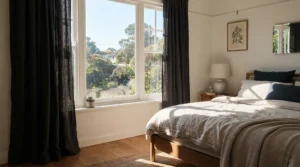
Here’s the awkward truth: the label on the packet rarely tells you which job the fabric is actually good at. A curtain can be sold as thermal blackout and still leak a halo of dawn light around the edges. Another can block every photon yet do very little for a draughty sash window. Getting it right matters. According to the Energy Saving Trust figure relayed in Groundwork’s guide to thermal curtains, roughly 18% of heat escapes through the windows of an uninsulated house. A decent curtain is one of the cheapest ways to claw some of that back.
This guide untangles the difference between blackout and thermal lining, explains curtain lining types, looks at what triple-weave fabric really does, and weighs up seasonal curtain choice for British weather. You’ll also find seven real ready-made options sold on Amazon UK, analysed from their published specs and aggregated review sentiment. To be clear on method: this is research and analysis, not hands-on testing. Where a claim comes from a manufacturer listing, I say so.
Short version? If light wrecks your sleep, prioritise opacity. If your lounge feels like a fridge by 6pm, prioritise insulation. If you want both, keep reading, because the answer costs less than you’d think.
Quick Comparison: Blackout Curtains vs Thermal Curtains at a Glance
| Feature | Blackout curtains | Thermal curtains | Blackout thermal curtains combined |
|---|---|---|---|
| Main job | Block light | Retain heat, cut draughts | Both, to varying degrees |
| Typical build | Opaque backing or dense weave | Layered or interlined fabric | Triple-weave or coated, lined fabric |
| Light blocking | High to near total | Often modest | High (claims range 85–99%+) |
| Insulation | Modest | Strong | Good, if edge gaps are managed |
| Best for | Shift workers, street-lit bedrooms: Deconovo Faux Linen | Cold lounges, single glazing: John Aird Coral | All-rounders: Deconovo Thermal Eyelet |
Looking at the table, the cleanest split is intent. Pure blackout fabric is the specialist for sleep, thermal fabric is the specialist for comfort, and the combined category is where most buyers should start. The Deconovo Thermal Eyelet pair is the most sensible entry point for that all-rounder route, while John Aird Coral leans towards the energy-saving end. Remember that listed percentages are manufacturer claims, not lab results you can rely on.
💬 Just one click — help others make better buying decisions too!😊
Top 7 Blackout Thermal Curtains on Amazon UK: Expert Analysis
Every pick below is a real product sold on Amazon UK at the time of research. Sizes, colours and prices shift constantly, so check the live listing before you buy.
1. Deconovo Thermal Insulated Blackout Eyelet Curtains — best all-round budget buy
The headline here is sheer track record: few budget ready-mades have gathered as many ratings. These panels use a triple-weave polyester build in a soft matte finish, and the common 46×54-inch pair (each panel around 117 cm wide) suits standard bedroom windows. Listings quote light blocking anywhere from 85–95% up to 99.8%, so treat those as manufacturer claims. The listings themselves note that darker shades block more. Because one triple-weave fabric does both jobs, you avoid the weight of a separate lining.
Based on the specs, this suits renters and anyone dressing several rooms cheaply. The fabric is machine washable on a gentle cycle, and one listing mentions OEKO-TEX certified materials. The trade-off is thinner drape than lined curtains, so buy a wide pole and generous overlap.
Reviewer sentiment on the listings I found sits around 4.5 out of 5 across tens of thousands of ratings, and a Mumsnet editorial picked the Supersoft version as its best overall thermal option. Specific complaint themes were harder to verify for this model.
Pros:
- ✅ Triple-weave build covers light and insulation together
- ✅ Machine washable with easy-hang eyelets
- ✅ Huge rating volume across several listings
Cons:
- ❌ Pale colours let more light through
- ❌ Light-blocking claims vary between listings
Around £10–£20 for the 46×54 pair at the time of research; exceptional value, but check current price for your size.
2. PONY DANCE Blackout Curtains — best for neat, rust-resistant eyelets
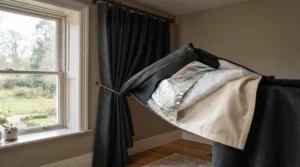
The twist is in the hardware: each panel carries 4 cm rust-resistant rings, roomy enough for most standard poles. The listing describes a 46×54-inch pair (117 cm wide, 137 cm drop per panel) in dense soft-matte polyester with a triple-weave build. It claims 85–95% light blocking and says darker colours perform best, which matches how triple-weave fabric behaves generally. The thermal claim is that the fabric acts as a barrier against draughts and summer heat.
On paper, the 4 cm ring matters more than it sounds. Narrow eyelets snag on thick poles and make drawing the curtains a wrestling match, so this suits a chunky modern rail. The honest take is that it is a close cousin of the Deconovo build, so choose between them on colour range and size availability.
I could not verify a reliable review count or recurring complaint themes for this specific listing, so I won’t pretend otherwise. Check recent buyer feedback on the live page for your size.
Pros:
- ✅ Generous 4 cm eyelets glide on thicker poles
- ✅ Soft matte finish with decent drape
- ✅ Triple-weave construction at a budget price
Cons:
- ❌ Light-blocking figure tops out at 95%
- ❌ Review sentiment hard to verify
Around £10–£15 for the 46×54 pair at the time of research; sound value, but check current price.
3. NICETOWN Pitch Black Thermal Insulated Grommet Blackout Curtains — most-reviewed, with one blackout caveat
The standout is scale: the US listing shows well over 125,000 reviews at roughly 4.6 out of 5, which makes it one of the most scrutinised curtains online. UK listings and ratings differ, so check yours. These are heavy triple-weave polyester panels, commonly sold as a 42×63-inch pair, claiming 85–99% light and UV blocking plus noise reduction. That wide range is the tell: block rates depend on colour.
My analytical take is that this is the best-documented option for renters who want a proven name. The documented catch is honesty about the word blackout. Several reviewers and a Sleepopolis writeup note that lighter colours let more light through, and some buyers say light leaks through the fabric itself. One buyer reported near-total darkness by layering these over existing curtains on a double rod, apart from gaps above and below.
Net sentiment: buyers broadly praise value and feel, while a vocal minority say they are not true blackout. If sleep is the goal, choose the darkest shade.
Pros:
- ✅ Enormous review base, mostly positive
- ✅ Heavy fabric with a soft, quality feel
- ✅ Works well layered over existing curtains
Cons:
- ❌ Some buyers report light leaking through
- ❌ Pale shades block noticeably less
Budget-friendly, but UK ranges vary by size and colour, so check current price on the live listing.
4. Deconovo Silver Grey 100% Blackout Faux Linen Curtains — linen look with a full-blackout claim
The attraction is aesthetics: a faux-linen texture that looks far more expensive than the price suggests. The listing describes two panels at 132 x 160 cm each with eight silver eyelets, claiming 100% blackout, some noise reduction and temperature moderation. That 100% figure is a marketing claim, and it appears alongside only 4.2 out of 5 from around 671 reviews on the deal listing I found. That is a much thinner evidence base than the brand’s best-sellers.
In practice, the 160 cm drop is longer than the 137 cm common on cheaper sets, so it suits taller windows and gets closer to the floor-length insulation advantage. The care label is the catch: hand wash below 30°C, no bleach, no tumble drying, line dry. That makes upkeep a chore compared with the machine-washable siblings.
This is my pick if you care about looks as much as darkness, and it is the right shape for a shift worker’s bedroom, though verify the opacity claim in recent reviews first.
Pros:
- ✅ Linen-style texture looks upmarket
- ✅ Longer 160 cm drop suits taller windows
- ✅ Full-blackout claim at a budget price
Cons:
- ❌ Hand wash only, no tumble drying
- ❌ Much smaller review pool than rivals
Under £15 for the pair at the time of research; good value if the care routine suits you, but check current price.
5. Deconovo Super Soft Thermal Pencil Pleat Curtains — pencil pleat for traditional tracks
The feature that sets it apart is the heading: pencil pleat, which hangs from hooks on a track or pole instead of through eyelets. The listing describes a 117 x 138 cm pair built with the brand’s sandwich technique, claiming 85–95% light blocking. Hooks are not included, which catches out first-time buyers. One listing shows about 4.4 out of 5 from roughly 25,000 reviews.
Why does heading matter? Pencil pleats gather the fabric into tight, uniform folds that sit close to a track, which narrows the gap at the top where heat and light love to escape. Eyelet curtains hang in wide, deep folds and can leave more edge exposure on a chunky pole. That makes this the stronger candidate for older homes with existing tracks and for rooms where thermal comfort outranks darkness.
Reviewer sentiment is broadly positive on value and softness. As with its siblings, expect pale shades to leak more light, so choose a darker tone for bedrooms.
Pros:
- ✅ Pencil-pleat heading sits snug on a track
- ✅ Soft, lightweight fabric at a low price
- ✅ Strong rating volume across listings
Cons:
- ❌ Hooks not included in the pack
- ❌ Light-blocking capped around 95%
Around £10–£20 for the pair at the time of research; strong value, but check current price for your size.

6. John Aird Coral Eyelet Thermal Energy Saving Blackout Curtains — the energy-saving specialist
The pitch is in the name: a thermal energy-saving build with a blackout finish. Yours.co.uk named it its best thermal blackout choice and linked to Amazon UK. Mumsnet’s editorial likewise rated a John Aird eyelet thermal blackout set as best-value thermal curtains. I couldn’t verify fabric weight, exact lining construction or sizes across listings, so confirm those yourself before ordering.
What does that mean in practice? An energy-saving pair should have a genuine rear layer rather than a single thin sheet, and that is worth checking in the product images. If you can see an opaque backing behind a face fabric, you get better insulation than a single-layer triple-weave. This is the one I’d shortlist for a draughty lounge or north-facing bedroom, where warmth matters more than complete darkness.
Two independent UK editorial picks is a respectable signal. It is not the same as a verified large rating pool, so read recent buyer feedback on your size.
Pros:
- ✅ Recognised by two independent UK editorials
- ✅ Thermal energy-saving focus suits cold rooms
- ✅ Eyelet heading is easy to hang
Cons:
- ❌ Specs vary between listings, so verify
- ❌ Review volume unconfirmed
Price varies by size, so check current price on the live listing; value looks sound for a thermal-first pair.
7. NICETOWN Star Blackout Curtains with Nets — best for decorative kids’ rooms
The distinguishing feature is design: decorative star cut-out panels with a voile layer behind. The listing describes a 168 x 183 cm (66×72-inch) pair, four curtain ropes for tie-backs, and a double-layered hybrid of blackout layer plus transparent voile. Eyelets have a 1.6-inch inner diameter, roughly 4 cm, so check your pole before ordering.
Let’s be honest about what this means. Cut-out stars let diffused light through the voile, so this is a daytime-play and privacy curtain, not a pitch-dark sleep solution. For a nursery or a child’s room where a soft glow is welcome, that can be a feature. For a shift worker, it is the wrong tool.
I couldn’t verify a reliable review pool or recurring complaint themes for this listing. Pair it with a plain dark curtain layer if you need real sleep conditions.
Pros:
- ✅ Decorative design suits kids’ rooms
- ✅ Includes four curtain ropes for tie-backs
- ✅ Voile layer adds privacy with soft light
Cons:
- ❌ Cut-outs mean it is not fully dark
- ❌ Review sentiment hard to verify
Varies by size and colour, so check current price; value depends on whether the decorative look matters to you.
Top 7 at a Glance
| Product | Heading | Light-blocking claim | Price range | Best for |
|---|---|---|---|---|
| Deconovo Thermal Eyelet | Eyelet | 85–95% (some listings 99.8%) | Around £10–£20 | Budget all-rounder |
| PONY DANCE Blackout | Eyelet, 4 cm rings | 85–95% | Around £10–£15 | Chunky poles |
| NICETOWN Pitch Black | Grommet | 85–99% claimed | Check current price | Proven value, layering |
| Deconovo Faux Linen | Eyelet | 100% claimed | Under £15 | Linen look, tall windows |
| Deconovo Pencil Pleat | Pencil pleat | 85–95% | Around £10–£20 | Traditional tracks |
| John Aird Coral | Eyelet | Check listing | Check current price | Cold rooms |
| NICETOWN Star with Nets | Eyelet | Partial (cut-outs) | Check current price | Kids’ rooms |
Reading across the table, the Deconovo Thermal Eyelet and PONY DANCE Blackout are near-twins on specs, so colour and size availability decide between them. The Deconovo Faux Linen is the only option claiming full opacity, but it demands hand washing. The NICETOWN Star with Nets is the outlier: charming, but never the answer for a dark bedroom.
How to Choose Blackout Curtains vs Thermal Curtains in 6 Steps
- Name your main problem. If light wakes you, prioritise opacity. If rooms feel cold or draughty, prioritise insulation. Most people need a bit of both, which points to a combined fabric.
- Read the construction, not the label. A triple-weave build, a coated backing or a separate lining each behave differently, and that is what sets blackout curtains vs thermal curtains apart in practice.
- Measure properly. Aim for a pole wider than the window frame so the curtains overlap the edges, and drop to the floor where you can. Floor-length hanging traps more air.
- Pick your heading. Eyelets are easy and modern, while pencil pleat sits snug on a track.
- Go darker if sleep matters. Darker shades block more light on every listing I read, so a pale grey will always leak more than charcoal.
- Check the care label. Machine washable beats hand wash if you hate chores.
Thinking about sleep specifically? The Sleep Foundation’s overview of light and sleep explains why even small amounts of light are worth blocking.
Difference Between Blackout and Thermal Lining
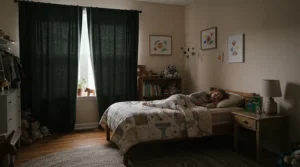
The difference between blackout and thermal lining is purpose. Blackout lining is an opaque layer, usually a coated fabric, that stops light getting through. Thermal lining is a fleecier or brushed layer that adds a pocket of still air between room and window. John Lewis, for example, describes its three-pass blackout lining as eliminating light while also adding an insulating layer, which shows how often the two overlap.
So why separate them at all? Because the same property that blocks light (density) is not identical to the property that blocks heat (trapped air). A thin coated blackout lining can be perfectly opaque yet provide little insulation. A thick brushed thermal lining can be warm yet still glow when the sun hits it.
My practical advice: identify the weaker side of your current curtains and fix that one. Light problem? Add opacity. Cold problem? Add loft. The difference between blackout and thermal lining also affects cost, since an add-on thermal lining is often cheaper than replacing the whole curtain.
Curtain Lining Types Explained
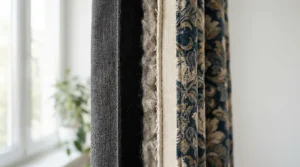
Curtain lining types explained simply: there are four you’ll meet.
- Standard lining: a light cotton or polyester sateen that protects the face fabric from sun and adds body. It filters light but does not block it.
- Blackout lining: coated or multi-pass fabric that stops light. Opaque, but can feel stiff.
- Thermal lining: brushed or bonded fabric that adds insulation. Warmer, but not necessarily dark.
- Interlining: a fleecy layer sandwiched between face fabric and lining, the traditional route to a luxurious, heavy hang.
Ready-made curtains sidestep all this with triple-weave or bonded builds that combine properties in a single fabric.
Curtain Lining Thickness: Does Thicker Always Win?
Not quite. Curtain lining thickness helps, but trapped air does the real work, so a lofty, soft layer beats a dense, flat one for insulation. Ready-mades rarely state fabric weight, so judge by drape and reviews. Heavy curtains also need a sturdy pole, so check the rod’s weight rating. Dorset Council’s draught-busting guide reckons heavy, floor-length curtains can cut window heat loss by around 41%, which suggests length and weight both count.
Triple-Weave Fabric: What It Is and What It Isn’t
Triple-weave fabric is a layered polyester construction, typically with a black yarn core between a face layer and a back layer. That core is what stops light, while the layered build traps air for insulation. It is the engine behind the Deconovo Thermal Eyelet, PONY DANCE Blackout and NICETOWN Pitch Black panels.
Here is the honest part. Triple-weave fabric is excellent value, soft and machine washable, but it isn’t the same as foam-coated blackout. Claims across listings run from 85% to 99%, and lighter colours leak more. A Sleepopolis review of NICETOWN Pitch Black‘s sibling styles echoed that pattern, noting that some buyers found them short of true blackout.
Coated blackout fabrics are usually more opaque but stiffer and sometimes fussier to clean. Choose triple-weave fabric for convenience and decent darkness, and choose coated linings for maximum opacity. A cheap test: hang the curtain, close it in daylight and look for pinpricks of light.
Blackout Thermal Curtains Combined: Do You Really Get Both?
Blackout thermal curtains combined are the sweet spot for most British homes, and yes, you largely get both. A dense blackout layer blocks radiant heat in summer and slows cold air in winter. That is why most ready-made thermal blackout sets are marketed together.
But there are compromises. Combined fabrics are heavier than light curtains, so they can strain thin poles. The insulation advantage collapses if there are gaps at the sides, top or bottom. A curtain can have excellent fabric and still lose its benefit to a wide gap at the edges.
You have three routes to blackout thermal curtains combined:
- All-in-one ready-made (such as the Deconovo Pencil Pleat): simplest and cheapest.
- Curtain plus add-on lining: best if you love your existing fabric.
- Double-rod layering: a decorative curtain at the front and a blackout layer behind, similar to what one NICETOWN Pitch Black buyer reported doing.
For bedrooms facing street lights, option three gives the most flexibility.
Seasonal Curtain Choice: Winter Warmth vs Summer Cool
Seasonal curtain choice is less about owning two sets and more about how you use one. In winter, close thermal curtains at dusk so the room keeps its heat, as the Energy Saving Trust advice relayed by Groundwork suggests, then open them in daylight to let free solar warmth in. In summer, close curtains on sun-facing windows during the day to block heat, and open windows at night once it cools.
Sleep matters here too. The Sleep Charity, as reported by Medical News Today, puts the ideal bedroom temperature at around 15.6–18.3°C. That suggests a dense curtain on a west-facing window is as much a summer tool as a winter one.
If you want to optimise seasonal curtain choice further, consider a heavier set (such as the John Aird Coral) for winter lounge windows and a lighter, darker-shaded pair (such as the PONY DANCE Blackout) for summer bedrooms. Swapping twice a year takes ten minutes and costs less than one tank of petrol.
✨ Don’t Miss These Exclusive Deals!
🔍 Take your bedroom to the next level with these carefully selected curtains. Click on any highlighted product to check current pricing and availability. These picks will help you create a darker, warmer room your whole household will love!
Blackout Curtains vs Thermal Curtains vs Other Window Coverings
| Option | Light control | Insulation | Cost | Best for |
|---|---|---|---|---|
| Thermal blackout curtains, such as Deconovo Thermal Eyelet | High | Good | Low | Most bedrooms |
| Standard lined curtains | Low to medium | Modest | Low to medium | Living areas |
| Roller blackout blinds | High | Moderate | Low to medium | Small windows |
| Add-on thermal lining | Varies | Good | Low | Existing curtains |
| Shutters | High | Highest | High | Long-term investment |
The table shows curtains winning on cost and flexibility, shutters winning on raw performance and blinds sitting in between. Dorset Council’s guide puts floor-length heavy curtains at around 41% heat-loss reduction, roller blinds at 38% and shutters at 57%, though these are indicative council figures rather than lab guarantees. For most renters, thermal blackout curtains such as the PONY DANCE Blackout offer the best balance of cost and effect.
Curtains don’t replace draught-proofing. The GOV.UK draught-proofing factsheet lists simple window measures, including thick curtains, as part of a wider approach. Seal the gaps first, then hang the fabric.
Common Mistakes When Buying Blackout or Thermal Curtains
- Trusting the label. The word blackout on a packet is a marketing term, and listings for the same fabric quote anything from 85% to 100%.
- Buying too narrow. Curtains that only just match the window width leave light and draughts at the edges. Go wider.
- Stopping short. Curtains that finish a few inches below the sill do less than floor-length ones. Where a radiator sits underneath, keep the fabric clear of it so heat isn’t trapped behind.
- Blocking trickle vents. The Centre for Sustainable Energy warns against blocking window vents and over-sealing kitchens and bathrooms, where damp air needs to escape.
- Ignoring care labels. A hand-wash-only fabric such as the Deconovo Faux Linen is lovely until washday arrives.
- Leaving curtains shut all day. Heavy closed curtains against cold glass can invite condensation, so open them in the morning.
Fixing these costs nothing and often improves performance more than spending extra on fabric.
Long-Term Cost & Maintenance: What Curtains Really Cost
Ready-made thermal blackout curtains such as the Deconovo Pencil Pleat or Deconovo Thermal Eyelet sit in a low price bracket. Spread across a five-year lifespan, a pair costing around £15 works out at roughly £3 a year. That is hard to beat for something you use every single day.
Savings on bills are harder to promise, so I won’t. The Energy Saving Trust publishes free, impartial guidance in its quick tips to save energy, and results depend on your glazing, heating and habits. A realistic expectation is a more comfortable room and a modest dent in heating demand, not a miracle.
Maintenance is cheap. Vacuum monthly with a brush attachment, wash according to the care label every few months, and keep fabric clear of direct radiator heat. Machine-washable options such as the PONY DANCE Blackout save time, while hand-wash fabrics need planning. Replace curtains when the backing cracks, the fabric thins or light starts showing through. Cheap ready-mades make that a painless decision.
Practical Guide: How to Hang, Seal and Maintain Your Curtains
Buying is half the job. Here is how to get the most from your curtains.
Before you hang: steam or warm-iron creases, following the care label. Hanging a wrinkled curtain makes it look cheap and can open gaps.
Mounting: fit the pole 10–15 cm above the frame and extend it well beyond each side. This is the single best trick for stopping light halos.
Sealing: if light still sneaks in at the edges, add return rods to bring the fabric back to the wall, or use adhesive fixings on the sides.
Common mistakes in the first 30 days:
- Overstuffing the pole so panels bunch.
- Forgetting hooks for pencil pleat styles such as the Deconovo Pencil Pleat.
- Judging darkness at noon rather than at dawn.
Maintenance schedule:
- Monthly: vacuum and shake out.
- Every three to six months: wash per label.
- Yearly: check the pole’s fixings for sag.
A little attention here turns a decent curtain into a properly effective one.
Real-World Scenarios: Which Curtains for Which Home?
The Victorian terrace renter. Single-glazed sash windows, a street light outside, and a tight budget. The Deconovo Pencil Pleat on an existing track or the John Aird Coral for the draughtiest room would be my starting points. Both are low cost, and closing them at dusk is a daily habit worth building.
The shift worker in a new-build flat. Large south-facing window, sleeping through daylight, and daily use. The Deconovo Faux Linen for its full-blackout claim, backed by a NICETOWN Pitch Black layer on a double rod, tackles light from two angles. The budget stays low and the setup is flexible.
Parents of a toddler. A small bedroom, nap-time glare, and a love of decor. The NICETOWN Star with Nets suits daytime play, while a plain PONY DANCE Blackout layer behind handles naps and early summer mornings.
Whatever your situation, add draught-proofing first, and check the Energy Saving Trust’s guidance for wider ideas.
FAQ
❓ Do blackout curtains keep heat in?
❓ Is thermal lining worth adding to existing curtains?
❓ Do blackout curtains reduce noise?
❓ Can blackout curtains cause condensation or damp?
❓ What length should thermal curtains be?
Conclusion
So, blackout curtains vs thermal curtains: which wins? Neither, because they solve different problems. Blackout fabric is the sleep specialist, thermal fabric is the comfort specialist, and a good combined ready-made covers most homes at a modest price.
If you want one safe starting point, the Deconovo Thermal Eyelet is the best-documented budget all-rounder, with PONY DANCE Blackout a near-identical alternative. Choose the Deconovo Pencil Pleat for traditional tracks and the John Aird Coral if warmth leads your priorities. Reach for the Deconovo Faux Linen if looks and a full-blackout claim matter, and keep the NICETOWN Star with Nets for children’s rooms where a soft glow is welcome. NICETOWN Pitch Black earns its place for proven value, especially layered.
Remember the details that matter most: darker shades block more light, wide poles beat narrow ones, and floor length beats short. Measure twice, hang wide and close the curtains at dusk.
✨ Ready to find your perfect pair?
🔍 Compare sizes, colours and current prices on Amazon UK today, then make your home darker, warmer and calmer. Your future well-rested self will thank you!
Recommended for You
- Voile Curtains For Privacy: 7 Best Picks For UK Homes (2026)
- Curtains For Bay Windows: 7 Foolproof Fixes For UK Homes (2026)
- Net Curtains For Kitchen Windows: 7 Best Easy-Care Picks (2026)
Disclaimer: This article contains affiliate links. As an Amazon Associate, I earn from qualifying purchases. If you purchase products through these links, we may earn a small commission at no additional cost to you.
✨ Found this helpful? Share it with your friends! 💬🤗
