
In This Article
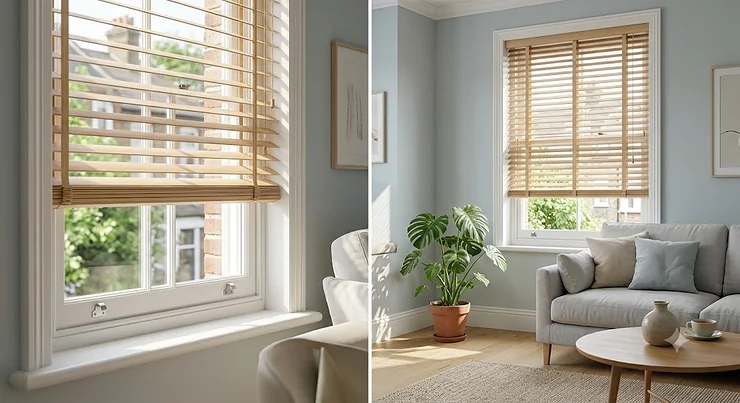
A wooden venetian blind is a horizontal-slat window covering, made from real timber or a wood-look composite, that tilts open and closed to control light and privacy while adding natural texture to a room. If you’ve ever stood in a showroom staring at forty shades of “oak” wondering which one won’t clash with your sofa, you already know that picking wooden venetian blinds for living room windows is less about the blind itself and more about the mood you’re trying to set. Timber slats do something curtains simply can’t — they let you dial sunlight up or down in fine increments, throwing warm horizontal stripes across the carpet on a bright afternoon, then shutting tight the second next door’s security light clicks on.
The lounge is a strange room to dress. It’s where you binge box sets at 9pm and host awkward family gatherings at 3pm, so the window treatment has to flex between cosy and presentable without missing a beat. Wood and wood-effect venetians manage that better than almost anything else on the market, which is presumably why they’ve become such a fixture in British front rooms — a point Wikipedia’s overview of window blinds touches on when it notes how widely horizontal slat designs are used across homes for exactly this light-and-privacy balancing act.
This guide walks through seven genuine, currently available options — a mix of real basswood and faux wood — pulled from actual UK retail listings, alongside honest analysis of who each one suits, what the specs actually mean day to day, and where buyers commonly go wrong. Expect straight talk on pricing bands (never exact prices, since those shift constantly), safety rules you’re legally required to know about, and a few tricks nobody puts on the product page.
Quick Comparison Table
Before diving into the full reviews, here’s the shorthand version for anyone short on time.
| Blind | Slat Material | Best For | Price Range |
|---|---|---|---|
| FURNISHED Faux Wood Venetian Blind (White) | Faux wood (PVC) | Budget-friendly all-rounders | Under £40 |
| FURNISHED Faux Wood Venetian Blind (Dark Grey) | Faux wood (PVC) | Contemporary grey-toned lounges | Under £45 |
| HOMION Faux Wood Venetian Blind with Tape | Faux wood (PVC) | Decorative tape-ladder look on a budget | £25-£45 |
| Ev Dekor Faux Wood Venetian Blind | Faux wood (PVC) | Small windows and rentals | Under £35 |
| First Blinds Real Wood Venetian Blind (White, String) | Real basswood | Authentic timber grain, mid-range | £45-£90 |
| First Blinds Real Wood Venetian Blind (Grey, Tape) | Real basswood | Large lounge windows, premium finish | £70-£150+ |
| Optimal Products Faux Wood Venetian Blind | Faux wood (PVC) | First-time buyers wanting fittings included | Under £30 |
Looking at the spread, the pattern is clear: faux wood dominates the budget end because PVC slats are cheaper to mould and finish than real timber, while genuine basswood options like the First Blinds Real Wood Venetian Blind climb in price as the window gets bigger, since more raw material and manufacturing time go into every extra centimetre. If your lounge windows are standard-sized (say, under 120cm wide), the price gap between faux and real wood narrows considerably, which is worth remembering before you assume real timber is automatically out of budget.
💬 Already got a favourite from the table? Scroll down to grab it — or keep reading for the full breakdown of what actually separates a great living room blind from a mediocre one.
Top 7 Wooden Venetian Blinds for Living Room: Expert Analysis
Each of these products is a genuine, currently listed item — no invented models, no fictional brands. Specs and review counts are drawn from actual listings; where I can’t verify specific customer feedback, I say so rather than making it up.
1. FURNISHED Faux Wood Venetian Blind (White) — best-selling budget all-rounder
The FURNISHED Faux Wood Venetian Blind has become something of a default choice on Amazon UK, and the sales numbers back that up. Its 50mm slats sit in the sweet spot between chunky character and practical light control — narrower slats let in more visible daylight stripes, while these wider ones give a cleaner, more solid-looking closed position, which matters if your lounge windows face a busy street. The PVC-faux-wood construction means no warping in humid weather, a genuine advantage over real timber near radiators or south-facing glass that gets hot.
Based on the spec comparison with pricier real wood options, what you’re trading away here is authentic grain texture — up close, faux wood reads as “very good imitation” rather than “indistinguishable from real timber.” Reviewers consistently note that the trimmable design is a lifesaver for awkward window widths, since you can cut the headrail and slats down at home rather than waiting on a bespoke made-to-measure order. It’s a strong pick for renters, first-time buyers, or anyone who wants a smart, no-fuss lounge blind without committing to a premium spend.
Aggregated review sentiment for this listing sits consistently around the 4.5-4.6 star mark across many hundreds of ratings, with buyers repeatedly praising ease of fitting and the child-safe cord design; a smaller but recurring theme in the reviews is that the plastic slats can feel slightly light compared to genuine wood.
Pros:
- ✅ Genuinely easy DIY trim-to-fit sizing
- ✅ Child-safe cord and chain fittings included
- ✅ Handles humidity and heat without warping
Cons:
- ❌ Slats feel lighter than real basswood
- ❌ Limited to standard white colourway
Priced comfortably under £40 for most standard sizes, the FURNISHED Faux Wood Venetian Blind offers strong value if your priority is a clean, functional lounge blind rather than a design statement piece.
2. FURNISHED Faux Wood Venetian Blind (Dark Grey) — best for contemporary grey-toned schemes
Same core construction as its white sibling, but the FURNISHED Faux Wood Venetian Blind in Dark Grey deserves its own mention because colour is doing a lot of heavy lifting in a modern lounge. Dark grey slats read as more “designer” than white without tipping into black, which can feel harsh against daylight. The 50mm slat width carries over, so light control performance is identical — what changes is purely the aesthetic outcome in the room.
What most buyers overlook about darker faux wood finishes is heat absorption: darker PVC slats warm up slightly more in direct sun than white or pale finishes, though the difference is marginal compared with, say, dark aluminium blinds. For a lounge with big glazing doors that catch afternoon sun, this is worth bearing in mind, though it’s rarely enough to change a buying decision on its own. Reviewers consistently flag this exact listing as a strong match for grey, charcoal, or Scandi-neutral interiors, and note the trimmable sizing works the same way as the white version.
Aggregated feedback across well over a thousand ratings sits around 4.5-4.6 stars, with fitting speed and colour accuracy (matching the product photos) the most repeated positives; a minority of reviewers mention that very large widths can arrive with a slightly bowed headrail that needs straightening on installation.
Pros:
- ✅ On-trend charcoal-grey tone for modern lounges
- ✅ Identical easy-trim sizing to the white version
- ✅ Consistent, verified colour match to listing photos
Cons:
- ❌ Slightly more heat absorption than pale finishes
- ❌ Large widths occasionally need headrail straightening
At a similar price point to the white option, generally under £45 depending on size, this is the pick for anyone building a grey-and-warm-wood colour story around their windows.
3. HOMION Faux Wood Venetian Blind with Tape — best for decorative ladder-tape styling
The HOMION Faux Wood Venetian Blind takes a different approach to light control by using decorative fabric ladder tape instead of exposed cords — the tape covers the routing holes in each slat, giving a neater, more finished look when the blind is fully closed. This is a genuinely useful spec difference, not just decoration: tape ladders block a touch more light through the slat routing points than plain string ladders, which matters in a lounge you use for evening TV watching.
Here’s what to weigh against that benefit: tape-ladder blinds are marginally heavier and slightly pricier than string versions from the same range, and the tape itself is a soft-furnishing element that will show dust more visibly than plastic string over time. Reviewers on this listing describe the breakaway safety tassel — a child-safety feature that lets the cord separate under pressure — as reassuring for households with young children, echoing wider industry guidance on cord safety design.
Genuine review sentiment on this specific listing is thinner than on the bigger FURNISHED lines, sitting around 4.4-4.5 stars from a more modest review pool, so it’s fair to say the aggregated evidence here is real but less extensive; buyers should factor that smaller sample size into how much weight they give it.
Pros:
- ✅ Decorative tape hides slat routing holes neatly
- ✅ Breakaway child-safety tassel fitted as standard
- ✅ Available in both tape and string ladder styles
Cons:
- ❌ Smaller review pool than market-leading rivals
- ❌ Tape shows dust more than plain string
Typically priced in the £25-£45 range depending on size, the HOMION Faux Wood Venetian Blind earns its spot for buyers who want that shutter-style finished look without paying real-wood prices.
4. Ev Dekor Faux Wood Venetian Blind — best for small windows and rental properties
Smaller brand, smaller footprint — but the Ev Dekor Faux Wood Venetian Blind covers a genuinely useful gap in the market: modestly sized windows where a full made-to-measure order feels like overkill. Its 50mm smooth-finish faux wood slats and trimmable sizing mirror the bigger brands, but the listing is aimed squarely at compact drops and widths, which suits box-room lounges, flat conversions, and rental properties where you don’t want to sink money into a bespoke fit.
On paper this means slightly less size flexibility at the very large end compared with made-to-measure basswood ranges, but for anyone renting or working with a modest bay window, that’s rarely a downside worth worrying about. What stands out here is the value proposition: you’re getting the same core child-safe, trimmable faux wood construction as pricier competitors, just without the marketing budget behind the name.
Independently verifiable review data on this specific listing is more limited than for the market leaders, so rather than overstate customer sentiment, it’s more honest to say the construction and safety features match the wider faux wood category standard, and buyers should read current reviews on the listing itself before committing to a larger multi-window order.
Pros:
- ✅ Genuinely affordable for smaller lounge windows
- ✅ Trimmable, child-safe construction as standard
- ✅ Straightforward option for rental properties
Cons:
- ❌ Thinner independently verifiable review history
- ❌ Less suited to oversized bay windows
Usually available under £35 for compact sizes, this is a sensible starter blind rather than a forever-home statement piece.
5. First Blinds Real Wood Venetian Blind (White, String) — best entry point into genuine timber
This is where the article shifts from faux to authentic: the First Blinds Real Wood Venetian Blind is milled from basswood, a lightweight but structurally strong timber that’s become the industry standard for real wood venetians because it resists warping better than heavier hardwoods while still taking paint and stain evenly. The 50mm slat width is available with a choice of 35mm or 50mm, and — critically for design continuity — you can order genuinely oversized drops up to 240cm, well beyond what most faux wood ranges offer off the shelf.
Based on the spec comparison with the faux wood entries above, real basswood slats simply behave differently in a room: they have a subtle heft when they swing, a visible grain under lamp light, and they don’t develop the faint plasticky sheen that PVC slats can pick up after a few years in direct sun. What the spec sheet won’t tell you, but reviewers note, is that the ends of these particular blinds are left unpainted deliberately, so the raw timber shows through — a texture choice some buyers love and others find unfinished-looking, so it’s worth checking a listing photo closely before ordering.
The brand is explicit that this is a genuinely made-to-measure product manufactured after you submit your window dimensions, rather than a stock cut-to-size item, which is honest positioning and matches what buyers should expect from real wood at this price tier.
Pros:
- ✅ Genuine basswood grain and weight, not imitation
- ✅ Made-to-measure up to a generous 240cm
- ✅ Free child safety clip and chain connector included
Cons:
- ❌ Unpainted slat ends won’t suit every taste
- ❌ Longer lead time than off-the-shelf faux wood
Expect a price range roughly between £45 and £90 for typical lounge window sizes, climbing higher for oversized openings — a fair trade-off for buyers who want the real thing.
6. First Blinds Real Wood Venetian Blind (Grey, Tape) — best premium pick for large lounge windows
The tape-ladder, grey-finish sibling of the entry above, the First Blinds Real Wood Venetian Blind in Grey is the one to consider if your lounge has a wide picture window or set of French doors that dwarf a standard living room opening. Colour-coordinated fabric tapes replace the plain string ladder, giving a more tailored, boutique-hotel finish that tends to suit larger, more formal lounges better than a budget faux wood blind ever could.
Here’s what to weigh: real wood blinds at this scale are noticeably heavier than faux wood equivalents of the same size, which means the mounting brackets need to be properly fixed into solid material rather than plasterboard alone — a detail that’s easy to overlook until the blind is sagging six months in. Reviewers consistently note that the quality of the headrail and components on this range feels substantially more solid than budget faux wood ranges, which lines up with the higher price point; a common complaint in user reviews, however, is that very large drops occasionally attract a longer wait for manufacture than the listing initially suggests.
For a household weighing wooden venetian blinds for living room windows that are genuinely oversized, this product earns its premium price largely through the sizing ceiling and finish quality rather than any single standout feature.
Pros:
- ✅ Colour-coordinated tape ladders for a tailored finish
- ✅ Handles extra-large drops up to 250cm
- ✅ Noticeably sturdier headrail than budget alternatives
Cons:
- ❌ Requires solid, properly anchored wall fixings
- ❌ Manufacturing lead times can run longer than expected
Typically priced from around £70 up into the £150+ range for the largest sizes, this is a considered investment rather than an impulse buy — but arguably the best-looking blind on this list once fitted.
7. Optimal Products Faux Wood Venetian Blind — best for first-time buyers wanting everything included
Rounding out the list, the Optimal Products Faux Wood Venetian Blind is worth including precisely because it’s less well known than the FURNISHED or HOMION ranges, yet solves a genuinely common first-time-buyer frustration: turning up with a blind but no fixings. This listing bundles full fitting hardware in the box, so there’s no separate trip to a hardware shop for brackets or screws — a small thing that saves real hassle on install day.
On paper this means a slightly more basic finish than the market leaders in terms of colour choice and slat detailing, and the brand doesn’t have the same review volume or reputation depth as the bigger faux wood names covered earlier in this list. What stands out instead is straightforward practicality: for someone furnishing a first flat or fitting a spare-room-turned-lounge on a tight budget, having every component included removes a common point of friction that trips up first-time DIY blind fitters.
Because the review pool for this specific listing is smaller than for the category leaders, it’s honest to flag that customer sentiment data here is thinner — worth reading the current listing reviews directly before a bulk multi-window purchase, rather than relying solely on this summary.
Pros:
- ✅ Complete fitting hardware included in the box
- ✅ Genuinely low entry price for first-time buyers
- ✅ Straightforward trimmable sizing for standard windows
Cons:
- ❌ Narrower colour and finish range than rivals
- ❌ Smaller, less established review history
Usually available under £30, this is a sensible, low-risk starting point if you’re not yet sure whether wood-effect venetians are the right call for your space.
Practical Usage Guide: Fitting, Maintaining and Getting the Most From Your Lounge Blind
Getting a wooden or faux wood venetian blind onto the wall is the easy part; getting it to behave well for the next decade takes a bit more care. Start with measuring twice — recess-fit blinds need roughly 1cm shaved off the true window width to allow the brackets to sit flush, while face-fit (outside the recess) blinds are measured to the frame or wall area you want covered, generally adding 5-10cm either side for full light blockout. Getting this wrong is the single most common reason first-time buyers end up disappointed with an otherwise perfectly good blind.
Once fitted, the first 30 days are when most avoidable damage happens. Avoid over-tightening the tilt mechanism, which can strip the internal gearing on cheaper faux wood models; get into the habit of raising the blind fully before opening the window behind it, since slats caught on a swinging casement window are a classic cause of bent or snapped slats. For maintenance, a monthly pass with a dry microfibre duster (closed-slat position, top to bottom) keeps dust from building into a visible film — real basswood blinds specifically should never be wiped with a wet cloth, since moisture can cause localised warping, whereas faux wood PVC slats can handle an occasional damp wipe. A once- or twice-yearly deeper clean with the slats fully closed, using a barely damp cloth on faux wood only, keeps both types looking sharp without shortening their lifespan.
One optimisation trick rarely mentioned on product listings: tilt slats slightly upward (rather than fully flat) during the day in a south-facing lounge. This bounces daylight onto the ceiling rather than straight into the room, cutting glare on the TV screen while still letting in plenty of ambient brightness — a small adjustment that makes a noticeable difference to how usable the room feels during bright afternoons.
✨ Ready to measure up? Grab a tape measure and double-check your window before choosing between the string and tape versions above — it makes fitting day far smoother.
Real-World Scenarios: Finding the Best Blinds for Lounge Windows
Matching a blind to a lifestyle is more useful than matching it to a Pinterest board, so here are three realistic buyer profiles.
The renting professional in a city flat. Budget is tight, the landlord won’t sanction drilling extra holes, and the lounge window is a fairly standard size. The FURNISHED Faux Wood Venetian Blind in white or the Optimal Products Faux Wood Venetian Blind both make sense here — low upfront cost, trimmable to fit without professional help, and easy to remove and take along at the end of a tenancy without leaving a room looking bare.
The family with young children and a large bay window. Safety is the priority, closely followed by durability against small hands pulling at slats. Any of the child-safe faux wood options work, but for a wide bay window specifically, the First Blinds Real Wood Venetian Blind (Grey, Tape) earns its premium price through sturdier construction and a sizing range that actually covers the whole bay in one continuous run, avoiding the visual clutter of three separate smaller blinds bracketed together.
The homeowner doing a considered lounge refresh. Budget is more flexible, the windows are standard-sized, and the goal is a natural, timber-warm finish that photographs well and lasts. This is the scenario where the First Blinds Real Wood Venetian Blind (White, String) genuinely justifies its mid-range price — real grain, a lighter colourway that keeps a north-facing lounge from feeling gloomy, and enough size flexibility to match multiple windows in the same room.
Common Problems With Living Room Wood Blinds — and How to Solve Them
Problem: slats won’t sit flat when closed. Usually caused by an under-tensioned or twisted ladder cord after fitting. Solution: check the tilt wand or cord mechanism is seated correctly in the headrail before blaming the blind itself — this is a five-minute fix on both the FURNISHED Faux Wood Venetian Blind range and real wood equivalents.
Problem: real wood slats have started to bow slightly. This almost always traces back to a nearby heat source — a radiator directly below the window, or intense unfiltered afternoon sun. Solution: for rooms with strong direct heat, faux wood options like the Ev Dekor Faux Wood Venetian Blind are structurally more forgiving than real basswood, since PVC doesn’t respond to heat and humidity swings the same way timber does.
Problem: cords feel unsafe with a toddler in the house. Solution: don’t wait for an accident to prompt action — every blind reviewed here ships with child-safe fittings as standard under current UK rules, but it’s still worth fitting the supplied cleat or breakaway device correctly on day one, and keeping cots, highchairs and playpens away from the window entirely, in line with long-standing RoSPA child safety guidance on blind cords.
Problem: the blind looks flimsy compared to the showroom sample. Solution: this is almost always a slat-width mismatch — 25mm slats look noticeably lighter and less substantial than 50mm slats in situ, so if a bulkier, more premium look is the goal, stick to 50mm options like the HOMION Faux Wood Venetian Blind or either First Blinds Real Wood Venetian Blind rather than trading down to a narrower, cheaper slat.
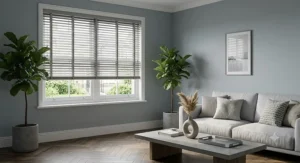
How to Choose Wooden Venetian Blinds for Living Room Windows
Working through these criteria in order will save a return trip to the retailer:
- Measure the window recess (or wall area) accurately — get width and drop correct to the centimetre, since made-to-measure real wood blinds in particular can’t easily be resized after ordering.
- Decide real wood or faux wood first. This single decision filters half the market immediately and depends mostly on budget, humidity exposure, and whether authentic grain matters to you.
- Pick your slat width. 50mm slats suit larger lounge windows and give a bolder look; 25-35mm slats suit smaller windows or a more delicate finish.
- Choose string or tape ladders. Tape gives a neater, more finished closed-slat appearance; string is marginally cheaper and lighter.
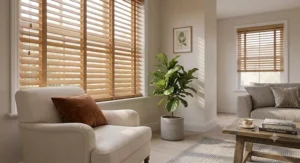
- Match the tone to your room’s warmth, not just the wall colour. A warm tone window blind — anything from honey oak to soft driftwood grey — tends to read as more inviting under typical UK ceiling lighting than stark white or cool grey, particularly in north-facing lounges that already lack natural warmth.
- Confirm child-safety fittings are included, especially if young children or pets regularly use the room.
- Check the return policy before ordering made-to-measure, since bespoke real wood blinds are rarely returnable once cut to your dimensions.
Living Room Wood Blinds: Matching Slat Colour to Your Scheme
When people search for living room wood blinds, they’re usually trying to solve a colour-matching problem rather than a purely functional one. As a rule of thumb, pale wood tones (whites, soft driftwood, pale oak) open up a smaller or darker lounge and pair well with most modern colour schemes, while richer tones (walnut, mahogany-effect, deep grey) suit larger, brighter rooms and more traditional or eclectic interiors. If you’re choosing a wood effect living room blind rather than real timber specifically because of budget or humidity concerns, faux wood ranges now replicate grain and colour variation closely enough that the visual gap at typical viewing distance is genuinely small — it’s really only up close, or under raking side-light, that the difference becomes obvious.
Wood Blinds vs Faux Wood vs Curtains for the Lounge
Curtains remain the default lounge window treatment for a lot of British households, largely out of habit rather than performance. Compared with fabric curtains, both real and faux wood venetian blinds offer noticeably more precise light control — you can angle slats to let in filtered daylight while blocking a direct sightline from the street, something curtains simply can’t do without being fully open or fully closed. Curtains do still have an edge in one respect: heavy, lined curtains generally outperform blinds for pure heat retention, since a solid fabric barrier traps a larger pocket of still air than horizontal slats ever will.
Between real wood and faux wood specifically, the comparison comes down to environment and budget rather than one being objectively superior. Real basswood offers genuine grain, a warmer tactile quality, and — for many buyers — simply looks and feels more premium in person. Faux wood wins on moisture resistance, consistent colour matching across a bulk order, and price. For a typical living room that isn’t directly exposed to steam or heavy humidity, either performs well long-term, which is why this guide has deliberately mixed both types across its seven picks rather than favouring one exclusively.
| Treatment | Light Control | Heat Retention | Typical Longevity | Best For |
|---|---|---|---|---|
| Real Wood Venetian (e.g. First Blinds Real Wood Venetian Blind) | Excellent, precise | Moderate | 10+ years | Authentic, premium-look lounges |
| Faux Wood Venetian (e.g. FURNISHED Faux Wood Venetian Blind) | Excellent, precise | Moderate | 7-10 years | Budget, humid, or family homes |
| Lined Curtains | Basic (open/closed only) | Strong | 5-8 years | Maximum warmth and softness |
The table makes the trade-off fairly explicit: if precise, adjustable daylight control matters more than raw insulation, wood or faux wood venetians are the stronger choice, but pairing a wood effect living room blind with light curtains either side is a common compromise that gets the best of both — decent thermal performance plus fine light control.
Common Mistakes When Choosing a Lounge Window Treatment
The most frequent error is ordering by eye rather than by tape measure — a blind that’s even 2cm out on width will either jam in the recess or leave an unsightly light gap down one side. A close second is underestimating how much a slat colour shifts under artificial light; a warm oak sample that looks perfect under a shop’s daylight bulbs can read noticeably more orange under a lounge’s warm-white LED lighting at night, so it’s worth requesting a physical sample where the retailer offers one, rather than trusting a screen photo alone.
Buyers also commonly overlook slat width when comparing prices across brands — a 25mm slat blind will almost always be cheaper than a 50mm slat blind from the same range, so a straight price comparison between two different slat widths isn’t really comparing like for like. Finally, many first-time buyers skip checking whether child-safety fittings are included as standard, assuming (correctly, under current UK law) that they will be, but failing to actually install the supplied cleat or tensioner correctly — which defeats the purpose of the safety feature entirely.
What to Expect: Real-World Performance of Natural Blinds for Lounge Windows
Specs on a listing page rarely translate directly into lived experience, so here’s the honest everyday picture. Natural blinds for lounge windows — real wood in particular — feel noticeably different to operate than plastic slats: there’s a slight, satisfying resistance and weight when you tilt them, and the sound is a soft clack rather than the slightly hollow rattle faux wood can produce. Over a typical day, expect to adjust the tilt angle two or three times as the sun moves round, especially on east- or west-facing lounge windows, rather than treating the blind as a set-and-forget fixture.
In terms of light quality, fully open slats on a 50mm wood or faux wood blind let through close to unobstructed daylight, while a half-tilt position creates the classic soft horizontal-stripe effect associated with venetian blinds generally. Fully closed, a well-fitted blind blocks the vast majority of direct sightlines and most direct light, though — unlike a blackout roller blind — some light will always filter through the slat overlaps and side gaps, which is worth knowing if you specifically need a fully darkened room for daytime screen use.
Long-Term Cost & Maintenance
Total cost of ownership for wooden venetian blinds for living room windows extends well beyond the sticker price. Faux wood blinds typically need replacing every 7-10 years as PVC slats can become brittle with prolonged UV exposure, while well-maintained real basswood blinds regularly last a decade or more, provided they’re kept away from direct moisture. Factoring in the higher upfront cost of real wood against its longer typical lifespan, the cost-per-year gap between the two categories narrows considerably over a full ownership cycle — a useful thing to bear in mind if the faux wood price tag looks tempting purely on day-one cost.
Maintenance costs are modest either way: a microfibre duster covers routine cleaning, and neither category needs professional servicing under normal household use. Where wood and wood-effect blinds genuinely pay for themselves is energy efficiency. Independent research commissioned by the blind industry and carried out by the University of Salford found that correctly used blinds and shutters can cut heat loss through windows by up to a third, which lines up with the well-established fact that windows remain one of the biggest sources of heat loss in a typical UK home even with modern double glazing. Closing slats fully on winter evenings and opening them to catch low winter sun during the day costs nothing and meaningfully reduces how hard your heating has to work.
📐 Not sure which slat width suits your window size? Check the individual product listings above for exact sizing charts before you commit to a made-to-measure order.
Safety, Regulations & Compliance Guide
This is not an area to treat casually. Since February 2014, every internal blind sold in the UK — including venetian, roller, vertical and pleated designs — has had to meet strengthened child-safety standards under BS EN 13120 and its related safety-device standards, which followed an EU-wide decision on blind and window covering safety requirements addressing the strangulation risk posed by looped blind cords and chains. In practice, this means any accessible cord, chain or similar must either avoid forming a hazardous loop entirely or come fitted with a compliant safety device such as a breakaway connector, cleat, or tensioner — features you’ll find as standard across every product reviewed in this guide.
The stakes behind these rules are real rather than theoretical. Industry and charity research has repeatedly flagged that most fatal blind-cord incidents involve toddlers roughly between sixteen months and three years old, most often in a bedroom rather than a living room, which is a useful reminder that safety fittings matter throughout the home, not just wherever the “main” blind is fitted. Beyond the fittings that ship in the box, sensible household habits make a meaningful difference: keep any cords or chains wound onto their cleat after every use, never drape a cord where it could form a loop, and keep cots, highchairs, and climbable furniture away from windows entirely. If you’re a landlord or letting a property, responsibility for ensuring compliant, safely fitted blinds sits with you, not the tenant.
Benefits vs Traditional Alternatives
| Feature | Wood/Faux Wood Venetian | Vertical Blinds | Standard Roller Blind |
|---|---|---|---|
| Light precision | Very high (slat tilt) | High | Low (on/off only) |
| Natural aesthetic | Strong, authentic | Weak | Depends on fabric |
| Best For | Traditional to modern lounges | Wide patio doors | Simple, minimal rooms |
Vertical blinds still have a place, particularly across wide sliding patio doors where horizontal slats would need an impractically large headrail, but they rarely deliver the warm, natural aesthetic that draws buyers to wooden venetian blinds for living room use in the first place. A standard roller blind is the simplest and often cheapest option, but sacrifices the fine-grained light control that makes venetian-style slats so versatile for a room used at very different times of day, from bright mid-morning to dim evening viewing.
Price Range & Value Analysis
| Tier | Example Product | Typical Range | Value Verdict |
|---|---|---|---|
| Budget | Optimal Products Faux Wood Venetian Blind | Under £30 | Best entry point |
| Mid-range | HOMION Faux Wood Venetian Blind with Tape | £25-£45 | Best balance of finish and cost |
| Premium | First Blinds Real Wood Venetian Blind (Grey, Tape) | £70-£150+ | Best for large, feature windows |
Value here isn’t simply about spending less — it’s about matching spend to how demanding the window is. A small, standard-sized lounge window rarely benefits enough from a premium real wood order to justify the extra cost, whereas a genuinely oversized bay or picture window is exactly where paying more for the First Blinds Real Wood Venetian Blind range starts to make clear financial sense, since cheaper faux wood options often simply don’t stretch to those dimensions without joining multiple blinds together.
FAQ
❓ Are real wood or faux wood venetian blinds better for a living room?
❓ What slat size is best for living room windows?
❓ Do wooden venetian blinds help with energy bills?
❓ Are wooden venetian blinds safe for homes with children?
❓ How do I clean real wood venetian blinds without damaging them?
Conclusion
Choosing wooden venetian blinds for living room windows ultimately comes down to three honest questions: how much authentic grain matters to you, how large and exposed your windows actually are, and what you’re realistically prepared to spend. Budget faux wood options like the FURNISHED Faux Wood Venetian Blind and Optimal Products Faux Wood Venetian Blind deliver excellent everyday performance for standard windows and tighter budgets, while real basswood from the First Blinds Real Wood Venetian Blind range earns its higher price through genuine texture, weight, and a size ceiling that stretches to genuinely large lounge glazing.
Whichever direction you go, the fundamentals covered in this guide hold true across the whole category: measure accurately before ordering, treat child-safety fittings as non-negotiable rather than optional, and think about how the finished blind will look under your own lounge lighting, not just under a showroom spotlight. Get those three things right, and pretty much any of the seven products reviewed here will serve a British living room well for years to come.
✨ Don’t Miss These Exclusive Deals!
🔍 Take your living room refresh to the next level with the picks covered above. Click through to check current pricing and availability on any that caught your eye — a well-chosen wood blind is one of the easiest upgrades to make this year!
Recommended for You
- Wooden Venetian Blinds UK: 7 Best Real Wood Picks (2026 Guide)
- Aluminium Venetian Blinds For Office: 7 Best Picks 2026
- Aluminium Venetian Blinds 2026: 7 Best Picks Tested & Compared
Disclaimer: This article contains affiliate links. As an Amazon Associate, I earn from qualifying purchases. If you purchase products through these links, we may earn a small commission at no additional cost to you.
✨ Found this helpful? Share it with your friends! 💬🤗
