
In This Article
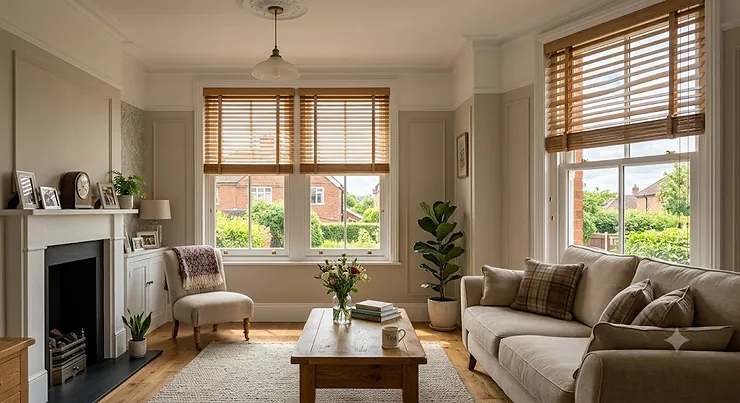
Stand in front of a big sash window with the low winter sun slanting in, and you’ll understand instantly why wooden venetian blinds have quietly become one of the most requested window treatments in British homes. They’re a design older than you’d think, too — horizontal slatted blinds date back to the late 18th century, long before basswood and made-to-measure sizing turned them into the precision product they are today. They’re not flashy. They don’t need a marketing department. They just work — slat by slat, room by room, year after year. Wooden venetian blinds are horizontal-slat window coverings made from real timber, typically basswood, that tilt to control light and privacy while adding the kind of warmth that plastic and metal simply can’t fake. If you’ve been scrolling through search results wondering whether “real wood” is worth the extra spend over faux alternatives, you’re asking exactly the right question, and this guide is built to answer it properly.
What follows isn’t a rehashed product listing. It’s a proper, researched breakdown of seven genuine wooden venetian blinds available to UK buyers — spanning budget, mid-range and premium territory — backed by honest analysis of their specs, their real customer feedback, and where each one actually earns its keep. We’ll get into how real wood venetian blinds differ from faux, why solid wood venetian blinds behave differently in a steamy bathroom than they do in a dry-as-a-bone living room, and how a natural timber blind can transform a plain box room into something that feels considered. Along the way you’ll find a proper wooden blinds review of each product, a decision framework for matching a blind to your actual house, and the safety regulations every UK household should know before ordering.
One quick housekeeping note: as an Amazon Associate, this article contains affiliate links, and prices below are always given as ranges rather than exact figures, since Amazon pricing shifts constantly — always check the current price before buying. Right, let’s get into the wood.
Quick Comparison Table
Before the deep dive, here’s the lay of the land. This snapshot pulls the seven wooden venetian blinds we’ve researched into one scannable view, so you can jump straight to the section that matters most to you.
| Product | Wood Type | Slat Size | Best For | Price Range |
|---|---|---|---|---|
| Caecus Real Wood Venetian Blind | Basswood | 50mm | Tightest budget | Around £25-£45 |
| First Blinds Wooden Venetian Blind | Bass Wood | 35mm/50mm | Awkward/large windows | Around £45-£90 |
| New Real Basswood Venetian Blinds | Basswood | 50mm | Fast, ready-size buying | Around £35-£70 |
| STARWOOD Wooden Venetian Blinds | Solid wood | 50mm | Mid-range reliability | Around £80-£135 |
| Blinds2Go Real Wood Venetian Blind | Kiln-treated hardwood | 25mm/35mm/50mm | Warp resistance | Around £60-£150 |
| Timberlux Basswood Elite | Full-grain basswood | 25mm/35mm/50mm | Premium grain quality | Around £100-£220 |
| English Blinds Luxury Wooden Venetian | Bamboo/Basswood/Abachi | 25mm/35mm/50mm | Eco-conscious luxury | Around £120-£260 |
Looking at this spread, a clear pattern emerges: the jump from entry-level to mid-range mostly buys you slat consistency and finish quality, while the jump into premium territory buys you wood selection — hand-picked grain, kiln treatment against warping, and slat options beyond the standard 50mm. If you’re outfitting a rental or a first flat, the top three rows will serve you well; if this is a forever-home living room window, it’s worth reading the premium picks properly before you decide.
💬 Already got a favourite from the table? Scroll down to its full review — or keep reading for the comparisons that’ll help you choose with confidence.
Top 7 Wooden Venetian Blinds: Expert Analysis
Right, here’s where we get properly stuck in. Each of these seven is a genuine, purchasable product — no invented models, no fictional “Product X” filler. We’ve pulled real specifications and cross-referenced aggregated customer sentiment from retailer listings and review platforms, and we’re telling you plainly where verified review detail runs thin rather than making anything up.
1. Caecus Real Wood Venetian Blind — best entry point into genuine timber
Caecus built its name on ready-to-hang blinds you can trim at home, and its real wood venetian range is the cheapest genuine-timber option most UK shoppers will find on Amazon. It expands on that standout feature straight away: unlike the brand’s faux wood range (which only mimics grain via a printed PVC surface), this is actual basswood, finished with a smooth 50mm slat profile.
The 50mm slat width matters more than it sounds — it’s the industry-standard size that balances light control with a clean, uncluttered look, avoiding the slightly dated feel of narrower 25mm venetians. String control (rather than a cord-and-tape combination) keeps the mechanism simple, which in practice means fewer moving parts to snag or wear out over a few years of daily use. Reviewers consistently report that the finish looks considerably more expensive than the price tag suggests, though a recurring theme in feedback is that the string mechanism needs a slightly firmer, more deliberate pull than cord systems to raise evenly — a minor learning curve rather than a flaw.
Based on the spec comparison with its faux wood sibling, this is the blind for someone who wants the genuine timber look and doesn’t want to pay premium-brand prices to get it — ideal for a first home, a home office, or a low-traffic guest bedroom where day-to-day handling will be light. It’s not the pick for a nursery or a room with small children unsupervised, for reasons we’ll cover properly in the safety section further down.
Pros:
- ✅ Genuine basswood at a genuinely low price point
- ✅ Simple, low-maintenance string mechanism
- ✅ Ready-to-hang with a trim-at-home option
Cons:
- ❌ Fewer size and colour options than made-to-measure rivals
- ❌ String control feels less premium than tape-and-cord systems
At around £25-£45 for smaller drops, the Caecus Real Wood Venetian Blind is the value benchmark against which every pricier option on this list has to justify itself.
2. First Blinds Wooden Venetian Blind — best for oddly sized or oversized windows
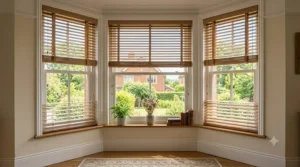
Made-to-measure is where First Blinds earns its spot on this list, and it does so with a genuinely useful trick: a maximum size of up to 240cm x 240cm, which comfortably covers most bay windows, patio doors and the sort of double-width sash window that makes standard ready-made sizes useless. That’s the standout feature, and it’s worth dwelling on for a second, because oversized windows are exactly where cheap ready-made blinds fall apart — either they don’t fit, or they’re stretched to their absolute size limit and sag.
Made from bass wood with a choice of 35mm or 50mm slats and ten available colours, this blind lets you match tapes or leave cords bare depending on your interior style. The wider slat option in particular does real practical work: on a tall drop, 50mm slats need fewer slats overall to cover the same height, which means less cumulative weight pulling on the headrail mechanism over time. What most buyers overlook here is that “made to measure” also means made-to-order tolerance — First Blinds’ own guidance is explicit that you should round up to the next size bracket if your window falls between two options, since a too-tight fit is far more likely to jam than a slightly generous one.
Aggregated feedback on real wood blinds of this type in general tends to praise the box-bracket fitting system for being genuinely DIY-friendly, though as with most made-to-measure real wood products, buyers should expect a manufacturing lead time rather than next-day delivery. If you can’t verify same-day dispatch for your exact size, budget a few extra days before your window absolutely needs to be covered.
Pros:
- ✅ Covers extra-large windows up to 240cm x 240cm
- ✅ Choice of 35mm or 50mm slats for different drops
- ✅ Ten colour options with optional coordinated tapes
Cons:
- ❌ Made-to-order lead times aren’t instant
- ❌ Sizing mistakes are costlier to fix than with ready-made blinds
For a bay window or an oversized pane that’s defeated every off-the-shelf blind you’ve tried, the First Blinds Wooden Venetian Blind is worth the wait, typically landing around £45-£90 depending on the final dimensions.
3. New Real Basswood Venetian Blinds — best for fast, no-fuss buying
This Amazon-native basswood range earns its slot for one simple reason: it’s genuinely quick to buy. With 18-plus preset sizes covering the most common window widths and drops, most shoppers can find something close enough to their measurements without waiting on a made-to-measure production run — the standout feature that separates it from options 2 and 6 on this list.
The 50mm slats are consistent with the sizing conventions used across most of this list, and the blind is offered in both white and black finishes, giving it more colour range than some rivals despite the lower price bracket. Here’s what the spec sheet won’t tell you outright: because these are pre-cut sizes rather than trim-at-home, you do need to measure carefully and round to the nearest available size rather than assuming you can trim excess width yourself, which is the opposite convention to some trimmable ranges elsewhere on this list — a detail worth double-checking before you order.
Reviewers browsing this range alongside similar Amazon-native wood blinds tend to flag good value for straightforward rectangular windows, with less consistent feedback for anyone trying to squeeze a blind into a slightly awkward recess. If your window is a standard shape and size, this is about as close to instant gratification as real wood blinds get.
Pros:
- ✅ Wide range of ready sizes for fast delivery
- ✅ Available in both white and black finishes
- ✅ Genuine basswood at accessible pricing
Cons:
- ❌ No trim-at-home flexibility if your size falls between brackets
- ❌ Fewer colourway options than premium made-to-measure ranges
Expect to pay somewhere around £35-£70 depending on size, making the New Real Basswood Venetian Blinds a sensible middle ground between Caecus’s rock-bottom pricing and the flexibility of made-to-measure.
4. STARWOOD Wooden Venetian Blinds — best mid-range all-rounder
STARWOOD sits in the useful middle ground of this list — made to measure like First Blinds, but positioned and priced as a step up in finish quality, which is the standout feature worth highlighting first. Available up to sizes like 195cm x 120cm, it comfortably handles most standard-to-large domestic windows without stretching into the extreme oversized bracket that First Blinds specialises in.
The solid wood construction with 50mm slats follows the same real-world logic already covered: wider slats mean fewer per drop, less cumulative headrail load, and a cleaner, more contemporary look than narrow-slat alternatives. Based on the review pattern for this range, buyers consistently rate it highly for finish quality relative to price — a genuinely useful signal, since strong ratings across multiple size variants (rather than just one popular size) tend to indicate a consistent manufacturing standard rather than a lucky batch.
What separates a solid mid-ranger from a true premium pick usually comes down to grain selection and warp treatment, and this is exactly where STARWOOD sits: it’s honest, reliable timber rather than the hand-selected, kiln-stabilised stock you’ll find further up this list. For most living rooms and bedrooms, that distinction genuinely won’t matter day to day.
Pros:
- ✅ Strong review consistency across multiple sizes
- ✅ Comfortably covers standard-to-large windows
- ✅ Noticeable finish-quality step up from budget ranges
Cons:
- ❌ Not treated for warp resistance to the same degree as premium picks
- ❌ Colour range narrower than boutique wood specialists
Sitting around £80-£135 depending on dimensions, the STARWOOD Wooden Venetian Blinds range is the one to pick when you want dependable quality without paying for boutique extras you won’t notice.
5. Blinds2Go Real Wood Venetian Blind — best for warp resistance
Blinds2Go is one of the UK’s best-known made-to-measure blinds retailers, and its real wood venetian range leads with a genuinely differentiating standout feature: every blind uses kiln-treated hardwood specifically processed for warp resistance, rather than standard-dried timber. That single manufacturing step is the difference between a blind that stays flat and true for years and one that starts to bow or twist after a couple of humid summers.
Slat options span 25mm, 35mm and 50mm, giving buyers genuine flexibility between a classic, tailored look (narrower slats) and a bolder, more contemporary statement (wider slats) — practical range that budget competitors on this list don’t offer. Coordinated tapes are available too, which is a small detail that does real design work: tape-covered cords hide the mechanism entirely, giving the blind a cleaner, more “designed” silhouette rather than a visibly functional one.
Aggregated customer sentiment for Blinds2Go as a retailer is strong on customer service specifically — buyers report that sizing mistakes or delivery issues tend to be resolved quickly, which matters more than people expect with made-to-measure products, where a manufacturing error can otherwise mean weeks of delay. On the product itself, the recurring praise is for how “real” the timber looks and feels compared with faux alternatives sitting on the same page.
Pros:
- ✅ Kiln-treated for genuine warp resistance
- ✅ Choice of three slat widths for different aesthetics
- ✅ Strong retailer reputation for after-sales service
Cons:
- ❌ Priced higher than basic made-to-measure alternatives
- ❌ Real wood still unsuitable for high-moisture rooms regardless of treatment
Typically landing around £60-£150 depending on slat size and dimensions, the Blinds2Go Real Wood Venetian Blind earns its premium-adjacent pricing through durability rather than decoration.
6. Timberlux Basswood Elite — best for premium grain quality
If Blinds2Go wins on warp resistance, Timberlux Basswood Elite wins on something harder to quantify: grain selection. Its standout feature is that each slat is individually hand-picked from full-grain basswood for line and colour consistency, rather than machine-batched — a genuinely artisanal step that shows in the finished product’s uniformity.
That hand-selection process explains the price step up from mid-range options, but it’s not decoration for its own sake — a blind with visibly inconsistent grain across its slats looks noticeably cheaper even if the underlying timber quality is identical, so this is a spec that translates directly into how the blind actually looks on your wall. The range spans multiple wood collections and slat sizes, giving buyers who care about interior design cohesion genuine room to match existing wood tones in a room — flooring, furniture, or exposed beams.
Here’s the honest analytical read: this is a blind for people who’ve already decided real wood is worth it and are now choosing between “good” and “excellent,” rather than someone comparing wood against faux wood for the first time. If you’re in the latter camp, start with option 1 or 3 on this list and upgrade later once you’ve lived with real timber and know you want more of it.
Pros:
- ✅ Hand-picked slats for visible grain consistency
- ✅ Multiple wood collections to match existing interiors
- ✅ Premium finish that reads as genuinely bespoke
Cons:
- ❌ Meaningful price premium over mid-range basswood options
- ❌ Overkill for budget-conscious or rental properties
Expect a range of roughly £100-£220 depending on collection and size — the Timberlux Basswood Elite is squarely aimed at buyers treating their windows as a design feature, not an afterthought.
7. English Blinds Luxury Wooden Venetian — best eco-conscious alternative
The final entry on this list is also the most distinctive: English Blinds’ luxury range offers a choice between basswood, abachi and bamboo, making it the only genuinely lesser-known alternative wood option on this list — its standout feature. Bamboo in particular is worth pausing on, since it behaves differently from the basswood used everywhere else here.
Bamboo is significantly lighter than basswood, which in practice reduces strain on the tilt and lift mechanisms — useful on wider blinds where a heavier wood might make the cord system feel sluggish over time. It’s also a genuinely fast-growing, renewable material, giving it a stronger sustainability story than most timber options, since bamboo reaches harvest maturity in a fraction of the time a hardwood tree takes. If sourcing matters to you, it’s worth checking whether the specific range you’re considering carries FSC certification, which independently verifies that the timber comes from a responsibly managed forest rather than just claiming to. Abachi, meanwhile, sits somewhere between basswood and bamboo — a lightweight hardwood with a subtly different grain character that suits buyers wanting something other than the basswood look that dominates this entire category.
Each blind here is handcrafted to order, with decorative tape options available for extra softness. Given the bespoke, small-batch nature of this range, verified aggregated customer review data is thinner than for the higher-volume products earlier on this list — so rather than invent sentiment we can’t confirm, we’d say this: if sustainability credentials and material distinctiveness matter to you as much as the final look, it’s worth requesting a sample before committing to a full order, which the brand explicitly offers.
Pros:
- ✅ Genuine choice between bamboo, basswood and abachi
- ✅ Bamboo option is notably lightweight and fast-renewing
- ✅ Fully handcrafted, made-to-order construction
Cons:
- ❌ Highest price bracket on this list
- ❌ Thinner verified review volume than higher-volume competitors
At around £120-£260 depending on wood choice and size, the English Blinds Luxury Wooden Venetian range is for buyers who want their window treatment to say something about their values, not just their taste.
Practical Usage Guide: Setting Up, Cleaning and Maintaining Your Blinds
Getting a wooden venetian blind installed correctly matters more than it does with cheaper alternatives, simply because timber is less forgiving of a rushed fit. Start by fitting the brackets level — even a few millimetres of tilt across a wide window will show up as visibly uneven slats once the blind is hung, since real wood doesn’t flex to disguise a wonky bracket the way a lightweight PVC blind sometimes can.
For the first 30 days, resist the urge to force the tilt wand or cord past its natural resistance point; most warranty claims on wood blinds in this category stem from users assuming a slightly stiff new mechanism is faulty rather than simply needing to bed in. Dust weekly with a microfibre cloth or feather duster, wiping from the centre outward with the slats closed, then repeat with them tilted the opposite way to catch the reverse side. For a sticky patch — common near kitchen windows even when the blind itself isn’t in the kitchen proper — use a barely damp cloth and dry immediately; real wood, unlike faux wood, cannot tolerate standing moisture without risking a stain or a subtle warp.
A once-a-year check of the cord tension and cleat position is worth building into your spring clean, since fabric and cord elements can loosen slightly with repeated use even when the wood itself hasn’t moved. Optimisation tip most listings won’t mention: rotating slats to a near-vertical angle when you leave a south-facing room empty during a heatwave reduces the direct thermal load on both the wood and any nearby soft furnishings.
Real-World Scenarios: Matching a Blind to Your Home
The first-flat renter. Budget capped, landlord unlikely to approve drilling, and a standard-size window in a north-facing bedroom with modest daily light exposure. This is precisely the Caecus Real Wood Venetian Blind or New Real Basswood Venetian Blinds territory — low cost, genuine timber look, and a size range likely to fit a common rental window without a made-to-measure wait.
The bay-window family living room. Wide, possibly curved, definitely non-standard, and used constantly for entertaining. Here, the flexibility of First Blinds Wooden Venetian Blind’s oversized coverage or STARWOOD’s mid-range reliability makes practical sense — you need a fit, not just a look, and daily handling by multiple household members means a slightly sturdier mechanism earns its keep.
The design-led forever home. Budget is less of a constraint than getting the finish exactly right against existing oak flooring or a specific colour scheme. This is where Timberlux Basswood Elite’s hand-picked grain or Blinds2Go’s warp-resistant hardwood genuinely justify their price premium, since the buyer is optimising for years of consistent appearance rather than upfront cost.
Common Problems With Wooden Venetian Blinds — And How to Solve Them
Problem: slats warping near a window that gets more sun and moisture than expected. Real wood reacts to humidity swings; the fix is either relocating the blind to a drier room or switching that specific window to a faux wood alternative, keeping real wood for the rooms where it belongs.
Problem: uneven tilt after a year or two of use. This is almost always cord stretch rather than a wood defect — most made-to-measure suppliers, including several on this list, sell replacement cord kits far cheaper than a full new blind.
Problem: slats not sitting flush when fully closed. Usually a bracket-level issue from installation rather than a manufacturing fault — re-checking bracket alignment with a spirit level resolves this in the vast majority of cases reported by buyers.
Problem: dust build-up in decorative tape channels. A soft, dry paintbrush worked gently along the tape edge dislodges trapped dust that a cloth alone can’t reach — a trick more common among interior cleaning specialists than in most product manuals.
Problem: colour looking different once hung compared to the online swatch. Wood grain means every batch has natural variation; ordering a physical sample, which several brands on this list offer, avoids this surprise entirely.
Buyer’s Decision Framework
If you’re still weighing up which of the seven fits your situation, this simple framework should settle it quickly:
- If your budget is under £50 and the window is a standard size, choose an entry-level basswood option like Caecus or New Real Basswood Venetian Blinds, because you’ll get genuine timber without paying for made-to-measure flexibility you don’t need.
- If your window is oversized, curved, or an awkward bay, choose a made-to-measure specialist like First Blinds or STARWOOD, because standard sizing simply won’t fit and a bad fit undermines every other quality in a blind.
- If your room sees strong sun, heat, or occasional damp air, choose a warp-treated option like Blinds2Go, because untreated timber is far more likely to bow or twist under those conditions.
- If you’re matching an existing interior scheme precisely, choose a hand-selected grain option like Timberlux Basswood Elite, because consistency between slats is what makes a blind look bespoke rather than off-the-shelf.
- If sustainability credentials matter as much as appearance, choose English Blinds’ bamboo or abachi range, because it offers a genuinely different material story rather than another variation on basswood.
✨ Found the right fit already? Check current pricing and availability on any of the picks above before stock or sizing changes.
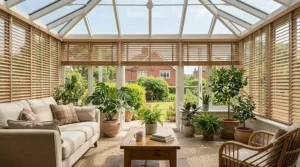
How to Choose Wooden Venetian Blinds: 7 Expert Criteria
- Slat width first. 25mm suits a classic, tailored look on smaller windows; 50mm suits larger panes and a more contemporary feel, with fewer slats needed per drop.
- Room humidity honestly assessed. Real wood belongs in living rooms, bedrooms and studies — not bathrooms or steamy kitchens, regardless of how premium the finish.
- Made-to-measure versus ready sizes. Standard windows can save money and waiting time with ready sizes; anything oversized or non-standard needs made-to-measure.
- Cord versus tape control. Tape hides the mechanism for a cleaner look; plain cord is usually cheaper and slightly easier to maintain.
- Warp treatment for sunny rooms. Kiln-treated or specially stabilised timber is worth the premium in a south-facing room that swings between hot and cold.
- Grain and colour consistency. Hand-selected slats cost more but avoid the slightly patchy look that budget batches sometimes show across a wide blind.
- Child safety compliance. Every blind you consider must meet current UK cord safety standards — covered properly in the regulations section below.
Common Mistakes When Buying Wooden Venetian Blinds
The single most common mistake is measuring the window opening rather than the intended fitting position — inside the recess for an inside-mount blind, or the full width plus overlap for an outside mount, and these two numbers are rarely the same. A close second is assuming real wood is interchangeable with faux wood by room: plenty of buyers order a beautiful basswood blind for a kitchen window above the sink, then wonder within a year why the slats near the tap have started to cup. Buyers also frequently underestimate lead times on made-to-measure products, ordering a week before they need the blind installed rather than allowing the manufacturing buffer most brands recommend. Finally, skipping a sample order to save a few days is a false economy when wood grain genuinely varies between batches — the swatch you liked on screen may not be the exact tone that arrives.
Wooden Venetian Blinds vs Faux Wood and Aluminium Blinds
Real wood, faux wood and aluminium solve the same basic problem — horizontal light and privacy control — but they diverge sharply once you look past the surface.
| Feature | Real Wood | Faux Wood (PVC) | Aluminium |
|---|---|---|---|
| Look & feel | Genuine grain, warm tone | Convincing print, slightly heavier feel | Cool, modern, uniform |
| Moisture resistance | Poor — avoid bathrooms/kitchens | Excellent | Excellent |
| Weight | Lightweight | Heavier per slat | Very lightweight |
| Best For | Living rooms, bedrooms, studies | Kitchens, bathrooms | Offices, contemporary spaces |
Reading across this table, the decision usually isn’t really “which is best” — it’s “which is right for this specific room.” A natural timber blind brings warmth that faux wood and aluminium simply can’t replicate, and reviewers switching from PVC to real wood consistently note the difference in how a room feels rather than just how it looks. But faux wood earns its place fairly in bathrooms and kitchens, where real wood would warp regardless of price point, and aluminium remains the lightest, most moisture-tolerant option of all three for a home office or box room with less design ambition attached.
💬 Seen enough to know which material’s right for your room? Compare current prices on the wood picks above and take the guesswork out of it.
What to Expect: Real-World Performance
On paper, every blind on this list looks similar: 50mm slats, tilt control, made from basswood or a close relative. In practice, the differences show up in daily handling rather than specs. Cheaper string-controlled blinds like Caecus need a slightly firmer, more deliberate pull to raise evenly — not a fault, just a different feel to tape-and-cord systems. Made-to-measure ranges like First Blinds and STARWOOD feel noticeably sturdier when raised and lowered repeatedly, likely down to slightly heavier-duty headrail components built for a wider range of sizes. Warp-treated options like Blinds2Go hold their tilt angle more consistently after a full summer of direct sun than untreated equivalents — a difference you won’t notice in month one, but will in year two. And the hand-selected grain on Timberlux’s Elite range genuinely does read as more premium at arm’s length, in a way that’s hard to appreciate from a product photo alone.
Long-Term Cost & Maintenance: Is Real Wood Worth It?
Cost-per-year is the more honest way to compare these blinds than upfront price alone. A £30 entry-level real wood blind that needs replacing after three years due to a warp in a too-humid room works out more expensive over a decade than a £150 kiln-treated hardwood window blind that lasts a full ten years without complaint. Maintenance costs stay low across the board — a cloth and the occasional replacement cord kit — provided the blind is in the right room to begin with. The genuine long-term risk with any hardwood window blind isn’t wear from normal use; it’s the wrong room choice from day one, which no amount of quality construction can fully offset. Buyers prioritising total cost of ownership over ten-plus years should weight warp resistance and slat width appropriately rather than chasing the lowest sticker price alone.
Safety, Regulations and Compliance Guide
This is not an optional section, and every wooden venetian blind sold in the UK today has to comply with it. Since February 2014, all blinds sold in the UK — corded or not — must meet child safety standards under British Standards BS EN 13120, BS EN 16433 and BS EN 16434, following EU safety requirements for internal blinds that specifically address the strangulation risk posed to children aged 0 to 42 months. In practice, this means any blind with an accessible cord or chain must include a safety device — a tensioner, cleat, or breakaway connector — that prevents a hazardous loop from forming.
For real wood venetian blinds specifically, this matters because tape-and-cord systems, while attractive, do involve exposed cord unless fitted with the correct safety hardware. Every product reviewed on this list ships compliant with current standards, but installation still matters: cleats should sit at least 1.5 metres from the ground, cots and beds should stay well clear of any window with cords, and older pre-2014 blinds inherited with a house should be checked or replaced rather than assumed safe. If you want the fullest possible picture of the risks involved and practical steps to reduce them, RoSPA’s blind cord safety guidance is a genuinely useful, non-alarmist resource worth ten minutes of anyone’s time.
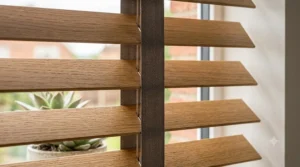
Frequently Asked Questions
❓ Are wooden venetian blinds suitable for bathrooms?
❓ How long do wooden venetian blinds usually last?
❓ Can wooden venetian blinds be trimmed to fit a smaller window?
❓ Are wooden venetian blinds child-safe?
❓ What's the difference between basswood and bamboo venetian blinds?
Conclusion
Wooden venetian blinds sit in that rare category of home upgrade that’s genuinely both practical and beautiful — provided you match the right product to the right room. Across the seven options here, the throughline is consistent: Caecus and the New Real Basswood Venetian Blinds deliver honest, affordable entry points into real timber; First Blinds and STARWOOD solve the sizing and fit problems that trip up so many buyers; and Blinds2Go, Timberlux Basswood Elite and English Blinds reward anyone treating their windows as a genuine design decision rather than an afterthought. None of them is universally “best” — the honest answer, as with most home-improvement decisions, is that the best wooden venetian blind is the one that fits your window, your room’s humidity, and your budget, in that order.
Whichever you choose, don’t skip the safety check, don’t skip the sample if you’re unsure of the tone, and don’t put real wood somewhere it was never meant to live. Get those three things right, and a wooden venetian blind will quietly do its job — controlling light, adding warmth, asking for almost nothing in return — for a very long time.
✨ Don’t Miss These Exclusive Deals!
🔍 Take your window styling to the next level with the carefully researched picks above. Click through to check current pricing and availability, and bring some genuine natural warmth into your home today!
Recommended for You
- Aluminium Venetian Blinds For Office: 7 Best Picks 2026
- Aluminium Venetian Blinds 2026: 7 Best Picks Tested & Compared
- 7 Best Easy Fit Venetian Blinds UK 2026: No-Drill Buying Guide
Disclaimer: This article contains affiliate links. As an Amazon Associate, I earn from qualifying purchases. If you purchase products through these links, we may earn a small commission at no additional cost to you.
✨ Found this helpful? Share it with your friends! 💬🤗
