
In This Article
There’s a particular kind of satisfaction in pulling a cord and watching a window fold itself into neat, even ridges — like a paper fan someone actually knew how to make properly. That’s pencil pleat curtains for you: unfussy, endlessly adaptable, and somehow still the heading style your nan, your interior designer friend, and the bloke fitting curtain poles for a living all agree on. Pencil pleat curtains have been dressing British windows for the best part of a century, and in 2026 they’re still the default choice for anyone who wants a tailored look without committing to the price tag of made-to-measure drapery.

Here’s the short version, if you’re in a hurry: pencil pleat curtains use a stitched-in heading tape with drawstring cords that gather the fabric into tight, cylindrical folds resembling a row of pencils standing on end. Pull the cords, tie them off, hang the hooks, done. They work on tracks or poles, suit any room, and range from £15 bargain-bin basics to £50-plus jacquard showpieces.
What you won’t get from scrolling an Amazon listing is honest guidance on which of the dozens of near-identical options is actually worth your money, and where a cheaper pair genuinely competes with something pricier. That’s what this guide sets out to do — real products, real spec comparisons, and the kind of blunt commentary a shop assistant would give you if they weren’t on commission. We’ve dug into seven genuine pencil pleat curtains sold on Amazon UK, sized up affordable pencil pleat curtains against premium ones, and answered the questions that actually decide whether you’re happy with your purchase in six months’ time: heading tape, hook versus ring hanging, and which lining type does what.
Prices below are given as ranges rather than exact figures, since Amazon pricing shifts by the week — always check the current price on the product page before buying.
Quick Comparison: Our Top Picks at a Glance
Before the deep dive, here’s the shape of the market in one table. Think of it as the cheat sheet you’d want if someone made you choose a pair of curtains in the next sixty seconds.
| # | Product | Best For | Price Range |
|---|---|---|---|
| 1 | Deconovo Super Soft Thermal Pencil Pleat Curtains | Budget blackout starter pair | £20–£35 |
| 2 | Catherine Lansfield Kelso Check Curtains | Classic check, traditional rooms | £25–£40 |
| 3 | Dreams & Drapes Norfolk Pencil Pleat | Shift workers and nurseries | £20–£35 |
| 4 | PONY DANCE Pencil Pleat Thermal Curtains | Awkward or oversized windows | £18–£45 |
| 5 | Emma Barclay Cali Pencil Pleat Curtains | Affordable built-in blackout | £15–£28 |
| 6 | Sleepdown Textured Rib Weave Curtains | Cheapest fully lined option | £14–£24 |
| 7 | Dreams & Drapes Hawthorne Jacquard | Premium living-room finish | £35–£58 |
A quick read of that table tells its own story: there’s a genuine spread from sub-£15-a-panel basics right up to jacquard weaves that wouldn’t look out of place in a boutique hotel, and price doesn’t map neatly onto quality the way you’d expect. Sleepdown and Emma Barclay both undercut Deconovo on price while matching it on blackout lining, which tells you the budget end of this market is more competitive than it first looks. Meanwhile, if you’re furnishing a whole house rather than one room, buying two or three different products from this list for different rooms is often smarter than forcing one pair to do every job.
💬 Found a pair that’s caught your eye already? Save this page and come back once you’ve measured your window — it’s the step almost everyone skips.
Top 7 Pencil Pleat Curtains: Expert Analysis
We’ve spread this line-up across budget, mid-range and premium territory, and made sure every genuine style of pencil pleat curtain — blackout, thermal, jacquard, checked, plain — gets a fair hearing. Every product below is real, currently listed on Amazon UK, and assessed on its actual specification and aggregated review sentiment rather than marketing copy.
1. Deconovo Super Soft Thermal Insulated Pencil Pleat Curtains — best budget blackout starter pair
If you need a functional pair of curtains fast and don’t want to think too hard about it, this is where most people land, and there’s a reason for that. Deconovo builds these on a triple-weave construction that blocks somewhere between 85% and 95% of incoming light, depending on the colourway you pick — darker shades like black and charcoal perform noticeably better than pastels, because the dye density itself contributes to opacity here rather than a separate blackout backing. That distinction matters practically: if you’re buying for a north-facing nursery, go dark; if it’s a sunny south-facing bedroom where you still want some daylight filtering through on lazy Sunday mornings, a lighter shade is the better trade-off.
The fabric sits on the lightweight end of the thermal-curtain spectrum, and reviewers consistently note that fit, softness and blackout performance meet expectations, while a smaller but persistent group flags the weight and stitching quality as underwhelming for the price. That’s a fair summary of what you’re buying: genuinely effective light-blocking at a genuinely low price, with construction that won’t survive a decade of daily use the way a heavier weave might. It suits renters, students, and anyone dressing a spare room where longevity isn’t the priority.
Pros:
- ✅ Triple-weave fabric blocks 85–95% of light in most colours
- ✅ Wide range of ready-made sizes to suit small and large windows
- ✅ Machine washable, so upkeep is genuinely low-effort
Cons:
- ❌ Some buyers report thinner fabric than the listing photos imply
- ❌ Stitching and hem finishing feel basic compared with heavier ranges
At around £20–£35 depending on size, Deconovo Super Soft Thermal Insulated Pencil Pleat Curtains deliver solid blackout performance for the price, though anyone wanting a pair that lasts a decade should look further down this list.
2. Catherine Lansfield Kelso Check Lined Pencil Pleat Curtains — best classic check for traditional rooms
Catherine Lansfield has been a fixture of British home textiles for long enough that the name alone does some of the selling, and the Kelso Check range shows why. This is a fully lined pencil pleat curtain in a traditional checked pattern, aimed squarely at buyers who want a coordinated, slightly heritage look rather than a plain block colour. The lining is the detail that separates it from budget alternatives — it’s not marketed as blackout, but a proper lining adds genuine light control, better drape, and noticeably improved insulation over an unlined panel, which the spec sheet won’t spell out but the physics does.
What most buyers overlook about lined-but-not-blackout curtains is that they’re often the more livable everyday choice: full blackout is brilliant for a bedroom, but a lined-only curtain lets in a soft, diffused morning light that many people actually prefer in a living room or dining room. The checked pattern, in charcoal grey particularly, reads as more expensive than its price point suggests, which is consistent with the brand’s positioning as an accessible-but-design-led label. Reviews and RRP-discounting patterns on this range suggest it’s frequently sold well below its listed price, so it’s worth checking current deals before assuming it’s a mid-range-only option.
Pros:
- ✅ Fully lined for genuine light control and better drape than unlined fabric
- ✅ Recognisable, design-led British homeware brand
- ✅ Often available well below RRP, improving the value proposition
Cons:
- ❌ Not a blackout curtain — light-filtering only
- ❌ Checked pattern limits colour-matching flexibility in some schemes
Typically priced in the £25–£40 range depending on size and current deals, Catherine Lansfield Kelso Check Lined Pencil Pleat Curtains are the pick for anyone who wants a tailored, traditional look without going fully blackout.
3. Dreams & Drapes Norfolk Pencil Pleat (3″ Header) Thermal Curtains — best three-pass blackout for shift workers and nurseries
Where most “blackout” curtains on this list rely on a single dense weave, the Norfolk range from Dreams & Drapes uses three-pass blackout construction — three separate fabric layers bonded together rather than one thick one. In practical terms, this tends to produce a more consistent light-block across the whole panel, with fewer of the faint pinprick light leaks you sometimes get through a single-weave fabric, particularly around seams. That’s a genuinely useful distinction for two very specific buyer types: shift workers who need to sleep during daylight hours, and parents trying to keep a toddler’s room properly dark through a British summer evening that doesn’t get dark until gone 9pm.
The 3-inch heading tape is the industry-standard depth, which means it plays nicely with almost any curtain pole or track without special fittings. Reviewers describe the fabric as effective for both blocking light and retaining heat in colder months, with the brand explicitly marketing thermal benefits alongside blackout ones — a sensible pairing, since three-pass fabric is inherently denser and therefore a better insulator than a thin single layer, even before you factor in any dedicated thermal backing. A handful of reviews note that colours can appear slightly different in person than in product photography, which is worth bearing in mind if you’re matching an existing colour scheme closely.
Pros:
- ✅ Three-pass blackout construction for serious light control
- ✅ Explicitly designed with shift workers and nurseries in mind
- ✅ Doubles as a genuine thermal curtain, not just a blackout one
Cons:
- ❌ Only available with the standard 3-inch header, no slimmer option
- ❌ Colour can vary slightly from the online photos, per reviewer feedback
At roughly £20–£35, Dreams & Drapes Norfolk Pencil Pleat Thermal Curtains earn their place for anyone whose sleep schedule doesn’t match the sun’s.
4. PONY DANCE Pencil Pleat Thermal Curtains — best size range for awkward or oversized windows
If your window doesn’t fit the standard 46-inch or 66-inch moulds that most curtain ranges are built around, PONY DANCE is worth a look purely on breadth of sizing — their pencil pleat range stretches from compact 46-inch-wide panels up past 90 inches, covering everything from a small kitchen window to a set of patio doors. The standard triple-weave line blocks somewhere around 60–75% of light without a dedicated blackout lining, which is meaningfully less opaque than the Deconovo or Norfolk options above, so it’s better suited to a living room where you want privacy and glare reduction rather than total darkness. For bedrooms wanting genuine blackout, the brand’s separate velvet pencil pleat range steps up to 70–80% light block with a noticeably heavier, more substantial fabric hand.
What’s striking about PONY DANCE compared with smaller competitors is the sheer volume of verified customer reviews behind individual listings — tens of thousands on some product pages, which gives the aggregated sentiment more statistical weight than a listing with a few hundred reviews. That sentiment leans positive on drape quality, thickness and value, including feedback describing the fabric as well-made with even, consistent pleating once hung. Based on the spec comparison across their own range, the practical takeaway is that PONY DANCE isn’t one product but a small ecosystem — check carefully which specific listing (standard triple-weave, velvet, or blackout-lined) you’re buying, because the light-blocking performance differs substantially between them under the same brand name.
Pros:
- ✅ Size range covers unusually wide or narrow windows well
- ✅ Backed by tens of thousands of verified customer reviews
- ✅ Separate velvet and blackout ranges available for bedrooms
Cons:
- ❌ Standard triple-weave range isn’t full blackout, only 60–75%
- ❌ Easy to buy the wrong sub-range without checking specs closely
Spanning roughly £18–£45 across sizes and fabric types, PONY DANCE Pencil Pleat Thermal Curtains reward buyers who read the listing carefully rather than judging the brand on the headline photo alone.
5. Emma Barclay Cali Pencil Pleat Curtains — best affordable built-in blackout lining
Emma Barclay is a British home textiles name with roots going back to 1922, and the Cali range is a good example of a smaller brand competing on genuine value rather than marketing spend. The headline feature here is that blackout lining is built into the curtain itself rather than sold as a separate add-on — plenty of budget ranges make you buy a lining panel afterwards if you want proper darkness, which adds cost and hassle most buyers don’t anticipate at checkout. Cali skips that step, and the same design is offered with either an eyelet or a pencil pleat heading, so you can match the heading style to your existing pole or track without hunting for a different product line entirely.
Aggregated reviewer sentiment on this range highlights value for money specifically, with feedback describing the quality as feeling notably more expensive than the price paid — a useful signal, since “cheap but doesn’t look cheap” is exactly what most people shopping at this end of the market are hoping for. As a smaller brand relative to the household names on this list, stock and less common sizes do tend to sell through and go temporarily unavailable more often, so if you find your size in your colour, it’s worth acting rather than waiting for a sale.
Pros:
- ✅ Blackout lining is built in — no separate liner purchase needed
- ✅ Same design available in eyelet or pencil pleat heading
- ✅ British textiles brand with a genuine trading history since 1922
Cons:
- ❌ Smaller stock pool means popular sizes sell out faster
- ❌ Colour range is narrower than the bigger household-name brands
Priced from around £15 up to the high £20s depending on size, Emma Barclay Cali Pencil Pleat Curtains are one of the strongest value picks on this list for anyone chasing affordable pencil pleat curtains without sacrificing blackout performance.
6. Sleepdown Textured Rib Weave Pencil Pleat Blackout Lined Curtains — cheapest fully lined blackout pick
Sleepdown positions itself explicitly as an affordable, UK-designed home décor brand, and this rib-weave range is where that positioning is most obvious — it’s consistently one of the least expensive fully lined, blackout pencil pleat options you’ll find on Amazon UK in a genuine ready-made format. The textured rib weave gives the fabric visible surface interest without needing a printed pattern, which is a clever way to make a cheap fabric look considered rather than flat and characterless. It comes in a handful of contemporary colourways, with navy and grey among the more popular choices for bedrooms and small living spaces.
What most buyers overlook about curtains at this exact price bracket is that “cheap” and “cheap-looking” aren’t the same thing, and Sleepdown’s rib-weave texture is a reasonably effective way of avoiding the latter — the raised weave catches light differently to a flat polyester panel, adding a sense of quality that the price tag alone wouldn’t suggest. The trade-off, as with most budget ranges, is a narrower size selection than you’d get from a bigger brand, with shorter drop lengths better represented than longer ones, so measure your window carefully before assuming your size is in stock.
Pros:
- ✅ Fully lined blackout construction at one of the lowest price points around
- ✅ Textured rib weave adds visible quality despite the low cost
- ✅ UK-designed brand with straightforward machine-wash care
Cons:
- ❌ Limited to shorter drop sizes in some colourways
- ❌ Fewer pattern choices than lifestyle-brand competitors
At roughly £14–£24, Sleepdown Textured Rib Weave Pencil Pleat Curtains are the answer if someone asks for cheap lined pencil pleat curtains and you want a genuinely good one to recommend.
7. Dreams & Drapes Woven Hawthorne Jacquard Pencil Pleat Curtains — best premium jacquard for a finished living-room look
At the top of this line-up sits the Hawthorne range from Dreams & Drapes’ Woven collection — a jacquard-textured pencil pleat curtain built from a cotton-rich 55% cotton, 45% polyester blend, with a heritage floral pattern woven directly into the fabric structure rather than printed onto it. That distinction is worth pausing on: a woven jacquard pattern has genuine texture and dimension you can feel with your fingers, and it holds its definition after washing in a way a printed pattern gradually can’t, since the pattern is structural rather than surface-level dye. The curtains come with matching tiebacks as standard and a light-filtering lining (52% polyester, 48% cotton) that adds body and improves drape without going full blackout.
Here’s what the spec sheet won’t tell you outright: jacquard-woven fabric is inherently heavier and more structured than a plain-weave equivalent, which means these curtains hang with a fuller, more tailored silhouette straight out of the packaging — less “flat sheet with pleats” and more “proper drapery.” That makes this the obvious upgrade pick for a main living room or a period-property sitting room where the curtains are doing real interior-design work, not just covering glass. The trade-off is care: iron-on-reverse-only instructions and a higher price point than anything else on this list reflect the more considered construction, and buyers on a genuinely tight budget will get better value from the Catherine Lansfield or Sleepdown options instead.
Pros:
- ✅ Woven jacquard pattern with real texture, not printed on
- ✅ Matching tiebacks included as standard
- ✅ Cotton-rich fabric drapes with a fuller, more tailored look
Cons:
- ❌ Iron on reverse only — more care needed than synthetic ranges
- ❌ Highest price point on this list by a clear margin
Sitting around £35–£58 depending on size, Dreams & Drapes Hawthorne Jacquard Pencil Pleat Curtains are the premium finishing touch for a room where curtains are meant to be noticed, not just functional.
Top 7 Products: Full Spec Comparison
Now that the individual analysis is out of the way, here’s how all seven stack up side by side on the details that actually decide a purchase.
| Product | Fabric / Lining | Light Block | Header | Price Range | Best For |
|---|---|---|---|---|---|
| Deconovo Super Soft Thermal | Triple-weave polyester | 85–95% | 3″ pencil pleat | £20–£35 | Budget blackout |
| Catherine Lansfield Kelso Check | Poly-cotton, fully lined | Light-filtering | 3″ pencil pleat | £25–£40 | Traditional/heritage |
| Dreams & Drapes Norfolk | Three-pass blackout | ~95%+ | 3″ pencil pleat | £20–£35 | Shift workers, nurseries |
| PONY DANCE Thermal | Triple-weave / velvet range | 60–80%* | 3″ pencil pleat | £18–£45 | Oversized windows |
| Emma Barclay Cali | Woven, built-in blackout | High | Pencil pleat or eyelet | £15–£28 | Affordable blackout |
| Sleepdown Rib Weave | Textured rib weave, lined | Blackout | 3″ pencil pleat | £14–£24 | Cheapest lined pick |
| Dreams & Drapes Hawthorne | Cotton-rich jacquard | Light-filtering | 3″ pencil pleat | £35–£58 | Premium living room |
*varies by sub-range within the PONY DANCE line-up.
Laid out like this, the pattern is clear: the products clustering around £20–£35 (Deconovo, Catherine Lansfield, Dreams & Drapes Norfolk) are doing the bulk of the competitive work in this market, while Sleepdown and Emma Barclay undercut them on price without giving up blackout performance, which is why they’re the picks worth flagging to anyone asking about affordable pencil pleat curtains specifically. At the other end, Dreams & Drapes Hawthorne is the only genuinely premium option here, and its jacquard construction is the clearest example on this list of a spec difference (woven versus printed pattern) that actually justifies a higher price rather than just marketing gloss.
💬 Spotted your match in the table above? Compare it against your window measurements before you commit — the next section explains exactly how.

What Is Curtain Heading Tape?
Curtain heading tape is the strip of stiffened fabric stitched to the top of a curtain that contains several rows of drawstring cords; pulling those cords gathers the flat fabric into evenly spaced folds, and the resulting fold shape is what defines the heading style, whether pencil pleat, gathered, or something else entirely.
For pencil pleat specifically, the standard tape is 3 inches (roughly 7.5cm) deep with three rows of hook pockets, though 2-inch and 4-inch depths exist for shorter or heavier curtains respectively. The extra hook rows aren’t decorative — they let you fine-tune exactly how far above your pole or track the curtain top sits, which matters more than most first-time buyers realise, because a curtain hung too high leaves a visible gap of ceiling above it, and one hung too low can obscure part of the pole itself. Before it was mass-produced as curtain tape, pencil pleat gathering was achieved by hand-sewing individual pleats, which explains why the pre-tape method still appears on high-end made-to-measure curtains today, where a tailor pleats and hand-stitches every fold rather than relying on drawstrings.
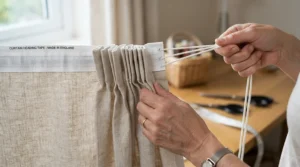
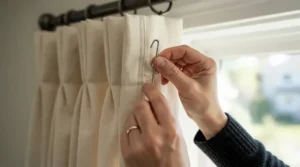
The other detail worth knowing: heading tape comes un-pulled from the factory on most ready-made curtains, meaning you’ll need to draw the cords yourself, distribute the gathers evenly by hand, and knot off the loose cord ends (never cut them — you may need to loosen the pleats later for cleaning or re-hanging). It’s a five-minute job the first time you do it, and about ninety seconds every time after that.
Hook vs Ring Hanging: Which Suits Pencil Pleat Curtains?
This is one of those small decisions that quietly determines how well your curtains actually work day to day, and it comes down to what your window is fitted with — a track or a pole.
If you’ve got a curtain track, curtain hooks are the standard and, frankly, the only sensible option: small plastic or metal hooks slot into the pockets along the pencil pleat tape, and the hook’s other end clips into the track’s runners, letting the curtain glide open and closed smoothly. Curtain tracks are specifically engineered for hook-based hanging, and trying to improvise rings onto a track setup generally doesn’t work, since most tracks lack the exposed rail that rings need to slide along.
If you’ve got a curtain pole, you have a genuine choice: hooks plus curtain rings (where the hook attaches to the tape and clips onto a separate ring that slides on the pole), or eyelet-style rings threaded directly through the fabric — though the latter isn’t compatible with a pencil pleat heading, which is tape-based rather than eyelet-based by design. For pencil pleat curtains on a pole specifically, hooks-and-rings is the standard combination, and it’s worth paying attention to ring diameter versus pole diameter: rings that are too tight against a thick pole will drag and struggle to glide, while rings that are too loose on a slim pole can look sparse and won’t stack neatly when the curtains are open. As a rough guide, aim for rings with an internal diameter at least a centimetre or two larger than your pole’s diameter for smooth, easy operation.
Curtain Lining Types Explained
Lining isn’t just a nice-to-have layer at the back of a curtain — it’s doing three separate jobs at once: blocking light, insulating against heat loss, and improving how the fabric hangs and drapes. Understanding the different types helps explain why two curtains that look near-identical from the front can perform completely differently in use.
Standard cotton or polyester lining is the baseline: a plain, usually pale-coloured fabric sewn to the back of the main curtain fabric. It adds body and a small amount of light-filtering, and it protects the main fabric from sun fading over time, but it isn’t designed to block light meaningfully — this is what Catherine Lansfield’s Kelso range and the Hawthorne jacquard both use, which explains why neither is marketed as blackout despite being fully lined.
Blackout lining uses a dense, often foam-backed or multi-layer fabric specifically engineered to block light almost entirely, typically achieving 90% or higher depending on construction quality. This is the lining you want in a bedroom or nursery where genuine darkness matters, and it’s what separates products like Deconovo, Emma Barclay, and Sleepdown functionally from the lighter-filtering options on this list, even though all seven are technically pencil pleat curtains.
Thermal lining sits somewhere in between conceptually, prioritising insulation over total light block, though in practice many modern thermal curtains — including the three-pass construction used by Dreams & Drapes’ Norfolk range — combine thermal and blackout properties in a single fabric, since a dense enough weave achieves both jobs simultaneously. According to the Energy Saving Trust, upgrading to heavier or thermal curtains is one of the more accessible ways to reduce heat loss through windows without the cost of full glazing replacement, which is worth remembering if your priority is a warmer room over Christmas rather than a darker one.
The practical upshot: match the lining to the room’s actual job. A living room usually wants standard or light-filtering lining so daylight still gets in during the day; a bedroom for a shift worker or a small child almost always wants blackout; and a draughty older property benefits from thermal properties regardless of which room it’s in.
How to Choose Pencil Pleat Curtains
Here’s a straightforward decision process, in the order that actually matters when you’re standing in front of a window with a tape measure.
- Measure your track or pole width first, not the window itself. Curtains need 1.5 to 2 times the width of your pole or track to gather properly into a full-looking pleat — measuring the window glass alone will leave you with skimpy, flat-looking curtains.
- Decide your drop: sill, below-sill, or floor-length. Floor-length (falling to just above carpet level) reads as the most tailored and is generally the safer default for living rooms and bedrooms alike.
- Choose your light-control priority before you choose a colour. Blackout, thermal, or light-filtering is a functional decision that should come before an aesthetic one — pick the lining type first, then shop for it in your preferred colourway.
- Match the heading to your hardware. Confirm whether you’re working with a track (hooks only) or a pole (hooks and rings), since this affects which accessories you’ll need to buy alongside the curtains themselves.
- Factor in fullness for pattern-heavy or jacquard fabrics. A patterned or jacquard weave like Hawthorne’s benefits from generous fullness (closer to double width) so the repeat pattern reads properly once gathered, rather than looking cramped.
- Check the fabric composition for care requirements. Dry-clean-only fabrics cost more to maintain over years of ownership than machine-washable polyester blends — factor that into your real total cost, not just the sticker price.
- Read the aggregated review sentiment, not just the star rating. A 4.5-star average tells you little; a pattern of reviews consistently praising fit and blackout performance, as with several products above, tells you a lot more.
Affordable Pencil Pleat Curtains That Still Look Considered
There’s a persistent myth that affordable pencil pleat curtains automatically look like affordable pencil pleat curtains — thin, flat, slightly see-through even when they’re not meant to be. Looking across this list, that’s simply not borne out by the products actually available on Amazon UK right now. Emma Barclay’s Cali range and Sleepdown’s rib weave collection both sit at the cheaper end of the market and both deliver genuinely lined, functional curtains that reviewers describe as looking more expensive than they cost.
What tends to separate a good affordable curtain from a disappointing one isn’t the headline price at all — it’s texture and lining. A flat, glossy polyester in a single block colour photographs fine but often looks cheap once it’s hanging in real light, because there’s nothing for the eye to catch onto except the sheen. A textured weave, like Sleepdown’s rib construction, or a fabric with a matte, slightly nubbly hand feel, reads as more considered even at an identical price point, because it mimics the visual language of more expensive natural fibres like linen or cotton twill without the laundering hassle that comes with them.
The other lever worth pulling is colour. Muted, slightly dusty tones — think dove grey, sage, or a soft charcoal rather than stark white or jet black — tend to disguise a budget fabric’s limitations better than high-contrast colours do, because subtler colours don’t draw the eye to fabric weight and drape in the same way. If you’re working with a genuinely tight budget, prioritise a textured, muted-tone option with proper lining over a printed pattern in a flat fabric; the former will read as intentional, the latter can read as an afterthought regardless of how carefully it was chosen.
Pencil Pleat Curtains for a Small Budget: A Room-by-Room Plan
Furnishing a whole house on a genuinely small budget is a different problem to buying one nice pair of curtains, and it rewards a bit of strategic thinking about where your money does the most visible work.
Living room, main focal window: this is where it’s worth spending slightly more of a limited budget, since it’s the room guests see and the window is usually the largest. Catherine Lansfield’s Kelso Check, especially when caught during one of its frequent RRP discounts, punches well above its price here, giving a designed, coordinated look for not much more than a plain budget option.
Bedroom, light control priority: for a small budget where the main job is sleep quality, Sleepdown’s rib weave or Emma Barclay’s Cali range deliver genuine blackout lining for less than the price of a takeaway for two, without compromising on the actual function you need most in this room.
Secondary rooms — home office, spare room, kids’ playroom: this is where Deconovo’s entry-level triple-weave range earns its keep. These are rooms where longevity and premium drape matter less than simply having a functional, reasonably attractive curtain up quickly and cheaply, freeing up budget for the rooms that need it more.
Kitchen or smaller windows: shorter drops and narrower widths cost proportionally less fabric to produce, so this is often the cheapest room to dress well — PONY DANCE’s wide size range makes it easy to find an exact fit rather than overpaying for excess fabric on an oversized standard size.
The overarching principle for pencil pleat curtains on a small budget: spend where the room is seen most and the function matters most (living room aesthetics, bedroom blackout), and economise everywhere else without guilt — nobody judges the curtains in your utility room.
Cheap Lined Pencil Pleat Curtains: What “Cheap” Should (and Shouldn’t) Mean
“Cheap” carries a slightly unfair reputation in curtain shopping, largely because a lot of genuinely poor products exist at the bottom of every marketplace. But cheap lined pencil pleat curtains, done properly, aren’t a compromise — they’re simply a fabric and lining combination that costs less to manufacture while still doing the job asked of it.
Here’s what cheap should mean: a lined curtain, ideally with blackout or at minimum light-filtering lining, made from a synthetic or synthetic-blend fabric that’s machine washable, in a limited but sensible colour range, without elaborate pattern-matching or jacquard weaving that adds manufacturing cost. Sleepdown’s rib weave range is close to the platonic ideal of this: fully lined, genuinely affordable, machine washable, with just enough textural interest to avoid looking flat.
Here’s what cheap shouldn’t mean: unlined fabric marketed as if it offers privacy or light control it doesn’t actually deliver, curtains so lightweight they don’t hang with any structure at all once pulled into pleats, or stitching so minimal that hems come loose within a handful of washes. The genuine aggregated review complaints across some budget ranges on this list — thinner-than-expected fabric, basic finishing — sit right at this boundary, which is why reading real reviewer sentiment before buying matters more at the cheap end of the market than anywhere else. A cheap curtain that’s honestly cheap and delivers exactly what it promises is a good purchase; a cheap curtain oversold as doing more than it can is where buyer’s remorse tends to live.
Practical Usage Guide: Hanging, Steaming and Caring for Pencil Pleat Curtains
Getting a new pair of pencil pleat curtains from box to window looking genuinely good takes about fifteen minutes of care that most people skip entirely.
Unpacking and de-creasing: curtains arrive folded, often tightly, and creases from packaging don’t always fall out on their own once hung. A handheld steamer run down the length of each panel, or a hotel-style trick of hanging them in a steamy bathroom for twenty minutes while you shower, will relax most fold lines without the risk of a hot iron scorching synthetic fabric.
Gathering the pleats evenly: pull the heading tape cords gradually from one end, redistributing the gather with your fingers as you go, rather than yanking from the centre and hoping it evens out — it won’t. Aim for consistent, even folds across the whole width before you knot the cords off, and coil the excess cord neatly rather than cutting it, so you can loosen the gather later if you need to wash and re-hang.
First-30-days mistakes to avoid: the most common one is hanging curtains too tight against the wall with no stack-back space, which blocks light entirely even when open and makes small windows feel smaller. Leave enough pole or track beyond the window frame — roughly 15 to 20cm on each side — for curtains to stack back cleanly rather than bunching over the glass.
Maintenance schedule: check the care label before any wash, since dry-clean-only jacquards (like Hawthorne) will lose their crisp texture and potentially shrink unevenly in a domestic machine. For machine-washable ranges, a cool 30-40°C cycle with a low-heat tumble or line dry preserves both blackout backing and thermal lining far better than a hot wash, which can degrade the bonded layers in blackout fabric over repeated cycles.
Optimisation trick most listings don’t mention: hanging curtains from a pole a few centimetres wider than the window frame, rather than exactly window-width, lets more daylight into the room when they’re open, since less fabric bunches directly in front of the glass.
Real-World Scenarios: Which Pencil Pleat Curtains Suit Your Home
The night-shift nurse in a terraced house. Needs total daytime darkness in a bedroom that gets direct morning sun through a standard sash window. Dreams & Drapes Norfolk’s three-pass blackout construction, paired with a snug fit against the window frame, is built precisely for this brief — genuine light exclusion over decorative flourish.
The young family furnishing a first home on a tight budget. Multiple rooms, one modest overall spend, kids’ bedrooms needing decent blackout for early bedtimes. A mix of Sleepdown for the children’s rooms (cheap, lined, easy-wash) and Emma Barclay’s Cali range for the main bedroom (built-in blackout without extra lining cost) covers the essentials without overspending on any single room.
The renter wanting a quick, low-commitment refresh. Doesn’t want to invest heavily in something they might leave behind at the end of a tenancy, but still wants the flat to look considered for viewings and their own comfort. Deconovo’s entry-level triple-weave range offers reasonable blackout and a wide colour choice at a price low enough that leaving it behind isn’t a financial wrench.
The homeowner finishing a period-property living room. Larger windows, an interior style built around texture and heritage detailing, and a budget that allows for a genuine upgrade over synthetic basics. Dreams & Drapes Hawthorne’s jacquard weave and included tiebacks suit this brief precisely, delivering the tailored, substantial drape that a formal living room benefits from.
Common Mistakes When Buying Pencil Pleat Curtains
The single most frequent error is measuring the window rather than the pole or track — curtains sized to window width alone almost always look flat and under-gathered once hung, because pencil pleat headings need that extra fullness (1.5 to 2 times width) to form proper folds rather than sparse, widely spaced pleats.
A close second is assuming “thermal” automatically means “blackout,” or vice versa. As covered in the lining section above, these are related but distinct properties, and buying a thermal-only curtain expecting total darkness — or a blackout curtain expecting meaningful heat retention from a thin single-layer fabric — leads to disappointment that a five-minute spec check would have avoided.
Buyers also frequently underestimate drop length, particularly when moving from a standard 54-inch drop to a room with higher ceilings; a curtain that’s even a few centimetres short of the sill, floor, or intended stopping point looks visibly wrong in a way that’s hard to unsee once you’ve noticed it. And finally, colour-matching from a phone screen is a genuine risk — several products across this list carry reviewer feedback noting colours appearing slightly different in person, which is a near-universal quirk of screen colour rendering rather than a fault specific to any one brand.
Pencil Pleat vs Eyelet Curtains: Which Heading Style Wins?
This is the debate that comes up in nearly every curtain-buying conversation, and the honest answer is that neither style objectively wins — they solve different problems.
| Factor | Pencil Pleat | Eyelet |
|---|---|---|
| Hanging hardware | Track or pole, via hooks | Pole only, rings built into fabric |
| Look | Soft, traditional, tightly gathered | Structured, contemporary, wider folds |
| Fullness needed | 1.5–2x pole width | Around 1.5x pole width |
| Adjustability | Height adjustable via hook rows | Fixed once made |
| Best For | Traditional and period rooms | Modern, minimalist interiors |
Reading across that table, the practical decision usually comes down to your existing hardware and your room’s style, more than any inherent performance difference. If you’ve got a curtain track — common in rented properties and older housing stock — pencil pleat is close to mandatory, since eyelet curtains need a pole to thread onto and simply won’t work on most tracks. If you’ve already got a pole and a genuinely contemporary room, eyelet curtains slide open with less effort and give a slightly more structured, architectural fold that suits minimalist interiors better than pencil pleat’s softer gather.
Worth noting: several products on this list, including Emma Barclay’s Cali range, are sold in the identical design with a choice of either heading, which is a useful shortcut if you like a specific fabric and pattern but aren’t sure which heading style your hardware demands.
💬 Not sure which heading your window needs? Check your pole or track before ordering — it’ll save you a return.
Long-Term Cost & Maintenance: Are Cheap Curtains Actually Cheaper?
The sticker price on any curtain is only part of its real cost over the years you’ll own it, and it’s worth doing this maths honestly before assuming the cheapest option wins.
A £20 pair of budget triple-weave curtains that needs replacing every two to three years due to thinning fabric or fading colour costs you roughly £7-£10 a year in like-for-like replacement terms. A £45 jacquard pair built from a heavier, cotton-rich fabric that lasts six to eight years with proper care works out to a similar, sometimes lower, annual cost — while also looking considerably better throughout its lifespan and requiring less frequent buying decisions. This is the classic value-versus-price distinction: the cheapest option upfront isn’t automatically the cheapest option over time, though it absolutely can be the right choice for a room where you genuinely don’t need eight years of use out of a single pair.
There’s a thermal dimension to this calculation too. Groundwork’s research, drawing on Energy Saving Trust data, notes that thermal curtains can be a cost-effective way of reducing heating bills, with the investment paying for itself over the years you keep the curtains rather than needing replacing every heating season. If you’re weighing up a mid-range thermal option like Dreams & Drapes Norfolk against a basic non-thermal alternative at a similar price, the thermal properties can genuinely offset the cost difference through lower heating bills over a typical winter, on top of the blackout benefits you’re getting regardless.
The practical rule of thumb: buy cheap and expect to replace it for rooms with low usage or low visual stakes (spare rooms, utility spaces); buy for longevity in rooms with daily use and high visibility (main living room, main bedroom), where the annualised cost of a better product often works out roughly equivalent — or better — than repeatedly replacing something flimsier.
Safety and Regulations: What UK Buyers Should Know
Curtain and blind cord safety isn’t just good practice — it’s a genuine legal and child-safety consideration that gets less attention for curtains than for blinds, despite carrying similar risks. Since 2014, UK regulations under British Standard BS EN 13120 have required new blinds sold in the UK to either have no accessible cords or to include an approved safety device, following a series of child strangulation incidents linked to looped cords. While pencil pleat curtains themselves don’t typically carry the same cord-and-loop risk that roller or vertical blinds do, the heading tape’s drawstring cords still present a hazard if left dangling loose and accessible, particularly in a child’s bedroom or nursery.
Local authority guidance, including advice published by South Tyneside Council, recommends keeping cords out of reach of children, using cleats or tie-backs to secure any loose cord rather than letting it hang freely, and never positioning a cot, bed, or high chair near a window where a child could reach a curtain or blind cord. For pencil pleat curtains specifically, the simplest safe practice is to knot off the pull cords neatly once the pleats are gathered, tuck any excess length behind the curtain rather than letting it dangle, and avoid placing furniture that a toddler could climb near the window.
Beyond cord safety, it’s worth checking fabric fire-retardancy labelling if you’re furnishing a rental property, a home with young children, or anywhere subject to fire safety regulations for furnishings — most ready-made curtains sold in the UK meet general consumer fabric standards, but dedicated fire-retardant fabric exists as an upgrade option for higher-risk settings and is worth specifically requesting if it applies to your situation.
Frequently Asked Questions
❓ What is the difference between pencil pleat and tape top curtains?
❓ How much wider should pencil pleat curtains be than my window?
❓ Can I use pencil pleat curtains on a curtain pole without rings?
❓ Do blackout pencil pleat curtains reduce noise as well as light?
❓ Are pencil pleat curtains suitable for bay windows?
Conclusion
Pencil pleat curtains earn their enduring popularity honestly: they’re compatible with almost any hardware you already own, they scale from bargain-bin basics to genuinely premium jacquard weaves, and — as this list hopefully makes clear — the differences between a £20 pair and a £50 pair are real and worth understanding rather than assumed. If your priority is straightforward blackout on a tight budget, Sleepdown or Emma Barclay’s Cali range deliver that without unnecessary extras. If you’re furnishing a room that genuinely needs to look finished, Dreams & Drapes’ Hawthorne jacquard justifies its higher price through construction quality you can feel, not just marketing language. And if you’re simply not sure yet, Deconovo’s entry-level range remains a sensible, low-risk starting point while you work out what actually matters to you in a curtain.
Whatever you land on, the fundamentals from this guide travel with you regardless of budget: measure your pole or track rather than your window, match your lining choice to the room’s real job, and don’t assume price and quality move in lockstep, because in this particular market, quite often, they don’t.
Recommended for You
- Best Curtain Poles UK: 7 Top Picks That Won’t Let You Down (2026)
- Curtain Track vs Curtain Pole: 7 Best UK Picks Compared (2026)
- Metal Curtain Poles vs Wooden Curtain Poles: 7 Proven Picks (2026)
Disclaimer: This article contains affiliate links. As an Amazon Associate, I earn from qualifying purchases. If you purchase products through these links, we may earn a small commission at no additional cost to you.
✨ Found this helpful? Share it with your friends! 💬🤗
