
In This Article
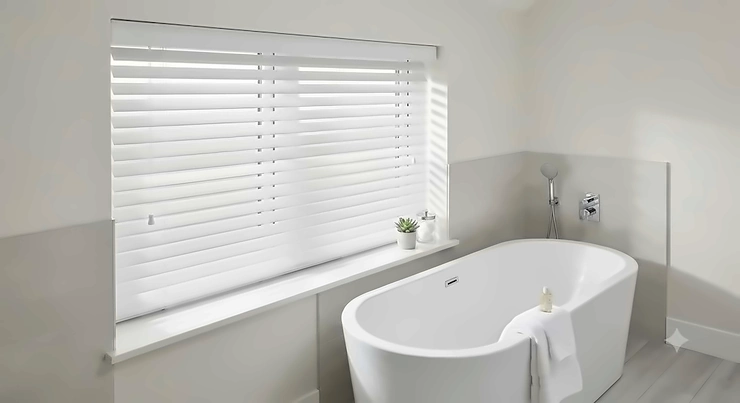
Bathrooms are where good window treatments go to die. Steam rolls off the shower, condensation beads on the glass, and within a year a “nice” wooden blind has cupped, yellowed, or quietly started smelling of damp flannel. That’s the whole reason faux wood blinds for bathroom use exist as a category on their own — they’re built from PVC that laughs off moisture instead of drinking it in. If you’ve ever watched a real wood venetian warp into a shape that no longer closes properly, you’ll understand why this swap matters more than most people think.
This guide digs into what actually separates a decent bathroom blind from one that’ll be in landfill by next winter. We’ve researched seven genuine faux wood options sold through Amazon UK, weighed up their slat sizes, lift mechanisms and finish quality, and paired that with what real buyers say once the novelty wears off. You’ll also find honest comparisons against roller blinds and true wooden venetians, a buyer’s framework for matching a blind to your specific bathroom, and the safety rules every UK household with kids needs to know about cords.
We’re not going to pretend we’ve physically tested every unit in a steamy bathroom over eighteen months — nobody writing an article like this has. What you’re getting instead is a grounded, spec-and-review-based analysis designed to save you from an expensive guessing game.
What Is a Faux Wood Blind for a Bathroom?
A faux wood blind for a bathroom is a horizontal venetian blind with slats made from PVC or a PVC-vinyl composite rather than timber, styled to mimic a wood grain or painted finish. Because the slats are plastic rather than porous wood, they resist water absorption, don’t swell or bow in humid air, and can typically be wiped clean rather than damaged by splashes — making them the go-to humidity proof blind for wet rooms, en-suites and family bathrooms.
Quick Comparison Table
| Product | Slat Size | Lift Type | Best For | Price Range* |
|---|---|---|---|---|
| eXtreme Faux Wood Venetian Blind | 50mm | String, made-to-size | Awkward or non-standard windows | £25–£65 |
| Ruby Deals Faux Wood Venetian Blind | 50mm | Tape or string | First-time buyers on a budget | £15–£35 |
| APEX FURNISHINGS Faux Wood Venetian Blind | 50mm | Tape, trimmable | Daily-use family bathrooms | £20–£45 |
| REHAN & CO Faux Wood Venetian Blind | 50mm | String/tape, aluminium headrail | Small windows and en-suites | £15–£30 |
| Funky Gadgets Faux Wood Venetian Blind | 50mm | String or tape | Colour-matching a bathroom scheme | £15–£38 |
| Aprica Faux Wood Venetian Blind | Shutter-style, trimmable | Twist wand | Renters wanting a shutter look | £30–£70 |
| Home In Style 4U Faux Wood Venetian Blind | 50mm | String, trimmable | Narrow ensuite or WC windows | £15–£32 |
*Approximate, based on smaller widths at the time of research — always check current pricing on the product page, as it varies by size and colour.
Looking at the spread here, most of these sit comfortably in budget-to-mid territory, which tells you something honest about this category: faux wood bathroom blinds aren’t a luxury purchase, they’re a practical fix, and none of these seven demand you remortgage to try one. The eXtreme Faux Wood Venetian Blind and Aprica Faux Wood Venetian Blind creep toward the top of the range mainly because of made-to-measure flexibility and shutter-style styling rather than premium materials. If you’re outfitting more than one window, the REHAN & CO Faux Wood Venetian Blind and Home In Style 4U Faux Wood Venetian Blind are the ones that won’t wreck a multi-window budget.
💬 Ready to stop guessing and start comparing? Scroll down to see exactly which blind fits your bathroom — and your budget.
Top 7 Faux Wood Bathroom Blinds: Expert Analysis
Every product below is a real, currently listed item on Amazon UK. We’ve assessed each on slat construction, lift mechanism, fit-and-finish, and what buyers report once the blind’s been living in a genuinely damp room for a while — not just sitting pretty in a showroom photo.
1. eXtreme Faux Wood Venetian Blind — made-to-your-own-size ordering
What makes the eXtreme Faux Wood Venetian Blind stand out is that it’s genuinely made to your dimensions — you order, then email over your exact width and drop, rather than being boxed into a fixed size chart. The 50mm slats are moulded from a dense, high-grade PVC rather than the thinner plastic you’ll find on the cheapest bargain-bin blinds, and the wood-grain or oak-effect finish holds up better against close inspection than you’d expect for the price. A contoured valance and matching wood-effect tassel round off the look so it doesn’t scream “plastic” from across the room.
Practically, this is the pick for anyone whose bathroom window refuses to match a standard size — dormer windows, older properties, or anything slightly off-square. Reviewers commonly flag the made-to-order process as slower than a same-day dispatch item, but say the accuracy of fit more than makes up for the wait. Based on the spec sheet, the maximum 240cm drop covers all but the tallest bathroom windows, and the string-operated tilt mechanism is simple enough that there’s little to go wrong with repeated damp-hand use.
Pros:
- ✅ Genuinely custom-sized rather than a fixed size chart
- ✅ Dense 50mm PVC slats resist bowing better than thin budget slats
- ✅ Wood-grain valance gives a more finished, less “plastic” look
Cons:
- ❌ Made-to-order turnaround is slower than off-the-shelf options
- ❌ String lift (not the cordless option some parents will prefer)
Expect this one to sit toward the upper end of our comparison range once you factor in a custom size, and it’s worth it if a standard-size blind simply won’t fit your window.
2. Ruby Deals Faux Wood Venetian Blind — best budget starter pick
The Ruby Deals Faux Wood Venetian Blind is the sort of blind you buy when you just need the job done without ceremony. Its 50mm PVC slats are available with either a grey or white tape trim, which does a decent job of hiding the string mechanism and giving it a slightly more considered look than a bare-string budget blind. As a straightforward horizontal venetian, it’s built to the same core formula as most faux wood blinds on this list — vinyl slats, aluminium headrail, trimmable width.
Where it earns its keep is honesty about what it is: an affordable, no-frills waterproof wood effect blind rather than a design statement. Reviewers who buy these tend to be furnishing a second bathroom, a rental, or a first flat, and the recurring theme in feedback is that it does the basic job — privacy, light control, a wipe-clean surface — without fuss. The trade-off, as with most budget faux wood blinds, is that the vinyl is thinner than the pricier options, so it can feel slightly less rigid at the very largest widths.
Pros:
- ✅ Genuinely low price point for a full faux wood venetian
- ✅ Tape-trim option looks tidier than a bare-string budget blind
- ✅ Straightforward trimmable design fits most standard windows
Cons:
- ❌ Slats feel thinner than premium faux wood ranges
- ❌ Limited colourway choice compared with pricier competitors
At this price bracket, it’s hard to argue with the value — just don’t expect the same heft as a made-to-measure premium range.
3. APEX FURNISHINGS Faux Wood Venetian Blind — sturdiest headrail for daily use
The APEX FURNISHINGS Faux Wood Venetian Blind leans into build quality more than most budget alternatives, with an aluminium headrail that reviewers describe as noticeably more rigid than the lightweight versions bundled with cheaper blinds. That matters more than it sounds: a flimsy headrail is usually the first thing to sag or twist on a blind that gets opened and closed multiple times a day, which is exactly the usage pattern in a family bathroom.
The 50mm slats come in a white tape finish that suits most bathroom colour schemes without fighting for attention, and the trimmable width means you’re not stuck if your window falls between standard sizes. Based on the spec comparison with the rest of this list, this is one of the better choices if your bathroom blind is going to be adjusted constantly — kids opening it for daylight, someone closing it for privacy, that daily churn. What most buyers overlook about this model is that the tape trim does double duty: it hides the lift strings from view and adds a bit of extra structural tension across the slats, which helps keep them sitting flat over time.
Pros:
- ✅ Sturdier aluminium headrail than typical budget alternatives
- ✅ Tape trim hides strings and helps slats sit flat
- ✅ Trimmable to fit non-standard bathroom window widths
Cons:
- ❌ White tape only, limited styling versatility
- ❌ Sits mid-price rather than genuinely bargain-bin
For a blind that’s going to earn its keep through heavy daily use, this is one of the safer bets on this list.
4. REHAN & CO Faux Wood Venetian Blind — lightest option for small windows
Small windows need small solutions, and the REHAN & CO Faux Wood Venetian Blind is built with exactly that in mind. Its 50mm slats sit on an aluminium headrail, available with either a string or tape lift, and the whole unit is genuinely lightweight — which matters more than people expect on a compact en-suite or WC window where a heavier blind can look and feel disproportionate to the frame.
What the spec sheet won’t tell you, but common sense (and user reports) will, is that faux wood blinds get heavier and stiffer to operate as they scale up in width — so a blind engineered around smaller dimensions tends to feel smoother and more responsive than a big blind cut down. This is the pick for a downstairs loo, a small en-suite shower room, or a narrow bathroom window where you want the moisture-resistant wood look blind aesthetic without an oversized headrail dominating a tiny frame. Feedback from buyers in this size bracket tends to focus on ease of installation more than anything else — brackets and fittings are included, and the trimmable design forgives minor measuring errors.
Pros:
- ✅ Lightweight build suits small or narrow bathroom windows
- ✅ Choice of string or tape lift depending on preference
- ✅ Child-safe fittings included as standard
Cons:
- ❌ Less suited to wide or oversized bathroom windows
- ❌ Colour range narrower than some competitors
If your bathroom window is more “porthole” than “picture window,” this is the most sensibly proportioned pick on the list.
5. Funky Gadgets Faux Wood Venetian Blind — best colour and finish choice
Where the Funky Gadgets Faux Wood Venetian Blind pulls ahead is sheer choice — smooth white slats, silver-grey tape trims, and string or tape lift combinations that let you actually match a bathroom’s colour scheme instead of settling for “the white one they had in stock.” The 50mm slats use the same waterproof PVC construction as the rest of this list, with an aluminium headrail and PVC valance/fascia that’s roughly a centimetre wider than the blind body, designed to fully conceal the headrail and fittings for a cleaner finish.
Honest analysis here: this isn’t a blind that’s reinventing bathroom window dressing, but the styling flexibility is genuinely useful if you’re trying to tie a blind into tiles, paintwork or a specific colour palette rather than just “getting a blind sorted.” Reviewers who’ve bought multiple variants from this range note that the fit-and-finish is consistent across colourways, which isn’t always true of budget blinds where the premium shade sometimes gets a cheaper build. Installation follows the same top, face or outside-fix flexibility as competitors, and the trimmable design covers most standard bathroom window widths without needing a custom order.
Pros:
- ✅ Widest colour and tape combination choice on this list
- ✅ Valance is sized to fully hide the headrail and fittings
- ✅ Consistent build quality reported across different colourways
Cons:
- ❌ More decision-making required at checkout (colour/lift combos)
- ❌ Still a manual string/tape lift, not motorised
If matching your bathroom’s palette matters to you as much as function, this is the most flexible choice here.
6. Aprica Faux Wood Venetian Blind — easiest trim-to-fit shutter style
The Aprica Faux Wood Venetian Blind takes a slightly different approach, styled closer to a shutter with string-joined faux wood slats rather than a standard tape-trimmed venetian. It’s finished in white, designed for home office or bedroom use as much as bathrooms, but the same waterproof PVC construction makes it a solid pick for a wood look bathroom blind if you want something a touch more architectural than a basic venetian.
The standout practical feature is how easily it trims down — for renters or anyone likely to move house and reuse a blind elsewhere, being able to cut a wider blind down to a smaller window without buying a whole new unit is a genuine cost-saver over time. Based on the spec comparison, the string-joined slats sit slightly differently to taped slats, giving a marginally more uniform, “shutter panel” look when closed, which some buyers prefer aesthetically even though it offers no functional advantage over tape in terms of waterproofing. What reviewers note most is that the trim-to-fit process, while straightforward, does need a careful hand and the right tools to avoid uneven edges.
Pros:
- ✅ Trims down easily for reuse across different window sizes
- ✅ Shutter-style closed look suits a more architectural bathroom
- ✅ Waterproof PVC construction matches purpose-built bathroom blinds
Cons:
- ❌ DIY trimming needs a careful hand to avoid uneven cuts
- ❌ Less “finished” out of the box than a made-to-size blind
For renters and serial movers, the ability to resize this blind for a future home is worth the slightly higher price tag.
7. Home In Style 4U Faux Wood Venetian Blind — best for narrow en-suite windows
Rounding out the list, the Home In Style 4U Faux Wood Venetian Blind is a straightforward 50mm horizontal venetian with a string lift and trimmable width, built for exactly the kind of narrow window you find in an en-suite or a small cloakroom. Its child-safe cord fittings and easy-fit hardware make it a sensible, no-nonsense choice for anyone who wants a wood-look finish without navigating a dozen customisation options.
The straightforward string design keeps the price accessible while still delivering the core promise of any faux wood bathroom blind: slats that won’t warp, crack or discolour from repeated exposure to steam. Reviewers buying for narrow bathroom windows tend to report that the trimmable width does exactly what it says on the tin, provided you measure carefully and follow the included instructions. It won’t win any styling awards next to the tape-trimmed options further up this list, but as a humidity proof blind for a small, high-moisture space, it does the fundamentals well.
Pros:
- ✅ Purpose-sized for narrow en-suite and cloakroom windows
- ✅ Child-safe cord fittings included as standard
- ✅ Simple trimmable design keeps installation straightforward
Cons:
- ❌ Basic string-only lift, no tape-trim option
- ❌ Narrower colour range than the mid-range picks on this list
For a compact bathroom window where budget matters more than styling flourishes, this is a sensible, low-risk pick.
Practical Usage Guide: Fitting, Cleaning and Getting the Most from Your Blind
Getting a faux wood blind to actually perform well in a bathroom starts before you even open the box. Measure the recess width at three points — top, middle, bottom — because older window frames are rarely perfectly square, and use the smallest measurement if you’re fitting inside the recess. Most of the products above are trimmable, so buying slightly oversized and cutting down is far safer than ordering too small and having gaps at the edges where steam and condensation can creep behind the blind.
Once fitted, a monthly wipe-down with a damp cloth (no harsh chemicals needed) keeps the PVC slats free of the soap-scum film that builds up in a bathroom faster than anywhere else in the house. In the first 30 days, the most common mistake is over-tightening the tilt mechanism trying to get a “perfect” close — faux wood slats have some flex built in, and forcing them can strain the ladder strings prematurely. Give the cords a gentle tug-test every few months, and keep the headrail dust-free, since a build-up there is what usually makes tilting feel stiff over time, not the slats themselves.
Real-World Scenarios: Which Blind Suits Your Bathroom?
If you’re renting a one-bedroom flat with a small en-suite and a landlord who won’t sanction drilling for anything permanent, a lightweight, easily trimmed option like the Home In Style 4U Faux Wood Venetian Blind or the REHAN & CO Faux Wood Venetian Blind makes sense — cheap enough to leave behind, light enough not to strain basic brackets.
For a busy family bathroom used by three kids before school, durability under constant handling matters more than styling. The APEX FURNISHINGS Faux Wood Venetian Blind‘s sturdier headrail is built for exactly that kind of daily churn, where a flimsier blind would sag within a year.
If you’re doing up a wet room or shower room where the window sits closer to direct spray, prioritise the waterproof PVC construction all seven share, but lean toward blinds with simpler mechanisms and fewer fabric-adjacent parts — a plain trimmable venetian like the Ruby Deals Faux Wood Venetian Blind avoids any complications that tape trims can occasionally introduce in a genuinely wet room window treatment scenario.
Buyer’s Decision Framework
If your window is a non-standard or awkward shape, choose a made-to-size option like the eXtreme Faux Wood Venetian Blind, because a fixed-size chart simply won’t fit properly and gaps let moisture behind the blind.
If your budget is the main constraint and the bathroom is low-traffic, choose a straightforward budget pick like the Ruby Deals Faux Wood Venetian Blind or Home In Style 4U Faux Wood Venetian Blind, because you don’t need to pay for features you won’t use.
If the blind will be adjusted multiple times daily by a busy household, choose a reinforced-headrail option like the APEX FURNISHINGS Faux Wood Venetian Blind, because cheaper headrails sag under repeated handling.
If you might move home within a couple of years, choose an easily resized option like the Aprica Faux Wood Venetian Blind, because trimming it down for a new window saves buying twice.
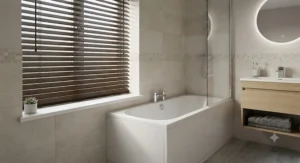
How to Choose Faux Wood Blinds for Bathroom
Choosing the right faux wood blinds for bathroom windows comes down to a handful of decisions that matter more than colour or brand name:
- Confirm it’s genuinely waterproof PVC, not just “moisture resistant.” These terms get used loosely — check the listing specifically states waterproof or 100% PVC construction.
- Measure three points on the window, not one. Older frames are rarely square, and the smallest measurement should guide your order.
- Decide on lift type based on who uses the bathroom. Cordless or child-safe fittings matter far more where young children are present.
- Match slat size to window size. 50mm slats suit most standard bathroom windows; narrower slats can look fussy on large panes.
- Check the headrail material. Aluminium headrails resist sagging better than basic plastic ones under daily use.
- Factor in trimmability. A trimmable blind forgives measuring errors and adapts if you move house.
- Read aggregated review themes, not star ratings alone. Look for recurring comments about slat rigidity, colour accuracy and ease of fitting.
Common Mistakes When Buying Faux Wood Bathroom Blinds
The single most common error is buying based on the drop measurement alone and ignoring width variance across the frame — a blind that’s a perfect width at the top of an old sash window can bind halfway down. A close second is assuming “faux wood” automatically means fully waterproof; some ranges use the term loosely for moisture-resistant rather than fully submersible slats, so it pays to check the specific listing wording rather than the category name.
Buyers also frequently underestimate how much a corded lift matters in a household with small children, retrofitting safety devices after the fact rather than checking the British Blind and Shutter Association’s safety guidance and choosing a cordless or properly tensioned option from the start. Finally, going for the cheapest available slat thickness on a very wide window is a false economy — thinner PVC bows more under its own weight at scale, something reviewers consistently flag on oversized budget blinds.
Faux Wood Blinds vs Waterproof Roller Blinds and Bathroom Venetian Blinds
Faux wood bathroom venetian blinds and waterproof roller blinds solve the same core problem — surviving steam — but in different ways. A roller blind is a single sheet of PVC or vinyl-coated fabric, which means fewer moving parts and, generally, an easier wipe-clean surface with nowhere for grime to collect between slats. That makes it the simpler choice for a small, heavily used shower room where minimal maintenance is the priority.
Faux wood bathroom venetian blinds, on the other hand, offer adjustable light and privacy control that a roller blind can’t match — you can angle the slats for privacy while still letting daylight in, rather than the binary open-or-closed nature of a roller. The trade-off is that slats need occasional dusting between the gaps, and a corded tilt mechanism (unless cordless) needs the same child-safety consideration. Against genuine solid wood blinds, the comparison is more one-sided for bathrooms specifically: real wood absorbs moisture and can warp, crack or discolour within a season of steady humidity, whereas faux wood’s PVC construction simply doesn’t have that vulnerability. If style is the only reason you’re drawn to real wood, a wood-grain faux finish gets you 90% of the aesthetic with none of the warping risk.
What to Expect: Real-World Performance in Humid, Steamy Bathrooms
On paper, waterproof PVC slats sound bulletproof, and largely they are — but real-world performance depends on ventilation as much as the blind itself. In a bathroom with a working extractor fan and reasonable airflow, faux wood slats typically show no visible change after a year or more of regular showers. In a poorly ventilated room where steam lingers and condensation pools on the glass for long periods, even waterproof slats can develop a slight film that needs more frequent wiping, and the cords or tapes (rather than the slats themselves) are usually the first part to show wear.
Expect the tilt mechanism to feel smooth for the first several months, then potentially stiffen slightly as dust and residual soap-scum accumulate in the headrail — a five-minute clean typically restores it. Reviewers across most of the ranges above consistently note that colour retention is strong; unlike some cheaper fabric roller blinds, faux wood’s pigmented PVC doesn’t visibly fade or yellow from steam exposure the way real wood can from repeated damp-dry cycling.
Features That Actually Matter (And Those That Don’t)
Waterproof PVC construction, a sturdy aluminium headrail, and child-safe lift fittings actually matter — these are the three features that determine whether a blind survives a bathroom long-term and stays safe in a family home. Trimmability matters more than most buyers initially rate it, because it’s your safety net against a mismeasured window.
What matters far less than the marketing suggests: elaborate decorative tape colour options and “designer” branding rarely change the functional performance of the blind underneath, since most faux wood ranges share very similar PVC slat formulations. Similarly, ultra-premium valance styling looks nice in a listing photo but has no bearing on how well the blind copes with steam — that’s entirely down to slat material, not the trim around the headrail.
Long-Term Cost & Maintenance
Faux wood blinds for bathroom use are, refreshingly, one of the lower total-cost-of-ownership window treatments available. A one-off purchase in the ranges shown in our comparison table typically lasts several years with nothing more than occasional wiping, compared with real wood blinds that may need replacing entirely once warping sets in, or fabric roller blinds that can show sun-fade or mildew staining sooner in a humid room. There are no ongoing costs — no batteries, no motors, no specialist cleaning products — beyond the very occasional replacement of a worn lift cord, which is a low-cost fix rather than a full blind replacement.
Where cost differences do show up is in slat thickness and headrail quality: cheaper, thinner-slat blinds may need replacing sooner if used on wide windows, making a slightly higher upfront spend on a sturdier option like the APEX FURNISHINGS Faux Wood Venetian Blind arguably better value per year of use, even if the initial price looks less attractive.
Safety, Regulations and Child-Safety Compliance
Since February 2014, all internal blinds sold in the UK — including faux wood venetians — must comply with child safety standards covering cords, chains and safety devices, following safety requirements adopted into UK law to address strangulation risks to young children. In practice, this means any corded blind you buy today should come fitted with cleats, cord tidies, or breakaway connectors designed to stop a looped cord from forming a hazard, and it’s worth applying that thinking to whichever room a blind ends up in.
Beyond cord safety, bathroom-specific considerations matter too. Poor ventilation is the real driver of condensation-related mould risk in bathrooms, and the NHS advises using extractor fans and keeping windows on the latch after bathing to reduce moisture build-up — steps that also help your blind last longer, since less ambient humidity means less residue on the slats over time. A humidity proof blind reduces one risk factor, but it isn’t a substitute for basic bathroom ventilation.
👉 Fancy browsing the full range before you commit? Take a look at today’s bathroom blind deals and compare finishes side-by-side.
FAQ
❓ Are faux wood blinds actually waterproof or just water-resistant?
❓ Can you put faux wood blinds in a shower or wet room?
❓ Do faux wood blinds need special cleaning products?
❓ Are faux wood blinds safe for bathrooms used by children?
❓ How long do faux wood blinds typically last in a bathroom?
Conclusion
A faux wood blind is one of the few bathroom upgrades that’s genuinely low-risk: it’s affordable, it solves a real problem, and it won’t leave you nursing a warped, mouldy mess a year down the line the way real wood often does. Whether you land on the made-to-size flexibility of the eXtreme Faux Wood Venetian Blind, the no-nonsense value of the Ruby Deals Faux Wood Venetian Blind, or the reinforced daily-use build of the APEX FURNISHINGS Faux Wood Venetian Blind, the underlying logic is the same — PVC slats built specifically to shrug off steam, condensation and splashes.
The real decision isn’t really about picking a “best” product from this list; it’s about matching the blind’s strengths to your bathroom’s actual conditions — window size, ventilation, and who’s using the room day to day. Get that match right, and a faux wood blind is one purchase you genuinely won’t have to think about again for years.
Recommended for You
- Faux Wood Venetian Blinds UK: 7 Best Picks for 2026
- Wooden Venetian Blinds for Living Room: 7 Best Picks 2026
- Wooden Venetian Blinds UK: 7 Best Real Wood Picks (2026 Guide)
Disclaimer: This article contains affiliate links. As an Amazon Associate, I earn from qualifying purchases. If you purchase products through these links, we may earn a small commission at no additional cost to you.
✨ Found this helpful? Share it with your friends! 💬🤗
