
In This Article
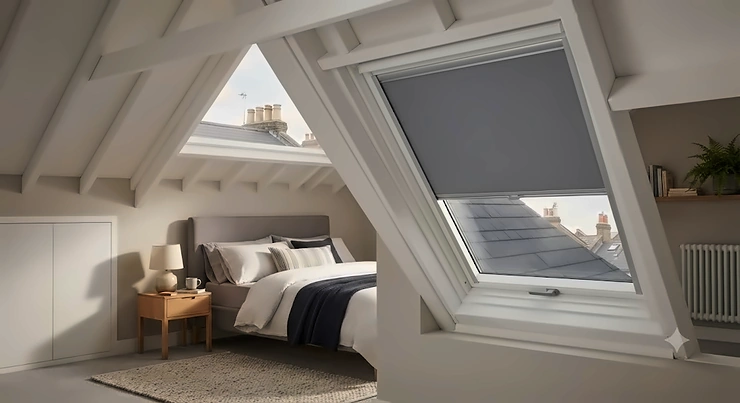
There’s a particular kind of 6am betrayal that only loft-bedroom owners understand: the sun, apparently unaware that it’s a Tuesday, comes barrelling straight through your ceiling window and lands on your face like a searchlight. If you’ve ever lain there squinting, wondering why nobody warned you that skylights turn bedrooms into greenhouses, you’re exactly who this guide is for. Velux window blinds are the fix — but “just buy a blind” undersells how many genuinely different products hide behind that phrase.

What is a Velux window blind? It’s a made-to-fit shade — roller, pleated or cellular — built specifically for the angled reference codes stamped on Velux and Velux-compatible roof windows, sold either as a genuine Velux product or as a certified compatible alternative, and used to control light, heat and privacy in loft rooms.
That’s the textbook version. In practice, choosing between a genuine £180 solar-powered blackout blind and a £25 budget roller depends entirely on your room, your window’s reach, and whether you’re trying to sleep through a July sunrise or just stop your laptop screen glaring at 2pm. Below, I’ve pulled together seven real products spanning cheap-and-cheerful to fully motorised, plus the comparison logic, buying pitfalls and setup advice that most listings skip entirely. The VELUX brand itself has been making roof windows since 1942, and that history matters here — it’s why the sizing codes on your window frame are so specific, and why “compatible” blinds have to work so hard to match that fit.
Quick Comparison: Velux Window Treatment Options at a Glance
Before diving into the full breakdown, here’s the shape of the market. This table covers the seven products in this guide, sorted loosely from budget to premium.
| Product | Type | Operation | Best For |
|---|---|---|---|
| VELUX Original Blackout Blind (DKL) | Roller, budget genuine | Manual | Renters wanting genuine-brand fit cheaply |
| Itzala Basic Blackout Roller Blind | Roller, third-party | Manual | Absolute lowest cost |
| VELUX Original Blackout Blind, Grey Rail | Roller, premium genuine | Manual | Best blackout performance |
| VELUX Blackout Energy Pleated Blind | Pleated, dual-fabric | Manual | Thermal insulation + dimming flexibility |
| Itzala Pleated Blackout Blind | Pleated, third-party | Manual | Pleated look on a mid budget |
| VELUX Original Solar Blackout Roller Blind (DSL) | Roller, solar-electric | Remote/app | Out-of-reach windows, smart homes |
| Moonice Cordless Honeycomb Blind | Cellular, custom-cut | Manual, cordless | Non-standard or non-Velux roof windows |
A few things jump out here. Manual roller blinds still dominate the affordable end of the market, and for good reason — they’re the simplest mechanism to manufacture and the cheapest to fit, which keeps the entry price low. The moment you want thermal performance or hands-free operation, though, the jump in price is real, and it’s driven by material engineering (the honeycomb air-pocket structure) or by motors and rechargeable cells rather than marketing markup. If your window is within arm’s reach and your main goal is a dark bedroom, you genuinely don’t need to spend premium money — but if the window sits over a stairwell or a vaulted ceiling, the solar option stops being a luxury and starts being the only practical choice.
💬 Found a blind that fits your window? Tap through to check today’s price and availability.🤗
Top 7 Velux Window Blinds: Expert Analysis
Every product below is real, currently listed, and matched against the reference codes printed on the little silver plate at the top of your window sash. Measure that code before you buy anything — it’s the single most common source of returns in this category, and no amount of good marketing photography fixes the wrong size.
1. VELUX Original Blackout Blind (DKL) — cheapest genuine-brand entry point
The VELUX Original Blackout Blind (DKL) is the manufacturer’s own budget line, built for reference codes such as GGL M04, GGU M04, GHL C04 and GPU M08, and it’s the blind most people land on when they just want something that fits properly without paying premium prices. The fabric delivers what Velux itself describes as an “almost complete” blackout rather than the total-darkness claim reserved for the grey-rail range, and it’s operated manually via stepless positioning, meaning you can stop it at any point on the glass rather than only fully up or fully down. Side channels keep the fabric tracking straight, and the pre-fitted mounting brackets mean most people are done in under fifteen minutes with a screwdriver.
Who should buy this: anyone prioritising genuine-brand compatibility over ultimate blackout performance — landlords fitting multiple rooms, first-time buyers testing whether a blackout blind even solves their glare problem, or anyone who wants the peace of mind of an official Velux part number rather than a third-party guess. Reviewers consistently report that the “almost complete” blackout claim is honest rather than optimistic — some residual light leaks around the edge channels, particularly on brighter mornings, which matters if you’re a shift worker needing total darkness at odd hours.
Pros:
- ✅ Genuine Velux part number guarantees exact fit
- ✅ Stepless positioning holds anywhere on the glass
- ✅ Fifteen-minute install with pre-fitted brackets
Cons:
- ❌ Not full blackout — some edge light leaks through
- ❌ Manual only, awkward for high or vaulted windows
The VELUX Original Blackout Blind (DKL) typically sits in the low-to-mid price bracket — think under £65 depending on window size — and at that price, for a genuine-brand roller blind, it’s hard to argue with the value.
2. Itzala Basic Blackout Roller Blind — best for absolute rock-bottom budgets
If price is the only variable that matters, the Itzala Basic Blackout Roller Blind is the answer. It’s built from a polyester and UV-resistant rubber fabric composite specifically engineered to undercut Velux’s own pricing while still fitting the same reference-code system, and it slides within a slim aluminium side profile rather than the chunkier guide rails used on genuine products. Based on the spec comparison, the trade-off is mostly cosmetic and tactile rather than functional — the fabric feels noticeably thinner in hand, and the aluminium trim is a shade less refined, but the core blackout mechanism performs a genuinely comparable job for a fraction of the outlay.
Reviewers consistently note that installation, while described as tool-free by the listing, can require a bit of patience aligning the bracket clips — several buyers mention needing “three hands” for the first attempt, though repeat installs go faster. What most buyers overlook about budget compatible blinds like this one is that they’re an excellent low-risk way to test whether a blackout blind actually solves your specific glare or light problem before committing to a premium genuine product elsewhere in the room.
Pros:
- ✅ Lowest price point in the entire category
- ✅ Five colour options to suit different interiors
- ✅ Genuinely near-complete darkness for the price
Cons:
- ❌ Thinner fabric feels less premium than genuine Velux
- ❌ First-time fitting can be fiddly without a helper
Expect the Itzala Basic Blackout Roller Blind to land somewhere in the £20-£35 range, making it comfortably the cheapest entry on this list — a genuinely sensible pick for a spare room, box room or short-term let.
3. VELUX Original Blackout Blind, Grey Guide Rail — best for true total darkness
Step up to the VELUX Original Blackout Blind, Grey Guide Rail and you’re paying for the difference between “almost complete” and genuinely total blackout. This is the range built with OEKO-TEX Standard 100 certified fabric — meaning it’s been independently tested for harmful substances — combined with a three-layer construction that includes a heat-reflecting aluminium coating on the reverse. That coating isn’t just about darkness; it’s doing double duty by bouncing summer heat back out through the glass rather than letting it soak into the fabric and radiate into the room overnight.
What most listings won’t tell you is that the grey guide rails aren’t purely aesthetic — they’re a slightly deeper channel than the standard white-rail version, which is what allows the thicker three-layer fabric to run without snagging. Based on the spec comparison against the entry-level DKL blind above, this is the version to choose if you’re fitting a bedroom for a shift worker, a nursery, or a home cinema room where genuine total darkness — not “almost” — is the whole point of the purchase.
Pros:
- ✅ OEKO-TEX certified fabric, genuinely total blackout
- ✅ Heat-reflecting coating helps with summer solar gain
- ✅ Deeper guide rails handle thicker fabric smoothly
Cons:
- ❌ Noticeably pricier than the standard DKL range
- ❌ Manual operation only on most window sizes
Price-wise, expect the VELUX Original Blackout Blind, Grey Guide Rail to sit in roughly the £65-£95 range — a fair jump over the entry blind, but justified if total darkness is non-negotiable for you.
4. VELUX Blackout Energy Pleated Blind — best for combined blackout and dimming flexibility
The VELUX Blackout Energy Pleated Blind solves a problem that pure roller blinds can’t: what if you want full blackout at night but a softer, semi-opaque dimming option during the day? This model combines a classic blackout fabric with a second, semi-opaque pleated layer in the same unit, held in a waterproof aluminium honeycomb structure that Velux states delivers up to 25% insulation against cold. Reviewers consistently report that the pleated construction feels noticeably more premium in operation — smoother glide, quieter mechanism — than the flat roller alternatives above, though that’s partly a function of the higher price point buying better components.
The honeycomb structure is the real differentiator here, and it’s worth explaining why it matters rather than just listing it as a spec. Trapped air pockets within the pleats act as an insulating buffer, similar in principle to double glazing, which is why this model pulls double duty as both a light-control blind and a modest thermal upgrade for a loft room that tends to lose heat through the glass in winter. It’s not a replacement for proper window insulation, but as a bolt-on improvement it’s measurable.
Pros:
- ✅ Dual blackout and semi-opaque fabric in one unit
- ✅ Honeycomb structure adds real thermal insulation
- ✅ Wide colour range to match different interiors
Cons:
- ❌ Among the pricier manual options on this list
- ❌ More moving parts than a simple roller blind
The VELUX Blackout Energy Pleated Blind generally sits in the £95-£140 bracket, making it a premium manual pick — genuinely justified if winter heat loss through your roof window bothers you as much as summer glare.
5. Itzala Pleated Blackout Blind — best mid-range pleated alternative
For buyers who like the pleated dual-fabric concept above but balk at the genuine-brand price tag, the Itzala Pleated Blackout Blind offers a comparable structure at a noticeably lower cost. It follows the same principle — blackout fabric paired with a lighter dimming layer, run through a honeycomb-style pleat — built to fit the same reference-code sizing system as genuine Velux windows. What the spec sheet won’t tell you, but the pattern across third-party pleated blinds generally suggests, is that the fabric weight tends to be marginally lighter than genuine Velux pleats, which can very slightly reduce the thermal benefit without meaningfully affecting the blackout performance.
Based on the spec comparison with the genuine pleated model above, this is the sensible middle path for anyone who wants the flexibility of dual fabric without paying full genuine-brand premium — particularly useful in a second bedroom or home office where the thermal insulation matters less than simply having a “soft daylight” daytime setting alongside a proper night-time blackout.
Pros:
- ✅ Dual blackout and dimming fabric at a lower price
- ✅ Same reference-code compatibility as genuine Velux
- ✅ Good middle ground between budget and premium
Cons:
- ❌ Slightly lighter fabric weight than genuine pleated blinds
- ❌ Smaller colour range than the genuine equivalent
Typical pricing for the Itzala Pleated Blackout Blind falls around the £55-£80 mark — roughly half the genuine pleated equivalent for most of the practical benefit.
6. VELUX Original Solar Blackout Roller Blind (DSL) — best for out-of-reach or smart-home windows
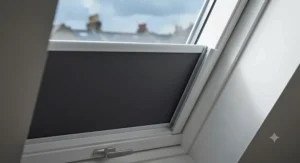
Once a roof window sits above a stairwell, over a kitchen island, or anywhere else you genuinely cannot reach with an arm and a control rod, manual blinds stop being an option and the VELUX Original Solar Blackout Roller Blind (DSL) becomes the practical answer rather than a luxury upgrade. It’s powered by a built-in solar cell that Velux rates for up to 600 operations even during stretches with no direct sunlight to recharge it, and it’s controlled via a wireless wall switch — with the option to fold it into the wider Velux ACTIVE smart-home ecosystem for scheduled or app-based operation. Compatibility is worth flagging clearly: this only fits Velux INTEGRA electric, solar or manual roof windows, not every reference code on the market, so double-check your window type before buying.
Here’s what to weigh: the solar mechanism removes any need for mains wiring, which keeps installation to roughly the same fifteen-minute bracket job as the manual blinds above — you’re not calling an electrician. But you are paying a significant premium for that convenience, and the trade-off is a slightly bulkier headrail housing the motor and solar panel, which some buyers find less discreet than a slim manual roller. For a genuinely out-of-reach window, though, there simply isn’t a comparably priced manual alternative that solves the access problem.
Pros:
- ✅ No wiring needed — solar cell handles charging
- ✅ Wireless switch or full smart-home app control
- ✅ Ideal for windows genuinely out of arm’s reach
Cons:
- ❌ Only compatible with INTEGRA-type roof windows
- ❌ Significantly pricier than any manual blind here
Expect to pay somewhere in the £170-£230 range for the VELUX Original Solar Blackout Roller Blind (DSL) — a genuine premium purchase, but one that’s solving an access problem money can’t otherwise fix.
7. Moonice Cordless Honeycomb Blind — best for non-standard or non-Velux roof windows
Not every roof window carries a tidy Velux reference code, and that’s exactly the gap the Moonice Cordless Honeycomb Blind fills. Rather than being manufactured to fixed size codes, it’s made to order across a custom width range and a maximum height of around 240cm, built around an aluminium alloy frame with a genuine honeycomb cellular structure designed to block UV and provide meaningful thermal insulation. Operation is cordless throughout — a push-pull telescopic rod (sold separately) moves the blind up and down and holds it at any position — which sidesteps the child-safety cord concerns that apply to older corded blind designs entirely.
What most buyers overlook about custom-cut compatible skylight blinds like this one is that they’re often the only realistic option for older houses, converted lofts, or non-Velux rooflights where the window manufacturer either no longer trades or never used a standardised code system in the first place. Reviewers consistently note that measuring precisely matters enormously here — Moonice’s own guidance recommends deducting a small margin from your measured width and height to avoid installation interference, and getting that wrong is the main source of dissatisfaction in the aggregated review sentiment.
Pros:
- ✅ Made-to-order sizing fits non-standard windows
- ✅ Genuine honeycomb structure aids thermal insulation
- ✅ Cordless operation removes child-safety cord risk
Cons:
- ❌ Custom sizing means no same-day availability
- ❌ Measuring mistakes are the buyer’s responsibility
Pricing for the Moonice Cordless Honeycomb Blind varies with size, but expect somewhere between £40 and £110 for most standard loft-window dimensions — solid value once you factor in that it’s solving a fitting problem the Velux-coded competitors above simply can’t.
Practical Usage Guide: Measuring, Fitting and Maintaining Velux Replacement Blinds
Getting the right velux replacement blinds starts before you open a single listing. Find the reference code on the metal plate on the inside of the window frame — it’s usually two codes together, a window type (GGL, GGU, GHL) followed by a size (M04, C02, P10), and every genuine and compatible blind on the market is sold against that exact pairing rather than a tape-measure dimension. Getting this code wrong is, by a wide margin, the single most common reason people end up returning a blind that “should” have fitted.
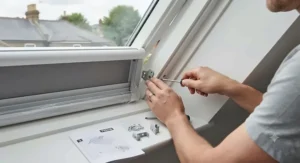
Once it arrives, fitting a roller-style blind is usually a fifteen-minute job: clip the pre-fitted brackets onto the existing frame lugs, slide the fabric roller into place, and check the side channels track smoothly through their full range before tightening anything down. Pleated and honeycomb blinds add one extra step — securing both top and bottom rails, since the fabric needs anchoring at each end to hold its accordion shape.
For the first thirty days, the two most common mistakes are over-tightening the side-channel screws (which can bind the fabric and cause premature wear) and forgetting to wipe down the tracks before first use, since a light dust film from transit can make a new blind feel stiffer than it actually is. After that, maintenance is minimal: an occasional wipe of the aluminium rails with a damp cloth, and for solar models, keeping the small panel free of dust so the charge cycle stays efficient.
✨ Ready to sort your loft room once and for all?
🔍 Browse the full range above and pick the fit that matches your window code — every product here installs in minutes, not hours.
Real-World Scenarios: Matching Blinds to Your Household
Consider three households facing the exact same “sun through the ceiling” problem with very different budgets and constraints.
A student renting a converted loft room, working with a tight deposit-friendly budget and a window well within reach, is squarely the audience for the Itzala Basic Blackout Roller Blind. It solves the actual problem — glare and early wake-ups — without any drilling, and it’s cheap enough to leave behind or take with them at the end of a tenancy.
A family with a toddler and a nursery under a roof window has different priorities entirely: total darkness for consistent naps, genuine child-safety cord compliance, and fabric that’s been independently tested. That combination points squarely at the VELUX Original Blackout Blind, Grey Guide Rail, backed by its OEKO-TEX certification and near-total blackout claim.
A homeowner with a vaulted stairwell skylight fifteen feet off the ground has a fundamentally different problem — access, not budget — and no manual blind on this list solves it. That’s the exact scenario the VELUX Original Solar Blackout Roller Blind (DSL) exists for, since the wireless control removes the need to physically reach the window at all.
Problem → Solution: Fixing Common Velux Blind Issues
Problem: light still leaks around the edges of a “blackout” blind. This is almost always a fitting issue rather than a fabric fault — check that the side channels are seated flush against the frame, and consider stepping up from a standard blind like the entry-level DKL to the grey-rail version, whose deeper channel design reduces edge gaps.
Problem: the room still overheats even with the blind down. A standard blackout fabric blocks light but not necessarily heat. The VELUX Blackout Energy Pleated Blind and the Moonice Cordless Honeycomb Blind both use trapped-air structures specifically to address this, and reflect gov.uk’s own general summer-heat guidance to close blinds on sun-facing windows during the day as a first line of defence against an overheating home.
Problem: the blind won’t hold its position and slides back down. This usually points to a worn or slightly misaligned side-rail tension mechanism rather than a design flaw — most manufacturers, including Itzala, note this as a settling-in issue that resolves after the first few operations as the fabric beds into the channel.
Problem: my window doesn’t match any listed reference code. This is precisely the gap a made-to-order option like the Moonice Cordless Honeycomb Blind is designed to close, since it’s cut to your measurements rather than a fixed code.
How to Choose Blinds for Velux Roof Windows
- Find your exact reference code first. Everything else is secondary — the code on your window frame determines which products will physically fit, full stop.
- Decide how dark you actually need the room. “Almost complete” blackout suits most living spaces; genuine total darkness matters more for shift workers, nurseries and home cinemas.
- Check whether the window is within reach. If not, manual blinds simply aren’t a realistic option regardless of price, and a solar or electric model becomes the sensible default.
- Weigh thermal performance against budget. Pleated and honeycomb structures cost more but genuinely reduce heat loss and solar gain — worth it in a room you use year-round.
- Confirm child-safety compliance if relevant. Any household with children under 42 months should prioritise cordless designs or confirm cord-retainer compliance before buying.
- Match colour and finish to the room, not just the window. Guide rail colour (white vs grey) is often overlooked but visibly affects how the blind sits against your ceiling.
- Read aggregated review sentiment, not just star ratings. Recurring complaints about fitting difficulty or fabric thinness tell you far more than an average score alone.
Velux Compatible Blinds vs Genuine VELUX Blinds
This is the comparison most buyers actually need to make, and it’s rarely explained honestly. Genuine Velux blinds are manufactured and warrantied directly by the brand behind the window system itself, which means the fit tolerances, fabric certification (OEKO-TEX Standard 100) and mounting hardware are all engineered against the exact same reference-code specifications as the window. Velux compatible blinds — like the Itzala and Moonice products in this guide — are made by third parties to match those same published dimensions, generally at a lower price point, without the direct brand backing.
In practice, the performance gap is smaller than the price gap suggests. Based on the spec and review comparison across this guide, compatible blinds handle the core job — blocking light, fitting the frame — competently, and the aggregated complaints tend to cluster around fabric feel and fitting fiddliness rather than outright failure. Where genuine Velux products pull ahead is in edge-sealing precision (less light leak), certified fabric safety testing, and warranty support directly from the manufacturer of your window system. If your budget is tight and your window is a common, well-documented size, a compatible blind is a reasonable bet. If you’re fitting a nursery, a shift-worker’s bedroom, or simply want one less thing to worry about, the genuine-brand premium buys real peace of mind.
Common Mistakes When Buying Velux Window Blinds
The single biggest mistake is ordering by rough measurement instead of reference code — a blind that’s “close enough” in centimetres will not fit the specific bracket geometry of your window. The second is assuming all “blackout” claims mean the same thing; as the product breakdown above shows, “almost complete” and OEKO-TEX-certified total blackout are genuinely different tiers, and the wrong choice for a nursery or shift-worker’s room causes real disappointment. A third common error is overlooking guide-rail colour, which is easy to miss on a small product photo but very visible once fitted against a white or dark ceiling. Finally, buyers frequently skip checking solar or electric compatibility — the VELUX Original Solar Blackout Roller Blind (DSL), for instance, only fits INTEGRA-type windows, and ordering it against a standard manual window code simply won’t work.
What to Expect: Real-World Performance of Velux Blackout Blinds
Specs on a listing page rarely translate directly into lived experience, so here’s the practical translation. A standard genuine or compatible roller blackout blind will noticeably dim a room within seconds of being pulled down, but on a bright July morning, a thin line of light typically remains visible around the fabric edges — enough to notice, not enough to read by. Step up to the OEKO-TEX-certified grey-rail range and that edge leak drops substantially, to the point most reviewers describe the room as genuinely dark rather than dim.
Heat is the part specs handle worst. A plain blackout roller does very little to stop a loft room overheating in summer, because it blocks visible light without addressing the infrared heat already passing through the glass — this is precisely why UK academic research from Loughborough University highlights external and reflective shading as far more effective against overheating than internal fabric alone. Pleated and honeycomb structures close some of that gap by trapping insulating air, but even the best internal blind is working with physics stacked against it once the sun’s already through the glass.
Velux Window Blinds for Families, Nurseries and Light-Sensitive Sleepers
For households prioritising consistent, dark sleep — newborns on a nap schedule, shift workers sleeping through daylight, or anyone genuinely light-sensitive — the choice narrows quickly to the OEKO-TEX-certified grey-rail blackout range or the dual-fabric pleated options, both of which deliver measurably darker rooms than the entry-level blinds. Cordless operation matters enormously here too, both for safety around young children and because the fumbling search for a pull-cord at 2am with a crying baby is its own special kind of frustration; the cordless push-pull mechanism on the Moonice Cordless Honeycomb Blind sidesteps that entirely.
It’s worth being clear-eyed about why darkness matters beyond comfort. Guidance from an NHS-affiliated sleep resource notes that an ideal sleep environment needs to be dark, quiet, cool and free of clutter — a genuinely blackout roof window blind is doing real, evidence-aligned work toward that goal, not just cosmetic light control.
Long-Term Cost & Maintenance
Thinking in total cost of ownership rather than sticker price changes the calculation for several products here. A budget roller like the Itzala Basic Blackout Roller Blind costs the least upfront but has a shorter realistic lifespan given its lighter fabric, so a household expecting to stay put for a decade may find the genuine VELUX Original Blackout Blind, Grey Guide Rail actually works out cheaper per year of use, thanks to sturdier construction and a manufacturer warranty. Solar blinds carry the highest upfront cost but effectively zero running cost — no batteries to replace, no wiring bills — which narrows the long-term gap versus manual blinds more than the initial price tag suggests. Maintenance across the board is genuinely low: an occasional wipe of the tracks, and for pleated or honeycomb models, an occasional gentle vacuum with a brush attachment to keep dust from settling in the pleats.
Safety, Regulations and Compliance Guide for Roof Window Shades
Any blind sold in the UK with a manual pull cord or chain is subject to BS EN 13120, the British safety standard introduced in 2014 following a string of child strangulation incidents linked to accessible blind cords. In short: if children aged 0–42 months are likely to have access to the room, corded blinds must either have no accessible cord or be fitted with a compliant safety device, such as a cord cleat or breakaway tensioner, keeping any loop at least 150cm from the floor (or 60cm with a breakaway fitted). Official guidance on internal blind cord safety sets this out in detail, and it applies regardless of whether the household currently has young children in it. Every blind featured in this guide is either cordless by design (the manual roller and pleated models use a control bar or push-pull rod rather than a hanging cord) or operated via a wireless switch, which sidesteps the issue entirely — worth confirming for any product you’re considering that isn’t on this list.
Frequently Asked Questions
❓ Do Velux window blinds fit any roof window brand?
❓ How do I find my Velux window's size code?
❓ Are Velux blackout blinds actually 100% dark?
❓ Can I fit a Velux window blind myself?
❓ Are solar-powered Velux blinds worth the extra cost?
Conclusion
Choosing between velux window blinds ultimately comes down to three honest questions: how dark do you actually need the room, can you physically reach the window, and how long do you plan to live with the fit. Budget rollers like the Itzala Basic Blackout Roller Blind solve the problem cheaply for reachable windows and shorter stays; the OEKO-TEX-certified VELUX Original Blackout Blind, Grey Guide Rail earns its premium for nurseries and light-sensitive sleepers; pleated options from both VELUX and Itzala add genuine thermal value for year-round rooms; and the VELUX Original Solar Blackout Roller Blind (DSL) exists specifically for windows nothing else can reach. For anything that doesn’t match a standard reference code, the Moonice Cordless Honeycomb Blind fills a gap the rest of the market simply can’t. Match the product to your actual constraints — window access, household safety needs, and how long you’ll own the room — and the “right” choice becomes considerably easier to see, even at 6am with the sun in your eyes.
Recommended for You
- Best Skylight Blinds UK 2026: 7 Top-Rated Roof Window Blinds
- Perfect Fit Blinds for UPVC Windows: 7 Top No-Drill Picks 2026
- Best Perfect Fit Blinds 2026: 7 Top Picks (No-Drill)
Disclaimer: This article contains affiliate links. As an Amazon Associate, I earn from qualifying purchases. If you purchase products through these links, we may earn a small commission at no additional cost to you.
✨ Found this helpful? Share it with your friends! 💬🤗
