
In This Article
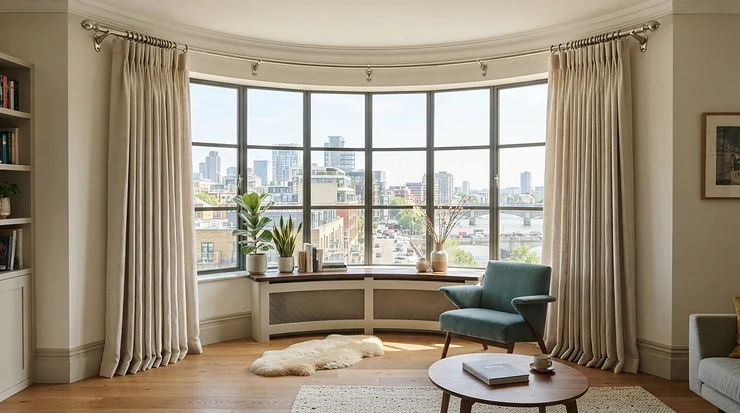
Bay windows are one of those features estate agents love to photograph and homeowners love to curse at 11pm while standing on a stepladder with a spirit level. The trouble is simple: a bay isn’t flat. It’s two, three, sometimes five panes meeting at angles that no standard curtain track was ever designed to handle, which is exactly why curtain poles for bay windows exist as their own product category rather than a footnote on a normal pole listing. Get the wrong one and you’ll spend a Sunday afternoon fighting a rigid rod that simply won’t turn the corner. Get the right one and the whole bay becomes the room’s best feature rather than its most awkward one.

So, what is a curtain pole for a bay window? In short, it’s a curtain support — either a single bendable rod or a multi-piece kit with hinged corner brackets — engineered to follow the angles of a splayed, square, or curved bay so curtains can glide smoothly around every join instead of catching on it. Some are flexible enough to be shaped by hand; others arrive pre-angled and simply bolt into place. Either way, the goal is the same: curtains that pull all the way around the bay without snagging.
This guide walks through seven genuinely available options on Amazon UK — a proper mix of budget, mid-range and premium — with honest analysis of what each one is actually good at, not just a list of specs copied from a product page. We’ve also dug into fitting, bracket types, pole length, and the perennial three-sided-versus-square-bay debate, because picking the pole is only half the job; getting it on the wall correctly is the other half. If your bay sits in a period property, it’s also worth a quick look at Historic England’s advice on traditional windows before drilling into original joinery, since some conservation areas treat window features more carefully than a standard semi.
Quick Comparison Table
| Product | Type | Diameter | Best For |
|---|---|---|---|
| Harrms Bay Window Curtain Pole | Bendable, 2 elbows | 25mm | Budget renters, irregular bays |
| STL County Crown Twist Cage Pole | Bendable, decorative | 19mm | Lightweight curtains, decorative look |
| Flexi Net Curtain Rod | Flexible PVC, trimmable | Slim rod | Voiles, sheers, layering |
| Swish Design Studio 28mm (3m) | Rigid, hinged corners | 28mm | Mid-weight pencil pleat curtains |
| Swish Design Studio 35mm (3m) | Rigid, hinged corners | 35mm | Heavier curtains, larger bays |
| Swish Design Studio 28mm (5m) | Rigid, hinged corners | 28mm | Wide or 5-sided bays |
| Swish Elements Belgravia | Rigid, complete metal set | 28mm | Premium finish, period rooms |
Looking at the spread here, the split is really between bendable poles that adapt to almost any bay angle on the day of fitting, and rigid hinged-corner kits that need slightly more planning but reward you with a cleaner, more furniture-grade finish. Budget bendable poles like the Harrms Bay Window Curtain Pole and STL County Crown Twist Cage Pole suit renters or anyone whose bay doesn’t match a standard angle, while the Swish Design Studio range and Swish Elements Belgravia are built for buyers who want a pole that looks like it was always part of the house. Diameter matters more than most buyers expect — a 19mm or 25mm pole is fine for lightweight curtains, but anything in a heavier pencil pleat or interlined fabric really wants the 28mm-35mm range to avoid sagging in the middle of each pole section.
💬 Just one click — help others make better buying decisions too!😊
Top 7 Curtain Poles for Bay Windows: Expert Analysis
1. Harrms Bay Window Curtain Pole — best budget bendable pole for irregular bays
The standout here is flexibility in the most literal sense: this is a curved, bendable rod rather than a fixed-angle kit, which means it can be manually shaped to match a bay that doesn’t fit a “standard” 90° or 135° angle. Specs-wise, you’re looking at a 25mm diameter pole covering a 76-460cm range, supplied in a white heavy-duty finish with two elbow joints already built in to handle the two corners of a typical three-sided bay. In practice, that 25mm thickness is doing real work — it’s substantial enough to resist the mid-span dip that thinner net rods develop once curtains are hung, but the two-elbow design still means you’re relying on joints rather than a genuinely one-piece curve.
Who should care about this one? Renters and anyone in a house where the bay angle simply doesn’t match off-the-shelf hinged kits — the bendable design sidesteps the whole “measure the angle first” problem that trips up first-time buyers of rigid poles. Aggregated review sentiment across this style of bendable bay pole on Amazon UK tends to cluster in the low-to-mid 4-star range, with buyers consistently praising how quickly they go up without any angle-measuring, though a recurring theme in this product category is that the elbow joints can feel slightly less rigid than a fully rigid kit once heavier curtains are hung, so it’s worth keeping fabric on the lighter side.
Pros:
- ✅ Bends to fit irregular or non-standard bay angles
- ✅ No angle measuring required before fitting
- ✅ Heavy-duty 25mm diameter resists sagging
Cons:
- ❌ Elbow joints can feel less sturdy under heavy curtains
- ❌ White-only finish limits decorating flexibility
At the time of research, poles in this bendable bay category typically sit in the under-£20 range, which makes this a genuinely low-risk way to test whether a pole (rather than a track) suits your bay before spending more. Check current price and stock before ordering, as availability on budget bay poles shifts often.

2. STL County Crown Twist Cage Pole — best decorative twisted design under budget
What sets this one apart is the twisted “cage” aesthetic — most budget bay poles are plain tube, but this one bends the same way while adding a decorative barley-twist finish that reads as more traditional. It’s a 19mm diameter pole, sold as an “easy bend” design for three-sided bays, with a total length of around 420cm and a silver finish topped with a County Crown-style finial. The thinner 19mm diameter is the trade-off for that decorative look: it’s genuinely easier to bend by hand into shape than the thicker 25mm-35mm poles further down this list, but that also means it’s happiest carrying lighter fabrics.
Based on the spec comparison with the other bendable option on this list, this pole is best suited to net curtains, voiles, or lightweight unlined curtains rather than full-length lined drapes — the 19mm profile just doesn’t have the bulk to support heavier fabric across a long run without support brackets at closer intervals. What most buyers overlook about this style of pole is that the “easy bend” claim genuinely does mean bend-in-situ rather than pre-angled, so you get a continuous curve rather than two hard corners, which some people find suits a bow-shaped bay better than a sharply angled one.
Pros:
- ✅ Decorative twisted finish stands out from plain tubes
- ✅ Continuous bend suits curved or bow-shaped bays
- ✅ Easy to shape by hand without tools
Cons:
- ❌ Slimmer 19mm profile best for lighter fabrics only
- ❌ May need extra support brackets on longer runs
Pricing on this style of decorative bendable pole tends to sit in a similar £10-£25 range at the time of research. It’s a sensible pick if your bay curves rather than angles, and you want something with more visual interest than a plain white rod.
3. Flexi Net Curtain Rod — best sheer and voile layering rod for any bay shape
This one isn’t trying to be your main curtain pole — its standout feature is that it’s a genuinely flexible PVC rod purpose-built for net curtains, sheers and voiles, which most bay window buyers end up needing anyway as a privacy layer behind their main curtains. The set covers a total length of 475cm (187″), supplied as five 95cm flexible rod lengths with 15 brackets and screws, four end caps and four joints, letting you configure it to more or less any bay shape by trimming the individual sections to size.
Here’s what the spec sheet won’t tell you outright: because it’s built from flexible PVC rather than metal, it has essentially none of the load-bearing capacity of the metal poles on this list, and that’s fine — it’s designed purely for lightweight sheers, not for pencil pleat curtains with interlining. Reviewers consistently note that the trimming and jointing system is genuinely simple for a DIY afternoon, and this style of product regularly appears as an “Amazon’s Choice” listing in the bay window net curtain category with ratings commonly sitting around 4.3-4.4 stars, though the honest caveat is that the plastic joints are the first thing to show wear if the rod is repeatedly flexed after initial fitting.
Pros:
- ✅ Trims to fit almost any bay window shape
- ✅ Ideal companion layer behind a main curtain pole
- ✅ Simple bracket and joint system for DIY fitting
Cons:
- ❌ Not rated for heavier lined or interlined curtains
- ❌ Plastic joints can wear if flexed repeatedly
Expect this to sit in the mid-£10s to £20 range at the time of research — genuinely one of the cheaper ways to solve the “I need something behind my main curtains for privacy” problem without a second full pole kit.
4. Swish Design Studio 28mm Bay Window Curtain Pole (3m, Chrome, Mondiale Finial) — best all-rounder rigid pole for pencil pleat curtains
This is where the list moves from bendable rods to properly engineered hinged kits, and the standout here is the complete pencil-pleat-ready system rather than a bare pole. The kit is a 28mm diameter, 3-metre (300cm) set finished in chrome with a Mondiale finial, built from four 75cm pole lengths, three end brackets, four passover brackets, a pole joiner, two adjustable bay corners, four luxury lined rings and 26 luxury passover rings — everything needed for a fully dressed three-sided bay in one box.
What that spec breakdown actually means in practice is that the adjustable bay corners let you fine-tune the angle after the brackets go up, rather than committing to a fixed angle before you’ve even measured, and the bracket projection adjusts between roughly 100mm and 132mm from wall to pole centre, which gives enough clearance for medium to heavyweight curtains to clear the window furniture underneath. This is squarely the pick for anyone who wants a traditional pencil pleat look with real rings gliding smoothly, rather than eyelet curtains pushed directly onto the pole. Reviewers of this Swish Design Studio range consistently mention the lined rings running quietly, which is a small detail that makes a real difference if the bay backs onto a bedroom.
Pros:
- ✅ Adjustable bay corners fine-tune the angle after fitting
- ✅ Lined rings glide quietly for smooth pencil pleat curtains
- ✅ Complete kit — no separate rings or brackets needed
Cons:
- ❌ Wall-fix only, no ceiling-mount option in this kit
- ❌ 28mm diameter may sag slightly under very heavy fabric
At the time of research, 3-metre kits in this Swish Design Studio range typically sit in the £30-£50 range depending on finial and finish. For a three-sided bay of standard proportions, this is genuinely one of the best value-for-quality options on the market.
5. Swish Design Studio 35mm Bay Window Curtain Pole (3m, Chrome, Rondelle Finial) — best thicker pole for heavier curtains
The standout feature here is simple: it’s the same trusted Swish Design Studio system as above, just built around a noticeably thicker 35mm pole rather than 28mm. That extra 7mm of diameter doesn’t sound like much on paper, but it meaningfully increases rigidity across each 75cm section, which matters once you’re hanging heavier interlined curtains or doubling up curtains with a separate voile layer on the same bracket run.
Based on the spec comparison with the 28mm version, the case for stepping up to 35mm comes down to two scenarios: either your bay is on the wider end (closer to the 3m-plus mark per side) where longer unsupported spans between brackets are more likely to bow over time, or you’re hanging genuinely heavy curtains — think blackout-lined or triple-weave fabric — where a slimmer pole visibly sags within the first few months. What most buyers overlook is that the thicker pole also changes the proportions of the whole window visually; a 35mm pole with a Rondelle finial reads as more substantial and traditional, which suits larger period bays better than a slim 19mm rod would.
Pros:
- ✅ Thicker 35mm diameter resists sagging under heavy fabric
- ✅ More substantial, traditional look for larger bays
- ✅ Same adjustable bay corner system as the 28mm version
Cons:
- ❌ Noticeably pricier than the 28mm equivalent
- ❌ Larger diameter may look oversized on a small bay
Expect a price range roughly £40-£60 at the time of research for the 3-metre kit — a sensible step up if your curtains are heavy or your bay is on the larger side.

6. Swish Design Studio 28mm Bay Window Curtain Pole (5m, Antique Brass, Prisma Faceted Ball Finial) — best for wide or five-sided bays
This one’s standout feature is simply scale: it’s a 5-metre (500cm) kit rather than 3-metre, built from two 150cm and two 100cm pole lengths, three end brackets, four passover brackets, a pole joiner, two adjustable bay corners, four luxury lined rings and 46 luxury passover rings — roughly double the ring count of the 3-metre kits above, reflecting the extra fabric width a 5m run is designed to carry.
Here’s what most buyers overlook when shopping by diameter alone: a 5-sided or unusually wide three-sided bay doesn’t just need a longer pole, it needs proportionally more passover rings and brackets to keep the curtain gliding smoothly across every joint, and this kit is specifically configured for that rather than being a 3m kit stretched to fit. The antique brass finish with a Prisma faceted ball finial also does more visual work here than on a smaller pole, since a larger bay tends to be the room’s focal point and benefits from a finial with genuine presence. Brackets on this kit are wall-fixed only, which is worth noting if your wall construction favours ceiling fixing instead (see the bracket section below).
Pros:
- ✅ Sized specifically for wide or 5-sided bay windows
- ✅ Nearly double the passover rings for smoother gliding
- ✅ Antique brass finish suits period and traditional rooms
Cons:
- ❌ Wall-fix brackets only — no ceiling-mount option
- ❌ Higher price point than the 3-metre kits
At the time of research, 5-metre antique brass kits in this range sit around £60-£90. If your bay is genuinely large, buying the correctly sized kit rather than joining two smaller ones is usually the better long-term investment.
7. Swish Elements Belgravia Bay Window Complete Metal Curtain Pole Set (Antique Brass, 400cm) — best premium finish for period rooms
The standout feature on the Swish Elements Belgravia is finish quality — this sits at the premium end of the Swish range, sold as a complete metal curtain pole set in a 400cm antique brass configuration aimed squarely at period and traditional interiors rather than contemporary ones. As a “complete” set, it’s built to the same wall-fix, hinged-corner logic as the Design Studio kits, but with a heavier, more ornate aesthetic across the brackets and finial detailing.
This is genuinely the most interesting product on the list from a review-honesty standpoint, because the real customer feedback is mixed in a useful way rather than uniformly glowing. On one hand, reviewers describe it as “fantastic,” calling out that “everything fit together really well and looks really beautiful” — genuine praise for build quality and finish. On the other, at least one verified review flags a real installation issue worth knowing before you buy: the bracket projection can sit further from the wall than expected on some bay configurations, meaning a visible gap between window and curtain during the day, and the reviewer noted needing to make adjustments to get a tidy fit. That’s exactly the kind of honest, aggregated sentiment worth weighing rather than the sanitised version you’d get from a listing alone — this is a premium, good-looking pole, but it rewards buyers who measure bracket projection carefully against their own window reveal before ordering.
Pros:
- ✅ Premium antique brass finish suited to period rooms
- ✅ Reviewers praise build quality and overall fit and finish
- ✅ Complete metal set with coordinated brackets and finials
Cons:
- ❌ Bracket projection reported as tricky on some bay shapes
- ❌ Premium finish comes with a premium price point
Pricing at the time of research tends to run higher than the standard Design Studio range, often in the £70-£100 bracket for the 400cm set. It’s worth the outlay if the room is period in style and you’re prepared to double-check bracket projection against your own bay before fitting.
Bay Window Pole Fitting: A Step-by-Step Practical Guide
Buying the right pole is only step one — bay window pole fitting is where most DIY jobs actually go wrong, usually because people try to hang the pole before working out the angle it needs to sit at. Start by measuring each section of the bay individually rather than the whole span in one go; a splayed bay typically has a wider centre section and two narrower angled sides, and getting those three measurements right before you touch a drill saves a repeat trip to the hardware shop.
Next, mark bracket positions on each section, keeping brackets roughly 15-20cm in from each end and adding a centre-support bracket on any section over about 1.2m to stop mid-span sag — this is where lightweight bendable rods and heavier rigid kits behave very differently, since the thicker 28mm-35mm poles can span further before needing extra support. Fit the corner brackets or elbows loosely first, offer the pole sections up, and adjust the angle before fully tightening anything; nearly every rigid bay kit builds in a small amount of adjustability at the corner joint specifically so you’re not locked into a single angle from the first screw. Finally, hang a few rings or curtain hooks temporarily and pull the curtain around the full bay before committing to final tightening — it’s much easier to spot a snagging joint now than after the plaster dust has settled.
A common first-30-days mistake is over-tightening the corner joints immediately, which can leave a rigid pole slightly misaligned with the true angle of an older bay window where the wall itself may not be perfectly symmetrical — loosen, re-check, and only fully tighten once the curtain has been test-pulled around the whole run.
✨ Don’t Miss These Exclusive Deals!
🔍 Take your bay window styling to the next level with these carefully selected poles. Click on any highlighted item to check current pricing and availability. These picks will help you create a genuinely well-dressed bay your whole family will notice!

Real-World Scenarios: Matching the Right Pole to Your Home
Consider a first-time renter in a Victorian conversion flat with a classic three-sided bay who can’t drill into the original plasterwork extensively. A bendable option like the Harrms Bay Window Curtain Pole or the STL County Crown Twist Cage Pole makes sense here: fewer fixing points, no need to match a specific angle, and if the tenancy ends, the whole thing comes down and travels to the next flat without leaving a mismatched hinged-corner kit behind.
Now picture a family in a 1930s semi with a wide, squared-off bay and heavy, blackout-lined curtains for a west-facing living room that gets strong evening sun. This household needs load-bearing capacity over flexibility, which points straight at the Swish Design Studio 35mm kit — the thicker pole resists the sag that heavier interlined fabric causes over a standard 28mm rod, particularly across the wider centre section of a squared bay.
Finally, think about a homeowner restoring a period property with a genuinely large five-sided bay and a preference for a traditional, high-end look throughout. Here, the calculation shifts toward finish and proportion as much as function, which is where the Swish Design Studio 5m Antique Brass kit or the Swish Elements Belgravia set earns its higher price tag — both are built with the ring count and bracket spacing to handle a genuinely wide run, and the antique brass finish reads correctly in a room full of period detailing rather than looking like an afterthought.
How to Choose Curtain Poles for Bay Windows
- Measure each bay section separately. A bay is rarely three equal panels — measure the centre and both angled sides individually before shortlisting a pole length.
- Decide bendable or rigid. Bendable poles solve irregular angles instantly; rigid hinged kits give a cleaner, more furniture-grade finish once fitted correctly.
- Match diameter to curtain weight. Lightweight voiles are fine on 19mm-25mm poles; heavier lined or interlined curtains need 28mm or thicker to avoid mid-span sag.
- Check bracket projection against your window reveal. As the Belgravia review above shows, a bracket that projects too far can leave a visible daytime gap between curtain and glass.
- Count the rings you actually need. Wider bays need proportionally more passover rings, not just a longer pole — a 5m kit built for that length includes nearly double the rings of a 3m kit for good reason.
- Confirm wall-fix vs ceiling-fix compatibility with your wall construction. Stud walls, solid masonry and older lath-and-plaster all take fixings differently (more on this below).
- Factor in finish last, not first. Chrome, antique brass and matt black all perform identically structurally — choose finish to match the room once the functional criteria above are settled.
Curtain Pole Brackets for Bay Windows: Ceiling-Fix vs Wall-Fix Brackets
Every curtain pole brackets for bay windows decision ultimately comes down to what your wall — and ceiling — can actually support, and the two main options behave quite differently in practice.
Wall-fix brackets, which every product on this list uses, mount directly into the wall beneath the window reveal. They’re the standard choice for most bays and generally the easier of the two to fit, since you’re working at a comfortable height rather than overhead, but they do rely on solid enough wall material behind the plaster to hold screws securely — an issue that occasionally crops up in older properties with softer or crumbling plaster around the window opening.
Ceiling-fix brackets, less common but worth knowing about, mount into the ceiling directly above the bay rather than the wall. They tend to suit rooms where the wall section above the window is minimal or structurally unsuitable for fixings, or where a homeowner wants the curtain to hang from directly above the glass line for a cleaner, more architectural look. The trade-off is that ceiling fixing generally needs to hit a joist rather than just plasterboard, so locating solid fixing points overhead can be more fiddly than a straightforward wall fix. None of the seven poles featured above ship with ceiling-fix brackets as standard, so if that’s your preferred method, budget for compatible brackets separately and confirm compatibility with your chosen pole diameter before buying.
Corner Curtain Pole Options for Every Bay Shape
Corner curtain pole options broadly split into three mechanisms, and picking the right one depends entirely on your bay’s actual geometry rather than personal preference. Elbow joints, used on bendable poles like the Harrms Bay Window Curtain Pole, are pre-formed corner pieces that lock the pole into roughly the same angle every time — reliable, but less adaptable to unusual angles than a genuinely flexible rod. Continuous bend poles, like the STL County Crown Twist Cage Pole, have no fixed joint at all; you shape the curve by hand, which suits bow-shaped or gently curved bays better than sharply angled ones. Adjustable hinged corners, used across the entire Swish Design Studio range, sit between the two — a purpose-built corner bracket that can be angled during fitting and then locked, giving you the clean look of a rigid pole with enough tolerance to match a bay that isn’t perfectly symmetrical.
If your bay has a sharp, near-right-angle corner, adjustable hinged corners are usually the tidiest solution. If it curves gently rather than angling sharply, a continuous-bend pole will follow the shape more naturally than any hinged kit ever could.
Bay Window Curtain Pole Length: How Long Do You Need?
Getting bay window curtain pole length right starts with the same rule that applies to any curtain pole: measure the pole run, not the window itself. The John Lewis curtains buying guide recommends positioning a pole roughly 10-15cm above the window and extending it 15-20cm beyond each side of the window opening for the best coverage, and that guidance applies per section on a bay rather than to the bay as a single span.
In practice, that means measuring the centre section width, then each angled side section separately, adding the recommended overhang to each before totalling them up — which is exactly why kits like the Swish Design Studio range are supplied as separate pole lengths (four 75cm sections, or two 150cm plus two 100cm sections on the 5m kit) rather than one continuous rod: it lets you configure the true length of each section independently rather than guessing at a single bent shape. If your bay doesn’t match a standard kit length once you’ve done this measuring, most rigid poles can be trimmed down with a hacksaw, while bendable poles simply extend or compress within their stated range — the Harrms Bay Window Curtain Pole, for instance, covers a 76-460cm span specifically so it can be adjusted on the day rather than pre-cut to a fixed size.
Common Mistakes When Buying Curtain Poles for Bay Windows
The single most common mistake is buying by window width rather than by pole-run length, which almost always results in a pole that’s too short once the recommended overhang either side is factored in. A close second is choosing diameter based on looks rather than curtain weight — a slim 19mm pole looks elegant in a product photo, but visibly bows within weeks under heavy lined curtains it was never designed to carry. Buyers also frequently underestimate how different a splayed bay is from a squared one; a kit designed for 90° corners will leave a visible gap or an over-tight pinch point if forced onto a shallower splayed angle, so checking your actual bay angle before ordering a fixed hinged-corner kit is worth the extra five minutes with a protractor or angle finder.
Finally, plenty of buyers order a rigid pole for a wall that simply can’t take a secure fixing — older properties with soft or damaged plaster around the bay reveal are a genuine risk here, and a pole that isn’t properly anchored is both a safety issue and a warranty headache. Where wall condition is doubtful, it’s always worth checking before ordering rather than after the pole has arrived.
Three-Sided Bay Window vs Square and Curved Bays
Not every bay is built the same way, and a three-sided bay window is only one of three common configurations you’ll encounter in UK housing. The classic three-sided bay — one flat centre panel with two angled side panels, typically found in Victorian and Edwardian terraces — is the shape most curtain pole kits, including every Swish Design Studio option on this list, are specifically engineered around, with two adjustable corner joints matching the two angle changes.
A square (or box) bay, common in 1930s semis, has 90° corners rather than splayed angles, which generally suits rigid hinged kits even better than a three-sided splay does, since the corner angle is a fixed, predictable 90° rather than a variable splay that differs from house to house. A curved or bow bay, by contrast, has no hard corners at all — just a continuous gentle curve — which is precisely where hinged-corner kits struggle and genuinely flexible or bendable poles, like the STL County Crown Twist Cage Pole, come into their own. Knowing which of the three you actually have before buying prevents the single most avoidable mistake on this whole list: ordering a pole engineered for angles your window doesn’t have.
Safety, Building Regulations and Listed Property Considerations
For most homeowners, fitting a curtain pole is a straightforward DIY job with no planning implications whatsoever. The exception is homes in a conservation area or listed buildings, where even seemingly minor changes to window treatments can occasionally intersect with wider guidance on preserving a property’s historic character, which is worth checking before drilling into original period joinery or reveals.
From a practical safety standpoint, always confirm what’s behind the plaster before drilling — old lath-and-plaster walls, hidden cabling, or shallow stud positions can all turn a five-minute bracket fitting into a repair job. Weight-rate your pole to your curtains honestly: a heavier interlined curtain on an undersized bracket isn’t just a cosmetic sagging issue over time, it’s a fixing that can eventually work loose from the wall — and a well-fitted pole pairs nicely with proper draught-proofing underneath it, since government guidance on draught-proofing windows and doors notes it can save a typical household £25-£35 a year in heating costs. If you’re in any doubt about wall condition, a cable and stud detector is a worthwhile few pounds spent before committing to drill positions on a bay you can’t easily patch and repaint invisibly.
Long-Term Cost & Maintenance
Curtain poles for bay windows are one of the lower-maintenance parts of any window treatment once correctly fitted, but total cost of ownership isn’t just the upfront price. A £15 bendable pole and a £90 antique brass complete set will both last for years if the wall fixing was sound in the first place — the real cost differences show up in curtain-hanging performance rather than pole lifespan. A thinner, cheaper pole that sags under heavy curtains will eventually need supplementary centre brackets (a small additional cost) or a full upgrade to a thicker pole, effectively doubling the spend versus buying the correctly rated diameter the first time.
Maintenance itself is minimal: an occasional wipe to keep dust off passover rings so curtains continue to glide smoothly, and a periodic check that corner bracket screws haven’t worked loose, particularly in the first few months after fitting while everything settles. Metal finishes like chrome and antique brass generally outlast the curtains hung on them, so when it’s time to redecorate, most buyers find they only need to replace the curtains rather than the pole underneath — which is worth factoring in when weighing a premium finish against a budget one at the outset.

Frequently Asked Questions
❓ What's the best type of curtain pole for a bay window?
❓ Can I use a normal curtain pole on a bay window?
❓ How much overhang should a bay window curtain pole have?
❓ Do bay window curtain poles need ceiling fixing?
❓ How do I stop curtains snagging on the bay window pole corners?
Conclusion
Bay windows deserve better than a compromise pole that half-fits the angle and half-supports the curtains, and the good news is that the market has genuinely matured to solve this properly rather than leaving buyers to improvise with straight rods and elbow joints from a hardware shop. Whether that means a flexible, renter-friendly option like the Harrms Bay Window Curtain Pole, a decorative bendable choice like the STL County Crown Twist Cage Pole, a dependable mid-range kit like the Swish Design Studio 28mm, or a premium finish like the Swish Elements Belgravia, the right pick genuinely comes down to your bay’s shape, your curtain weight, and how much finish quality matters to you.
Take the time to measure each section of your bay individually, decide honestly whether your wall favours a wall-fix or ceiling-fix approach, and match diameter to curtain weight rather than to looks alone — do that, and any of the seven options above will serve the room well for years. Curtain poles for bay windows aren’t a glamorous purchase, but getting one right is one of those small home decisions that quietly makes a whole room feel finished.
Recommended for You
- Curtain Pole for Small Windows: 7 Best Picks for UK Homes (2026)
- Woven Natural Blinds: 7 Best Picks for UK Homes (2026)
- Best Bamboo Blinds UK: 7 Top Picks for Natural Style (2026)
Disclaimer: This article contains affiliate links. As an Amazon Associate, I earn from qualifying purchases. If you purchase products through these links, we may earn a small commission at no additional cost to you.
✨ Found this helpful? Share it with your friends! 💬🤗
