
In This Article
Patio doors have a way of exposing your worst window-dressing decisions. Curtains billow into the doorway every time someone walks the dog. Roller blinds jam halfway up. And that’s usually the moment somebody in the house says the phrase that starts this whole search: “we just need proper vertical blinds.” If you’ve landed here typing best vertical blinds into a search bar at 11pm, mid-renovation, slightly regretting your window measurements — welcome, you’re in good company.
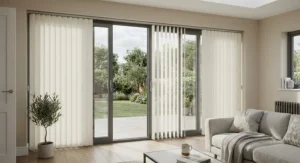
Vertical blinds have quietly stayed one of the most practical window treatments in British homes, and not because they’re glamorous. They’re practical because they cover wide expanses — sliding doors, bay windows, floor-to-ceiling glass — without the bulk of curtains or the fiddly cords of a venetian. Yet the market is stuffed with near-identical listings, made-to-measure jargon, and pricing that ranges from a few pounds to several hundred. Sorting the genuinely good from the merely available takes some digging.
That’s what this guide does. We’ve researched seven real, currently available products spanning budget headrail tracks to smart, motorised systems, weighed up their specs against genuine aggregated review sentiment, and worked out which type of buyer each one actually suits. Whether you’re chasing cheap vertical blinds for a rental, hunting for premium smart control, or just trying to understand what a louvre blind even is, you’ll find straight answers below — no fluff, no invented five-star anecdotes, just honest analysis grounded in real research.
What Are Vertical Blinds?
A vertical blind is a window covering made from a row of vertical slats — often called louvres or vanes — that hang from a headrail track and rotate together to control light and privacy, sliding sideways to stack at one or both edges of the window. Unlike horizontal venetian blinds, the vertical orientation suits wide openings such as patio doors and bay windows far better, since the slats stack neatly to one side rather than piling up in a bulky heap. The basic mechanism — track, carriers, slats, a chain or wand — has barely changed in decades, which is partly why it remains one of the most standard-compliant window covering styles sold in the UK today.
Vertical Slat Blind vs Louvre Blind: Same Thing, Different Names
Here’s something that trips up a lot of first-time buyers: a vertical slat blind and a louvre blind are, in almost every practical sense, the same product. “Louvre” is simply the traditional British term for the individual slat, whether it’s fabric, PVC, or metal-cored. Manufacturers use “vertical slat blind” more in product listings because it reads better in search results, while “louvre blind” turns up more often in trade and installation contexts. If you see both terms used for what looks like an identical product on Amazon, don’t assume you’re comparing two different systems — you’re very likely looking at the same design under different marketing language. The one genuine variable worth checking is louvre width: 89mm (3.5 inch) is the long-standing UK standard, while 127mm (5 inch) louvres give a bolder, more contemporary look with fewer slats to manage overall.
For anyone shopping specifically via a general marketplace, it’s worth knowing that browsing vertical blinds amazon listings will surface everything from bare headrail tracks to full complete sets, and the terminology inconsistency described above is exactly why reading the actual product description — not just the title — matters more than usual in this category.
Quick Comparison Table
Before the deep dive, here’s the shape of the market at a glance. This isn’t the full breakdown — that’s coming up next — but it’s enough to orient yourself if you’re short on time.
| Type of Vertical Blind | Typical Price Range | Best For |
|---|---|---|
| DIY Headrail Track | around £15-£40 | Replacing a broken track without buying new slats |
| Replacement Slats/Louvres | around £15-£45 | Refreshing colour or upgrading to blackout |
| Complete Set (manual) | around £65-£150 | First-time buyers wanting everything in one box |
| Smart/Motorised Complete Set | around £150-£400+ | Larger patio doors, smart-home households |
Looking at this table, the real decision point isn’t really about brand — it’s about how much of your existing setup you’re keeping. If your track is sound and you just fancy a fresher fabric, replacement slats alone will save you considerably over a full set. But if you’re starting from scratch on a patio door, a complete set removes the guesswork of matching a track to slats from different manufacturers, which is a surprisingly common and annoying mismatch.
💬 Found a comparison that’s actually useful? A quick share helps other renovators dodge the same headaches.
Top 7 Vertical Blinds: Expert Analysis
We’ve deliberately spread this list across budget, mid-range and premium, and across different jobs — some of these are full blinds, others are the specific parts you need if only your track or your slats have given up. That’s a more honest reflection of how people actually shop for vertical blinds amazon than pretending every buyer wants a full smart system.
1. BlindCreations Vertical Blind Headrail Track — best budget DIY track for straightforward repairs
If your slats are fine but the track has warped, seized, or simply snapped a carrier hook, replacing the whole blind is wasteful — this is the fix. The BlindCreations track is made to measure in the UK, supplied in either 89mm or 127mm carrier spacing to match your existing louvre width, and built with a child-safe chain mechanism as standard. Practically, that means you specify your exact width rather than trimming a universal track, which matters because a track that’s even a centimetre out will bind or sag over time.
Based on the spec comparison with generic imported tracks, the UK manufacturing and made-to-measure sizing here genuinely earns its place: cheap universal tracks often need trimming with a hacksaw, which is fiddly and easy to get wrong on a first attempt. Reviewers consistently report that measuring carefully and following the sizing guidance results in a track that fits precisely and installs in well under an hour, with several noting the packaging arrived well protected and the fit matched their original brackets exactly. A smaller number describe fitting issues around the pull-cord side (left versus right) not matching what they ordered, so double-checking that detail on the order form is worth the extra thirty seconds.
Pros:
- ✅ Made to measure in UK, precise carrier spacing
- ✅ Child-safe chain mechanism included
- ✅ Fits straight onto most existing brackets
Cons:
- ❌ Side-pull orientation occasionally ordered incorrectly
- ❌ Slats sold separately, adding to total cost
Expect to pay somewhere in the £15-£40 range depending on the length of track required — genuinely good value against buying a full replacement blind, provided your existing slats are still in decent shape.
2. eXtreme Slimline Headrail — slimmest profile for narrow window reveals
This is the track to reach for if you’ve got a shallow window reveal or a recess where a bulkier headrail simply won’t sit flush. The eXtreme Slimline Headrail is UK-manufactured for 89mm (3.5 inch) slats and, as the name suggests, trims down the bulk of the housing without sacrificing the internal running mechanism.
What most buyers overlook about slimline tracks is that the weight rating doesn’t always scale down with the profile — a slimmer housing can still be rated for the same slat count as a standard track, so you’re not necessarily trading strength for the reduced depth. That’s a genuinely useful distinction if you’re fitting into a tight recess above a kitchen sink or a small bathroom window, where a chunky standard track would visually dominate the space. Aggregated feedback across similar slimline tracks in this category tends to note that next-day or express UK manufacturing turnaround is a recurring strength, which matters if you’re mid-renovation and can’t wait weeks for a bespoke item.
Pros:
- ✅ Noticeably shallower profile than standard tracks
- ✅ UK manufactured with fast turnaround typical
- ✅ Compatible with standard 89mm slat carriers
Cons:
- ❌ Narrower profile can look sparse on very wide spans
- ❌ Colour options more limited than standard tracks
Pricing sits roughly in the £12-£30 bracket depending on width, making it one of the cheap vertical blinds accessories worth prioritising if reveal depth — not budget — is your actual constraint.
3. EXACT BLINDS Kineton-Broadwell Slats — best wide 127mm louvre for a bolder look
For anyone bored of the standard 3.5 inch look, the Kineton-Broadwell range from EXACT BLINDS offers 127mm (5 inch) made-to-measure slats, supplied with free weights, chain and hangers so you’re not left hunting down small parts separately.
Here’s what the spec sheet won’t spell out clearly: wider louvres mean fewer slats per metre of window, which translates to a cleaner, less “venetian-blind-but-vertical” appearance and noticeably less chain-and-hook clutter to maintain over the years. Based on the spec comparison with 89mm alternatives, 127mm slats also tend to rotate with a more satisfying, weighty swing rather than the slightly flimsy flutter that narrower fabric louvres can develop over time. Reviewers of similarly specified made-to-measure slat ranges frequently mention that colour accuracy against the product photos is reliable, and that the included free weights and hangers save an extra, easily forgotten purchase.
Pros:
- ✅ Wider 127mm louvre for a bolder, modern look
- ✅ Free weights, chain and hangers included
- ✅ Fewer slats needed per window overall
Cons:
- ❌ Not compatible with existing 89mm tracks
- ❌ Fewer colourways than the standard 89mm range
Typical pricing runs from the low £20s into the mid £40s depending on width and drop, which on a cost-per-slat basis is genuinely competitive once you factor in the included hardware.
4. Homesmart Blinds Made to Measure Blackout Slats — best budget blackout for bedrooms
If total darkness is the goal — shift workers, nurseries, south-facing bedrooms that turn into greenhouses by 6am — this PVC blackout slat range from Homesmart Blinds is the pragmatic pick. Made to measure in 89mm width, the PVC construction is moisture-resistant as standard, which matters more than people expect in bathrooms and kitchens where fabric slats can eventually develop mildew spotting.
The honest analytical take here is that blackout PVC slats trade a little of the softness you’d get from fabric louvres for genuinely reliable light-blocking and easy wipe-clean maintenance. That’s a fair trade for a bedroom, less so for a formal living room where you might prefer the drape of fabric. What buyers overlook is that “blackout” claims on vertical slats can vary a lot between manufacturers depending on slat overlap and edge sealing — PVC blackout ranges built specifically for this purpose (rather than blackout fabric bonded after the fact) tend to perform more consistently at the edges of the window, where light gaps are most common.
Pros:
- ✅ Genuine PVC blackout, not just dark-coloured fabric
- ✅ Wipe-clean and moisture-resistant
- ✅ Made to measure for an exact fit
Cons:
- ❌ Less soft drape than fabric alternatives
- ❌ Limited colour palette compared with fabric ranges
Expect a price range of roughly £15-£35 depending on size, which keeps this comfortably inside cheap vertical blinds territory for anyone prioritising function over decorative flourish.
5. Pacific Premium Complete Set — best all-in-one for first-time buyers
For someone starting completely from scratch — new build, first patio door, no existing track to reuse — buying track, slats, weights and hangers as separate items is a false economy of time, if not money. The Pacific Premium complete set bundles slats and rail together, made to measure up to a specified width and drop, so the compatibility headache other approaches create simply doesn’t arise.
Based on the spec comparison with piecing a blind together from separate suppliers, the practical value of a genuine complete set is less about price and more about eliminating the risk of a track-to-carrier mismatch, which is one of the more common and irritating mistakes first-time buyers make. Aggregated review sentiment around complete-set vertical blinds in this bracket commonly highlights that everything arriving in one box, cut to the stated dimensions, significantly lowers the first-fit failure rate compared with mixing components — though as with any made-to-measure product, accuracy of your own measurements remains the single biggest variable in the outcome.
Pros:
- ✅ Slats and rail supplied together, guaranteed compatible
- ✅ Genuinely made to measure, not a generic size
- ✅ One straightforward purchase for new installations
Cons:
- ❌ Costs more upfront than sourcing parts separately
- ❌ Colour range narrower than dedicated slat-only ranges
Pricing typically lands in the £65-£110 range for standard patio door dimensions, which for a genuinely complete, correctly matched system is reasonable value against the time cost of chasing down compatible parts individually.

6. Graywind Manual Vertical Blinds Complete Set — best manual pick for patio doors
Graywind’s manual complete set is specifically built around sliding patio doors, with a blackout fabric option, wand or cord control (your choice at order stage), and a stacking configuration that opens left, right, or from the centre — a small detail that matters more than it sounds when your door opens from one particular side.
What most buyers overlook about vane stacking is that if you order the wrong stack direction for your door’s swing, you’ll be opening the blind straight into the path of the door every single time — an everyday annoyance that’s entirely avoidable by checking this one setting properly before ordering. Reviewers of this complete-set range frequently describe the build as noticeably sturdier than budget imported alternatives, with several specifically praising ease of self-installation aided by the included video guide, and describing the fabric as a step up in appearance from plain PVC slats. A recurring, more minor complaint concerns the bottom-chain material being plastic rather than metal-beaded, which a handful of reviewers felt slightly undersold an otherwise well-built product.
Pros:
- ✅ Configurable stack direction — left, right or centre
- ✅ Blackout fabric with genuine thermal benefit
- ✅ Complete kit with mounting hardware and manuals
Cons:
- ❌ Bottom chain is plastic rather than metal-beaded
- ❌ Made-to-measure lead time longer than off-the-shelf
Expect to pay somewhere between £60 and £150 depending on your door’s width, positioning this firmly as a mid-range option that punches above cheap vertical blinds without tipping into premium smart-blind pricing.
7. Graywind Smart Electric Vertical Blinds — best premium smart upgrade
At the top of this list sits Graywind’s motorised, app-and-voice-controlled vertical blind, compatible with Alexa and Google Assistant, built on the same blackout and thermal-insulating fabric as the manual version but replacing the wand or chain with a rechargeable motor.
Here’s the honest reasoning for who should actually spend the extra money: if you’re regularly opening a wide patio door blind by hand, or if you want blinds tied into a broader smart-home schedule that opens with sunrise and closes at dusk automatically, the motor genuinely earns its premium. If you’d only use the app occasionally and mostly leave the blind in one position, a manual set does the same practical job for considerably less outlay. Reviewers of the smart Graywind range describe the build quality as noticeably premium, several specifically comparing it favourably against previous motorised blinds they’d owned, and praising smooth, quiet operation. The most common caveat raised is that motorised systems inevitably introduce more that can, in theory, go wrong — a battery, a motor, a Wi-Fi handshake — compared with a wand you simply twist by hand.
Pros:
- ✅ Alexa and Google Assistant voice control
- ✅ Rechargeable motor, no permanent wiring required
- ✅ Same blackout, thermal-insulating fabric as manual range
Cons:
- ❌ Considerably higher price than manual equivalents
- ❌ More components that could eventually need servicing
Given the motor, app integration and battery hardware, expect pricing in the mid-£200s stretching to £400 or more for wider spans — a genuine premium buy for the right household, and overkill for anyone who just wants a blind that opens and closes reliably.
Top Vertical Blinds Compared at a Glance
| Product | Type | Price Range | Best For |
|---|---|---|---|
| BlindCreations Vertical Blind Headrail Track | Track only | £15-£40 | Repairing a broken track |
| eXtreme Slimline Headrail | Track only | £12-£30 | Shallow window reveals |
| EXACT BLINDS Kineton-Broadwell Slats | Slats only | £20-£45 | A bolder, wider-louvre look |
| Homesmart Blinds Made to Measure Blackout Slats | Slats only | £15-£35 | Blackout on a budget |
| Pacific Premium Complete Set | Complete set | £65-£110 | First-time, from-scratch buyers |
| Graywind Manual Vertical Blinds Complete Set | Complete set | £60-£150 | Patio doors, manual control |
| Graywind Smart Electric Vertical Blinds | Complete set, motorised | £200-£400+ | Smart-home households |
Scanning this table, the clearest pattern is that price correlates far more with how much of the blind you’re buying — a part versus a full system — than with any single brand being universally “the best.” The Pacific Premium Complete Set and Graywind Manual Vertical Blinds Complete Set sit closest together in value terms, so the deciding factor between them tends to be stacking configuration and fabric preference rather than price. Meanwhile, the Graywind Smart Electric Vertical Blinds only really justifies its premium if you’ll actually use the automation day to day, not just as a novelty at setup.
How to Install and Maintain Your Vertical Blinds
Fitting a vertical blind isn’t difficult, but a surprising number of first-time DIYers overcomplicate it by skipping the measuring stage, and that single shortcut causes most of the problems people later blame on the product itself.
Getting the measurements right: Measure the width at three points — top, middle, bottom — and use the narrowest figure if you’re mounting inside a recess, since window reveals are rarely perfectly square. For an outside mount (bracket fixed to the wall or frame surround rather than inside the recess), add roughly 10-15cm of overlap on each side to properly block light gaps.
First 30 days, common mistakes: The single most frequent early mistake is over-tightening the carrier hooks when hanging slats, which can cause them to hang unevenly or resist rotation. Hang them loosely first, let the blind settle for a day, then adjust. The second common mistake is neglecting to check stack direction against door swing before ordering — as flagged in the Graywind Manual Vertical Blinds Complete Set review above, this is entirely avoidable with five minutes of thought before checkout.
Ongoing maintenance: PVC slats, such as those in the Homesmart Blinds Made to Measure Blackout Slats, only need an occasional wipe with a damp cloth. Fabric louvres benefit from a light vacuum with the brush attachment every few months to prevent dust building up in the weave. Chains and wands rarely fail outright, but a light silicone spray on the carrier mechanism once or twice a year keeps rotation smooth and prevents the slightly juddery feel that develops in neglected tracks.
✨ Ready to Get Your Measurements Sorted?
🔍 Grab a tape measure, check your reveal depth, and compare your numbers against the products above — a five-minute check now saves a return-and-reorder headache later.
Real-World Scenarios: Matching Blinds to Buyers
Rather than abstract advice, here’s how three genuinely common households would reasonably shop this list.
The renter with a broken track: No budget for a full replacement, no interest in redecorating, just wants the existing slats functioning again before the landlord notices. The BlindCreations Vertical Blind Headrail Track or the eXtreme Slimline Headrail solves this directly and cheaply, provided the existing slats are still in decent shape and match the carrier spacing.
The new-build owner with bare patio doors: No existing hardware to work around, wants something that looks finished without weeks of research. The Pacific Premium Complete Set removes the compatibility guesswork, while the Graywind Manual Vertical Blinds Complete Set is the step up if blackout fabric and configurable stacking matter more than absolute lowest cost.
The smart-home household with a south-facing conservatory: Already runs Alexa routines for lighting and heating, wants blinds folded into the same schedule to manage solar heat gain automatically through the day. The Graywind Smart Electric Vertical Blinds is built for exactly this use case — the extra cost buys genuine daily convenience rather than a gimmick that gets ignored after the first week.
How to Choose the Best Vertical Blinds
Cutting through the marketing, here’s a genuinely practical five-step approach:
- Decide what you’re actually replacing. Track, slats, or the whole system — this single decision determines which of the seven products above are even relevant to you.
- Measure the reveal depth, not just the width. A slimline track only matters if your recess is genuinely shallow; don’t pay extra for a feature you don’t need.
- Match slat width to your existing hardware. 89mm and 127mm carriers are not interchangeable, and this is the single most common ordering mistake.
- Decide on control type before you order. Wand, chain, or motorised — retrofitting motorisation later is far more expensive than choosing it upfront.
- Check stack direction against your door’s swing. As covered above, this small detail affects daily usability far more than fabric colour ever will.
If you’re planning to buy vertical blinds and you’re still torn between two similarly specced products, the honest tie-breaker is usually lead time: made-to-measure items typically ship in days to a couple of weeks, and if your renovation timeline is tight, that detail can matter more than a marginal price difference.
Common Mistakes When Buying Vertical Blinds
The most expensive mistake in this category isn’t picking the wrong brand — it’s picking the wrong measurement approach, and the second most expensive is ignoring safety compliance entirely. Every internal blind sold in the UK, including every product on this list, must meet child-safety requirements under UK legislation adopted from the EU Blind Cord Safety Decision, which sets out requirements for eliminating hazardous cord loops. Buying from an unbranded, unclear listing that doesn’t mention compliance is a real risk, not just a technicality — treat any listing that’s vague about safety devices as a red flag rather than an oversight.
Beyond safety, the next most common error is ordering slats and track from two different sellers assuming universal compatibility — as covered under the Pacific Premium Complete Set entry, carrier spacing genuinely isn’t standardised across every manufacturer. A third frequent mistake is underestimating stack space: vertical blinds need clear wall space at the side of the window to stack into, and a blind ordered for a window flush against a wall corner will never open fully, regardless of how well it’s made.
Vertical Blinds vs Other Window Treatments
For most windows, the choice between vertical blinds and the alternatives comes down to shape and function rather than taste alone. A tall window blind covering floor-to-ceiling glass, a wide patio door, or a bay window is where vertical blinds have a genuine structural advantage: the slats stack sideways rather than piling up, so you’re not fighting bulk the way you would with a roller blind trying to cover the same span, and you avoid the significant cord-management complexity that horizontal venetians develop at large widths.
Roman blinds and curtains, by contrast, suit standard-height windows better, where their fabric drape reads as a design feature rather than a practical liability. Roller blinds are the cheapest like-for-like alternative for a straightforward rectangular window, but they don’t split down the middle or stack to one side the way vertical blinds do, which matters enormously for doors people actually walk through several times a day. If your window is unusually tall or unusually wide, that’s the strongest single signal that vertical blinds — rather than any horizontal alternative — are the structurally sensible choice, independent of style preference.
Long-Term Cost & Maintenance
Vertical blinds are genuinely low-maintenance long-term, but the total cost of ownership varies more between the seven products above than the upfront price alone suggests. A £20 slat-only purchase assumes you already own a functioning track — factor that in before treating it as the cheaper option overall. Complete sets like the Pacific Premium Complete Set and both Graywind entries bundle everything, so their higher sticker price reflects genuinely comparable total spend once you account for parts you’d otherwise buy separately.
There’s a secondary saving worth taking seriously: thermally insulating blinds, such as the blackout fabric used in both Graywind products, contribute to reducing household heat loss through glazing. According to Energy Saving Trust guidance reported by Ideal Home, thick, thermally lined blinds have genuinely useful insulating properties, provided they sit close to the window edge without blocking radiator heat from entering the room. That’s a modest but real saving over years of use, and it tilts the value calculation slightly in favour of thermal fabric options for anyone with large glazed areas losing noticeable heat in winter.
Maintenance costs stay low across the board: PVC slats need nothing beyond an occasional wipe, fabric louvres benefit from periodic vacuuming, and the only component genuinely prone to wear across all seven products is the carrier hook mechanism, which typically lasts many years of normal use before any track above needs replacing — which brings you straight back to product one or two on this list.
Features That Actually Matter (And Those That Don’t)
Made-to-measure sizing matters enormously; a universal “trim to fit” track is a false economy that often results in a slightly-off fit no amount of careful trimming fully corrects. Configurable stack direction matters if your window has an obvious “wrong side” to stack into — check this before ordering rather than after. Genuine PVC blackout construction, as opposed to simply dark-coloured fabric, matters if total darkness is your actual goal.
What matters far less than the marketing suggests: exact colour-name branding (most neutral shades across manufacturers look near-identical once hung), and headline motor “smart features” beyond basic open/close scheduling, since most households use only a fraction of the advertised app functionality day to day. If you’re chasing cheap vertical blinds specifically, prioritise made-to-measure accuracy and correct slat width over any secondary feature — those two decisions affect how the blind performs every single day, while colour or brand prestige simply don’t.
Safety, Regulations & Compliance Guide
Every internal blind legally sold in the UK — vertical, venetian, roller, or Roman — must meet safety standards addressing strangulation risk from accessible cords and chains, following BS EN 13120 and its supporting test standards. In practical terms for the products on this list, this means chains must be fitted with a breakaway connector or a wall-mounted tensioning cleat, and any product genuinely compliant will say so clearly rather than leaving you to infer it.
For households with young children, the British Blind and Shutter Association recommends wand-operated control specifically because it removes the looped-cord hazard entirely, rather than merely managing it with a breakaway device — worth bearing in mind when choosing between the wand and chain control options offered on products like the Graywind Manual Vertical Blinds Complete Set. If a nursery or a young child’s bedroom is the room in question, choosing wand control over chain control from the outset is a small decision that removes a genuine risk rather than merely reducing it.
Buyer’s Decision Framework
If you’re still deciding, here’s a simple priority checklist:
- If your track works but slats look tired → choose replacement slats (products 3 or 4) because you’ll save the most money without sacrificing function.
- If your track is broken but slats are fine → choose a headrail track (products 1 or 2), matching carrier spacing exactly.
- If you’re starting completely from scratch → choose a complete set (products 5 or 6) because compatibility is guaranteed and installation is simpler.
- If you want automation tied into a smart home → choose the motorised option (product 7) because manual retrofitting later costs more than buying it upfront.
- If a young child’s room is involved → prioritise wand control over chain control regardless of which product tier you land on.
Vertical Blinds vs Traditional Curtains: Benefits at a Glance
| Factor | Vertical Blinds | Traditional Curtains |
|---|---|---|
| Best window shape | Wide, tall, patio doors | Standard height windows |
| Light control precision | High — slat rotation | Lower — mostly open/closed |
| Maintenance | Low, occasional wipe/vacuum | Higher, regular washing |
| Space needed to stack | Side of window (both sides ideal) | Above and beside window |
The clearest takeaway from this comparison is that vertical blinds win decisively on precision light control and low maintenance, while curtains still hold their ground on softness and acoustic/thermal bulk for smaller, standard windows. For anyone specifically shopping a tall window blind for floor-to-ceiling glazing, the stacking and precision advantages of vertical blinds become even more pronounced, since curtains at that scale become genuinely heavy and expensive to launder.
💬 Comparisons like this only help if they reach the people who need them — pass it along if it saved you some research time.
Frequently Asked Questions
❓ What size vertical blinds do I need?
❓ Are vertical blinds still in style in 2026?
❓ What is the difference between 89mm and 127mm vertical blinds?
❓ Can you get blackout vertical blinds?
❓ Do vertical blinds need professional fitting?
Conclusion
If there’s one honest takeaway from all seven products above, it’s that “best” genuinely depends on what you’re replacing, not which brand shouts loudest. The BlindCreations Vertical Blind Headrail Track and eXtreme Slimline Headrail solve a broken-track problem cheaply and precisely. The EXACT BLINDS Kineton-Broadwell Slats and Homesmart Blinds Made to Measure Blackout Slats refresh existing hardware for a fraction of a full replacement. The Pacific Premium Complete Set and Graywind Manual Vertical Blinds Complete Set are the sensible from-scratch choices for most households, and the Graywind Smart Electric Vertical Blinds is the justified splurge only for those who’ll genuinely use the automation daily.
Whatever you land on, measure twice, check your stack direction against your door’s swing, and don’t skimp on safety compliance for the sake of a few pounds saved on an unbranded listing. That’s the difference between a blind you’re happy with in five years and one you’re quietly replacing again next spring.
Recommended for You
- 7 Best Mini Venetian Blinds 2026: Small Window Blinds That Actually Fit
- Faux Wood Blinds for Bathroom: 7 Best Waterproof Picks 2026
- Faux Wood Venetian Blinds UK: 7 Best Picks for 2026
Disclaimer: This article contains affiliate links. As an Amazon Associate, I earn from qualifying purchases. If you purchase products through these links, we may earn a small commission at no additional cost to you.
✨ Found this helpful? Share it with your friends! 💬🤗
