
In This Article
There’s a particular kind of 2am frustration that comes from tugging a curtain closed and getting a screech loud enough to wake the whole street. Nine times out of ten, it isn’t the pole. It isn’t the curtains. It’s the little metal loops doing the actual work — and most of us never think about them until they start letting us down. Curtain rings for curtain pole systems are the small circular fittings, usually made from metal, wood or plastic, that slide along a pole and either clip directly onto the fabric or thread through sewn eyelets, letting the whole curtain glide open and shut. They’re the unglamorous middlemen of window dressing, and getting them wrong is a surprisingly common way to ruin an otherwise lovely set of curtains.
This guide is built entirely around real, currently available products from British retailers and Amazon UK — no invented “top picks”, no recycled listing copy. We’ve dug into actual specifications, genuine curtain ring design history, and honestly aggregated customer sentiment to work out which curtain rings for curtain pole setups actually earn their keep in 2026, whether you’re hanging café curtains in a rental kitchen or dressing a bay window with proper interlined drapes. We’ll cover clip styles, eyelet compatibility, sizing by pole diameter, and the age-old brass-versus-plastic argument, because every one of those choices changes how your curtains look, sound, and behave for years to come.
By the end, you’ll know exactly which style suits your pole, your curtain weight, and your patience for squeaky 6am wake-up calls.
Quick Comparison Table
Before the deep dive, here’s the shortlist at a glance.
| Product | Ring Type | Pole Size | Best For |
|---|---|---|---|
| TSKDKIT Metal Curtain Rings with Clips | Clip | Up to 28mm | Budget lightweight curtains |
| Coideal Black Curtain Rod Ring Clips | Clip | Up to 25mm | Heavier drapes, blackout linings |
| Rothley Matt Black Steel Curtain Rings | Eyelet | 28mm | Trusted UK brand, quiet glide |
| Speedy Standard Lined Curtain Rings | Eyelet | 28mm | Silent glide, hook-hung curtains |
| Integra Elements 35mm Curtain Rings | Eyelet | 35mm | Finish-matching multiple poles |
| Rolls Neo Curtain Rings | Eyelet | 35mm | Heavy or interlined curtains |
| Hallis Hudson Eden Wooden Rings | Eyelet | 45mm | Premium wooden pole statements |
A pattern emerges fast: there’s no single “best” curtain ring, only the best match for your pole diameter, your curtain weight, and how much noise you’re prepared to tolerate at 7am. The Rothley Matt Black Steel Curtain Rings and Speedy Standard Lined Curtain Rings both lean on nylon-lined glide for quieter operation, while the clip-based TSKDKIT and Coideal options skip sewing altogether. If your pole is a chunky 45mm statement piece, only the Hallis Hudson Eden wooden rings will actually fit — sizing rules out half the market before price even enters the conversation.
💬 Just one click — help others make better buying decisions too!😊
Top 7 Curtain Rings for Curtain Pole: Expert Analysis
Specification comparisons only tell half the story, so here’s the fuller picture before we get into individual verdicts.
| Product | Ring Size | Material | Glide Type | Price Range | Best For |
|---|---|---|---|---|---|
| TSKDKIT Metal Curtain Rings with Clips | 30mm | Brass-plated steel | Pincer clip | Under £10 | Beginners, café curtains |
| Coideal Black Curtain Rod Ring Clips | 35mm | Rustproof metal | Pincer clip | £10-£15 | Mid-weight drapes |
| Rothley Matt Black Steel Curtain Rings | 28mm | Powder-coated steel | Nylon-lined eyelet | £4-£6 (per 10-pack) | DIY-shed reliability |
| Speedy Standard Lined Curtain Rings | 28mm | Steel | Nylon-lined eyelet | £5-£8 | Traditional hook-hung curtains |
| Integra Elements 35mm Curtain Rings | 35mm | Steel | Nylon-lined eyelet | £6-£9 | Matching multiple finishes |
| Rolls Neo Curtain Rings | 35mm | Steel | Nylon-lined welded eyelet | £6-£10 | Heavy, interlined curtains |
| Hallis Hudson Eden Wooden Rings | 45mm | Ash wood | Slide eyelet | £15-£25 | Premium wooden poles |
Look closely and the price spread tells its own story: budget clip rings undercut everything else because they skip the nylon lining and the eyelet welding that add both cost and quiet performance. The Rolls Neo Curtain Rings justify their mid-table price with a genuinely stronger welded eyelet rather than a cheaper pressed one, which matters enormously once you hang anything heavier than a lightweight voile. Meanwhile the Hallis Hudson Eden Wooden Rings sit in a different bracket entirely, because you’re paying for hand-finishing and a completely different material, not just a bigger ring.
1. TSKDKIT Metal Curtain Rings with Clips — budget-friendly no-sew option
Twenty-four rings for under a tenner is the kind of value that makes this the obvious starting point for anyone who’s never touched curtain hardware before. Each ring measures 30mm internally with a brass-plated steel pincer clip fixed to the base, sized to comfortably fit poles up to around 28mm in diameter. What that actually means day to day: you clamp the clip onto your curtain’s top edge, no needle required, and the ring does the rest of the work sliding along the pole.
Based on the spec comparison, this is squarely a beginner and renter’s pick — the kind of thing you buy when you’ve just moved into a flat and need curtains up by Sunday night, not a considered long-term hardware investment. The clip mechanism does the heavy lifting instead of stitched eyelets, which is genuinely handy for anyone without a sewing machine or the patience to use one. Reviewers across this style of clip ring on Amazon UK commonly report ratings in the 4.3 to 4.7 star range across hundreds of purchases, with recurring praise for how quickly curtains go up and recurring complaints that the clip’s grip can leave faint crease marks on very delicate or sheer fabrics if squeezed too far.
Pros:
- ✅ No-sew clip attachment saves real time on install day
- ✅ Brass-tone finish suits most neutral interior schemes
- ✅ Generous 24-pack easily covers two curtain panels
Cons:
- ❌ Clips can mark or pinch very delicate, sheer fabric
- ❌ Not rated for poles above roughly 28mm diameter
At under £10, this sits firmly in impulse-buy territory, and for lightweight unlined curtains it earns that price without complaint.

2. Coideal Black Curtain Rod Ring Clips — matte black clips built for heavier drapes
Where the TSKDKIT rings feel like a stopgap, the Coideal Black Curtain Rod Ring Clips feel like a slightly more considered purchase. Thirty rustproof metal rings arrive with a 35mm internal diameter and a noticeably sturdier clip jaw, designed with mid-weight curtains and blackout linings in mind rather than featherweight voiles.
What most buyers overlook about this style is that the matte black powder coating isn’t purely cosmetic — it also resists the corrosion that plain steel picks up in humid kitchens or bathrooms far better than a bare metal finish would. The trade-off, based on the spec comparison, is a firmer clip action that takes a bit more hand strength to open than the featherweight TSKDKIT clips, which is exactly what you’d want if you’re hoping the clip won’t slip off under a heavier curtain’s weight. Aggregated feedback on clip-style curtain rings in this weight class consistently flags durability and rust resistance as strong points, alongside occasional notes that the coating can chip at the clip hinge after years of daily use.
Pros:
- ✅ Matte black finish resists rust in humid rooms
- ✅ Sturdier clip jaw suits mid-weight curtains and linings
- ✅ Large 30-pack works well for wider windows
Cons:
- ❌ Firmer clip action needs more hand strength to open
- ❌ Coating can chip at the hinge after heavy long-term use
For anyone hanging interlined or blackout curtains without wanting to sew eyelets, this is the more honest choice over the cheapest clip rings on the market.
3. Rothley Matt Black Steel Curtain Rings — quiet nylon-lined glide from a trusted UK ironmongery brand
Rothley isn’t a flashy interiors brand chasing Instagram trends; it’s the sort of name you’ll find on a shelf at Screwfix next to hinges and hacksaw blades, which is precisely why it earns its place here. These 28mm steel rings come in a powder-coated matt black finish and, crucially, include a nylon glide insert bonded into the inner edge of each ring.
Here’s what to weigh: the nylon insert exists purely to solve the single most common complaint about metal curtain rings — that metal-on-metal contact with the pole produces an unmistakable scraping screech every time you open or close the curtains. Based on the spec comparison, that one addition changes the daily experience of using these rings more than any other feature on this list, and it’s a big part of why this brand keeps turning up across UK hardware retailers rather than disappearing after a season. Reviewer feedback for Rothley’s curtain ring range sits around 4.5 to 5 stars, albeit from a smaller, more trade-focused review pool than mainstream Amazon marketplace listings, with buyers regularly noting how well the matt black coordinates with Rothley’s wider pole and bracket collections.
Pros:
- ✅ Nylon insert genuinely quietens the glide over metal poles
- ✅ Matt black coordinates neatly with popular matt-black pole ranges
- ✅ Backed by a long-standing UK brand stocked nationwide
Cons:
- ❌ 28mm sizing only suits mid-diameter poles, not chunky ones
- ❌ Matt coating can show wear at the edges over years of use
At roughly £4 to £6 per 10-pack, you’ll likely need two or three packs for a standard window, but even then the total cost undercuts most premium alternatives comfortably.
4. Speedy Standard Lined Curtain Rings — reviewer-rated silent glide with a pressed eyelet base
If your curtains already use traditional curtain hooks rather than clips, the Speedy Standard Lined Curtain Rings are worth a proper look. Sold in packs of eight for 28mm poles, each ring has a 40mm internal diameter, a pressed metal eyelet at the base for securing a standard curtain hook, and the same nylon lining principle as the Rothley rings above.
What most buyers overlook about this model is how deliberately it’s built around compatibility with existing curtain headings that use buttonhole or pencil-pleat tape rather than sewn-in eyelets — you’re not locked into a specific clip mechanism, just a hook of your choosing. On the retailer’s own site, this exact product carries a five-star aggregate rating from a small but unanimously positive review pool, with buyers specifically praising build quality and ease of fitting, though one reviewer noted the glide isn’t quite as frictionless as a fully plastic ring might be. That’s an honest trade-off worth knowing before you buy: nylon-lined metal rings are quieter than bare metal, but pure plastic or glass rings can glide even more smoothly, usually at the cost of weight capacity.
Pros:
- ✅ Nylon lining measurably cuts down on rattle and squeak
- ✅ Pressed eyelet base pairs neatly with standard curtain hooks
- ✅ Consistently high buyer satisfaction across available reviews
Cons:
- ❌ Curtain hooks are sold separately, adding a small extra cost
- ❌ Smaller review sample means broader consensus is still forming
In the £5 to £8 range for eight rings, this is a sensible mid-tier pick for anyone re-ringing existing curtains rather than starting from scratch.
5. Integra Elements 35mm Curtain Rings — widest finish choice for matching existing hardware
Colour-matching curtain hardware across a house full of different poles is a genuinely underrated headache, and it’s the exact problem the Integra Elements 35mm Curtain Rings are built to solve. They’re available in four coordinated finishes — satin steel, chrome, antique brass, and matt black — all sharing the same 35mm sizing and nylon-lined construction.
Based on the spec comparison, the real value here isn’t any single technical feature, it’s flexibility: if you’ve got a chrome pole in the bathroom, a brass one in the hallway, and a matt black one upstairs, one product line can supply matching spare rings for all three without you hunting across three different manufacturers. What the spec sheet won’t tell you, but general buyer behaviour with newer, less-reviewed product lines suggests, is that it’s worth cross-checking a physical finish sample or verified buyer photo before ordering online, since “antique brass” and “satin steel” can render slightly differently across screens and lighting. As a comparatively newer line, dedicated public review volume is still limited, so leaning on the brand’s broader curtain-hardware reputation makes sense here.
Pros:
- ✅ Four coordinated finishes cover most modern interior schemes
- ✅ Nylon lining keeps the glide quiet across all finish options
- ✅ Pressed eyelet design accepts any standard curtain hook
Cons:
- ❌ 35mm sizing won’t fit slimmer 19-25mm poles
- ❌ Limited independent review history compared with older product lines
Priced between £6 and £9 for six rings, this earns its spot for finish-matching flexibility rather than any single standout spec.
6. Rolls Neo Curtain Rings — welded eyelets for genuinely heavier curtains
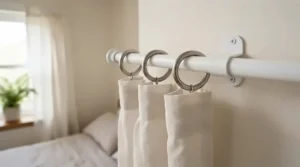
Not all eyelets are built the same, and this is where the Rolls Neo Curtain Rings pull ahead of several cheaper alternatives on this list. Sized for 35mm poles, each ring has an oval-edged profile and, notably, a welded eyelet rather than the pressed-metal eyelet used on most of the other entries here.
Reviewers consistently note that welded construction resists flexing and cracking under sustained weight far better than a pressed eyelet, which is a meaningful difference if you’re hanging interlined, thermal, or blackout curtains rather than a single layer of lightweight cotton. The oval shape is a deliberate design choice too — it reduces the risk of a ring catching awkwardly on a bracket as it passes, something round rings occasionally struggle with on poles with closely spaced supports. Aggregated feedback across the wider Rolls Neo curtain hardware range highlights durability as a recurring theme, alongside the occasional comment that the oval shape sits slightly differently on the pole compared with a perfectly round ring, which some buyers found took a little getting used to visually.
Pros:
- ✅ Welded eyelet copes far better with heavy or interlined curtains
- ✅ Oval edge reduces catching on brackets during use
- ✅ Nylon lining keeps operation quiet despite the extra strength
Cons:
- ❌ Oval rings aren’t interchangeable with standard round-ring packs
- ❌ Only available in the 35mm size for this specific line
At £6 to £10 for six rings, this is the pick for anyone whose curtains are noticeably heavier than average.
7. Hallis Hudson Eden Wooden Rings — premium hand-finished Ash wood for statement wooden poles
Every list needs one product that exists on a different tier entirely, and the Hallis Hudson Eden Wooden Rings are it. Sized for chunky 45mm poles, each ring is solid Ash wood, hand-finished in England, and available in five natural stain shades — Oatmeal, Natural Ash, Sisal, Cocoa, and Umber — sourced from Forestry Commission responsibly managed forests, with the brand partnering with One Tree Planted on top.
Based on the spec comparison, this product simply isn’t competing with metal or plastic rings on price or glide mechanics — it’s competing on material honesty. Reviewers consistently note that pairing a proper wooden pole with plastic or steel rings undercuts the whole look, and that’s precisely the gap this fills, with five stain options allowing genuine colour-matching rather than the usual “close enough” compromise buyers make with off-the-shelf rings. Dedicated review volume for the ring packs themselves is thinner than for the metal options above, largely because most buyers acquire them bundled with a full Eden pole set rather than as standalone spares, but the retailer’s own customer feedback for the wider Eden range consistently praises finish quality and the noticeably handmade feel.
Pros:
- ✅ Genuine hand-finished wood feels considerably more premium
- ✅ Five stain shades allow close, deliberate colour-matching
- ✅ Responsibly sourced material with a tree-planting partnership
Cons:
- ❌ Noticeably pricier per ring than any metal or plastic option
- ❌ Chunky 45mm sizing won’t suit slim, modern poles
Between £15 and £25 for six rings, this is a considered purchase rather than an impulse one — reserved for poles that deserve the extra investment.
How to Fit Curtain Rings to Your Pole: A Step-by-Step Setup Guide
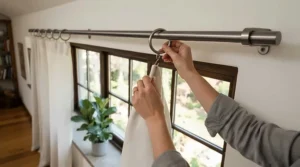
Fitting curtain rings for curtain pole systems properly takes about twenty minutes once you know the order of operations, but getting it wrong the first time usually means unpicking stitching or re-threading an entire curtain later. Start by counting your rings before you begin: as a rule of thumb, one ring roughly every 10-15cm along the pole gives curtains enough support without bunching, and lightweight curtains can stretch that spacing slightly further than heavy interlined ones.
Thread or clip the rings onto the pole before fitting any brackets, since it’s far easier to slide rings on an unmounted pole than to squeeze them past a finial afterwards. If you’re using clip-style rings like the TSKDKIT or Coideal options, attach the clips to the curtain’s top edge working from one side to the other, keeping spacing even so the curtain hangs in consistent folds rather than lopsided pleats. For eyelet rings paired with hooks, like the Speedy or Rolls Neo rings, insert the hook through both the ring’s eyelet and the curtain’s heading tape loop, checking the hook sits snugly without gaping.
A common first-30-days mistake is fitting rings too tightly together, which restricts the curtain’s ability to stack neatly when opened. Space them slightly generously rather than tightly, and you’ll notice cleaner folds within the first week of use.
Curtain Ring Size for Pole Diameter: Getting the Fit Right
Getting the curtain ring size for pole diameter wrong is probably the single most common and most avoidable mistake in this entire category. A ring that’s too snug won’t glide at all; one that’s too loose will wobble and rattle every time a breeze catches the fabric.
| Pole Diameter | Recommended Ring Internal Diameter | Typical Products | Best For |
|---|---|---|---|
| 19-25mm | 28-30mm | TSKDKIT, Coideal | Slim café or net poles |
| 25-28mm | 30-35mm | Rothley, Speedy | Standard bedroom windows |
| 28-35mm | 35-40mm | Integra Elements, Rolls Neo | Living room bay windows |
| 40-45mm | 45-50mm | Hallis Hudson Eden | Statement wooden poles |
As the table shows, the general rule is to allow roughly 5-10mm of clearance between a pole’s outer diameter and a ring’s internal diameter, since too little clearance causes friction and too much causes wobble. Manufacturers rarely state this margin outright, which is exactly why so many buyers order rings based on curtain pole width alone rather than checking the ring’s actual internal measurement against it — always measure your pole with a tape measure rather than trusting a listing’s category label.
Real-World Scenarios: Matching Curtain Rings to Your Room
Picture three fairly typical UK households. First, a first-time renter in a Manchester flat share, hanging lightweight unlined curtains on a slim 25mm pole in a bedroom, on a tight budget and without a sewing machine in sight — the TSKDKIT clip rings solve this in one afternoon, no stitching required. Second, a family in a Victorian terrace with a young child who wakes at the slightest noise, hanging heavier thermal-lined curtains on a 28mm pole in the nursery — here, the nylon-lined Rothley or Speedy rings genuinely earn their keep, since the quiet glide directly protects a sleeping toddler from a 6am screech.
Third, a couple who’ve just invested in proper interior design for their living room, complete with a substantial 45mm wooden pole as a focal point — cheap plastic rings would visibly undercut that investment, making the Hallis Hudson Eden wooden rings the only sensible match. Thermal-lined curtains in particular deserve a mention here: as the government’s own energy efficiency guidance on window coverings notes, well-fitted curtains drawn at dusk can meaningfully cut heat loss through windows, which means heavier thermal curtains are increasingly common — and heavier curtains need rings rated for the extra load, not the cheapest pack on the shelf.
How to Choose Curtain Rings for Your Curtain Pole
Choosing correctly comes down to five checks, in this order.
- Measure your pole’s exact diameter. Don’t rely on the product category name; measure with a tape measure and add 5-10mm clearance when picking ring size.
- Weigh your curtains honestly. Lightweight cotton and voile tolerate basic clip rings, while interlined or blackout curtains need welded eyelets and sturdier metal.
- Decide between clips and eyelets. Clips suit no-sew setups and rentals; sewn eyelets or hook-compatible rings suit curtains you’re keeping long-term.
- Prioritise noise if it matters to you. Bedrooms, nurseries, and shared walls all benefit from nylon-lined rings over bare metal.
- Match the finish to your pole, not just your walls. A mismatched ring finish is more visually jarring at close range than most buyers expect until it’s already installed.
Reviewers consistently note that skipping the measuring step is the single most common reason for a return or a repeat purchase, so treat step one as non-negotiable regardless of how tempting a good-looking product photo might be.
Curtain Rings With Clips: Are They Right for Your Curtains?
Curtain rings with clips solve a genuine problem: not everyone owns a sewing machine, and not every curtain fabric suits a stitched eyelet heading. Clip rings, like the TSKDKIT and Coideal options covered above, use a spring-loaded pincer jaw that clamps directly onto the curtain’s top edge, meaning the curtain itself needs zero alteration before hanging.
That convenience comes with a genuine trade-off in clip ring compatibility, though. Very sheer or delicate fabrics can crease or even tear slightly under a firm clip’s grip, particularly on cheaper clips with sharper jaw edges, so it’s worth testing a clip on a spare fabric scrap before committing an entire curtain to it. Clip ring compatibility also depends heavily on curtain weight matching clip strength — a lightweight clip on a heavy interlined curtain risks slow slippage over weeks of use, while an overly stiff clip on delicate voile risks visible pinch marks. What most buyers overlook is that clip and pole compatibility isn’t just about the ring’s internal diameter; it’s about whether the clip mechanism itself has enough spring tension for your specific fabric weight, which rarely appears clearly on a product listing.
Eyelet vs Ring-Top Curtains: Which Works Best With Curtain Rings
The eyelet vs ring-top curtains debate often gets muddled because the terms overlap in confusing ways. Ring-top curtains have sewn-in fabric loops or tape that a separate curtain ring threads through, while true eyelet curtains have metal-reinforced holes punched directly into the fabric, often designed to slide straight onto a pole without any ring at all.
| Method | How It Attaches | Noise Level | Best For |
|---|---|---|---|
| Curtain rings (clip) | Clamps onto fabric edge | Low-moderate | No-sew, lightweight curtains |
| Curtain rings (eyelet + hook) | Hook through ring and heading tape | Low with nylon lining | Traditional pencil-pleat curtains |
| Sewn fabric eyelets | Pole threads directly through fabric | Low, but drags on pole | Modern, minimalist curtains |
| Ring-top tab loops | Fabric loop over pole, no ring | Moderate, fabric-on-pole friction | Casual, rustic styling |
Here’s what to weigh: sewn fabric eyelets look sleek and modern because there’s no visible hardware, but the fabric itself drags directly against the pole with every open and close, which wears the fabric faster than a proper ring ever would. Curtain rings, by contrast, take that friction entirely off the fabric and onto replaceable, purpose-built hardware — which is exactly why most heritage and premium curtain brands still favour rings over direct-eyelet fabric even when the ring-free look is trending in interiors media.
Brass vs Plastic Rings: Which Material Wins for Your Pole
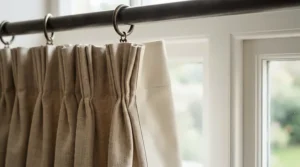
The brass vs plastic rings question isn’t really about which material is objectively better — it’s about which trade-offs suit your specific pole and curtain weight. Brass and brass-plated steel rings, like several options covered above, offer genuine durability and a traditional finish that ages well, but they’re heavier and, without a nylon lining, noisier against a metal pole.
Plastic rings glide more smoothly with less friction and cost less to manufacture, which is why they dominate the cheapest end of the market, but they’re rated for lighter curtain weights and can become brittle over several years of UV exposure near a sunny window. What the spec sheet won’t tell you is that many “brass” rings on the market are actually brass-plated steel rather than solid brass, which affects long-term wear differently — plated finishes can show base metal through at contact points after years of daily sliding, while solid brass simply develops a natural patina. For anyone torn between the two, a nylon-lined steel ring, like the Rothley or Speedy options above, often splits the difference more sensibly than either pure brass or pure plastic.
Long-Term Cost & Maintenance of Curtain Rings
Curtain rings are cheap individually, but total cost of ownership adds up faster than most buyers expect once you factor in replacement packs for a full window, plus any curtain hooks bought separately. A single 10-pack rarely covers an entire standard window on its own — most bay or wide windows need two to three packs, pushing what looks like a £5 purchase closer to £15 in practice.
Maintenance itself is minimal but not zero: nylon linings can pick up dust over years, which slightly increases friction, and an occasional wipe with a dry cloth restores most of the original glide. Metal rings without protective coating can develop light surface rust in humid bathrooms or kitchens within a couple of years, which is precisely why matte or powder-coated finishes, like those on the Rothley and Coideal rings, tend to outlast bare steel in those specific rooms. Wooden rings need the least ongoing attention but the most care during initial fitting, since forcing a wooden ring onto a pole that’s even slightly too large risks a hairline crack that metal rings simply wouldn’t suffer.
Silent Curtain Rings UK: What to Expect from Real-World Performance
Silent curtain rings UK buyers are, more often than not, chasing one specific outcome: not waking a light-sleeping partner, child, or themselves at an unreasonable hour. In real-world use, “silent” is a slightly optimistic word for what a nylon lining actually achieves — it’s more accurate to call it “significantly quieter” rather than perfectly silent, since some contact noise between ring and pole is essentially unavoidable with any rigid material.
That said, the difference between a bare metal ring on a metal pole and a nylon-lined equivalent is genuinely noticeable, not a marginal marketing claim. University research into window coverings has separately found that heavier, better-fitted curtains reduce more than just heat loss — the added mass and denser weave of thermal curtains also dampens vibration and rattle at the pole itself, an effect explored in academic research on curtains and domestic heat retention. Reviewers consistently note that combining a nylon-lined ring with a slightly heavier curtain produces a noticeably quieter result than lightweight curtains on the exact same rings, suggesting the ring is only ever half of the noise equation.
Curtain Ring Problems and Quick Fixes
Problem: rings squeak on a metal pole. Fix: swap to nylon-lined rings like the Speedy or Rothley options, or apply a small amount of clear furniture wax to the pole itself for a temporary improvement.
Problem: clips slip off heavier curtains over time. Fix: move to eyelet-and-hook rings rated for heavier fabric, such as the Rolls Neo welded-eyelet design, rather than pushing lightweight clips beyond their intended weight range.
Problem: rings won’t glide smoothly around bay window corners. Fix: check that ring internal diameter has enough clearance from the pole, and consider oval-profile rings, which some buyers find catch less on tight bends.
Problem: mismatched finishes across multiple poles in the same house. Fix: standardise on a single coordinated finish range, such as Integra Elements, so spare rings for any room come from one consistent product line.
For anyone leaning into heavier thermal curtains to cut winter heating costs, it’s worth reading up on how thermal window treatments actually perform before assuming any old ring pack will cope with the extra weight — heavier fabric genuinely does demand sturdier hardware.
FAQ
❓ What size curtain rings do I need for a 28mm pole?
❓ Are curtain rings with clips better than eyelet curtains?
❓ How many curtain rings do I need per metre of curtain pole?
❓ Can I mix brass and plastic curtain rings on the same pole?
❓ Do silent curtain rings really stop the noise?
Conclusion
Choosing curtain rings for curtain pole hardware rightly feels like a small decision, right up until the wrong choice starts squeaking at 6am or sagging under a curtain it was never rated to hold. The good news is that narrowing it down genuinely isn’t complicated once you measure your pole diameter honestly, weigh up your curtain fabric, and decide how much you value a quiet glide over raw cost.
Budget clip rings like the TSKDKIT and Coideal options earn their keep for lightweight, no-sew setups, while nylon-lined eyelet rings from Rothley, Speedy, Integra Elements, and Rolls Neo cover everything from standard bedrooms to heavier interlined living-room curtains. And if you’ve invested in a genuine wooden pole as a design statement, the Hallis Hudson Eden rings are the only choice that won’t visibly undercut that investment. Whichever you land on, the sizing table and setup steps above should mean your next curtain-ring purchase is a considered decision rather than a guess.
Recommended for You
- Heavy Duty Curtain Pole For Thick Curtains: 7 Best Picks (2026)
- Bendable Curtain Pole For Bay Window: 7 Best Flexible Picks (2026)
- Extendable Curtain Pole for Large Windows: 7 Best UK Picks (2026)
Disclaimer: This article contains affiliate links. As an Amazon Associate, I earn from qualifying purchases. If you purchase products through these links, we may earn a small commission at no additional cost to you.
✨ Found this helpful? Share it with your friends! 💬🤗
