

In This Article
Stand in front of any bare window with a tape measure in one hand and a laptop full of open tabs in the other, and the question always arrives the same way: curtain track or curtain pole? It sounds like a footnote decision, the sort of thing you settle in thirty seconds between choosing a paint colour and arguing about blackout lining. It isn’t. The hanging system you pick decides how your curtains move, how much weight they can carry, whether they’ll hug a bay window or fight it, and whether visitors ever clock the hardware at all.

A curtain track is a slim rail, usually plastic or aluminium, that gets tucked out of sight above the curtain heading and quietly does the mechanical work. A curtain pole is the opposite instinct entirely — a visible rod, often in wood, brass or matt black, with rings that clunk gently as you draw the curtains, finished off with a pair of finials that act like jewellery for your window. Both do the same basic job. How they do it, and how they look while doing it, could not be more different.
Many British homes still have curtains with cords, and it matters who’s choosing the hardware behind them, because loops and cords around a window pose a genuine strangulation hazard to small children. That single fact — dry-sounding, easy to skim past — shapes several of the buying decisions in this guide, so keep it in mind as you read on. Below, seven real UK-available systems, honestly compared, so you can pick the one that actually suits your windows rather than the one that photographed best on Pinterest.
Quick Comparison Table
| System | Type | Best For | Price Range |
|---|---|---|---|
| Swish Sologlyde | Track | Lightweight curtains on a budget | Under £40 |
| Rolls Superglide | Bendable track | Bay windows on a budget | £40-£70 range |
| Swish Superluxe | Corded track | Heavy curtains, hard-to-reach windows | £50-£90 range |
| Silent Gliss System 3900 | Corded track | Premium quiet operation | £140-£160 range |
| Rothley Klick-Fit | Extendable pole | Quick DIY fitting, decorative look | £20-£45 range |
| John Lewis Wooden Pole | Fixed pole | Traditional, statement finials | £35-£90 range |
| Silent Gliss Metropole | Hidden-pole hybrid | Designer look, smooth glide | £150+ range |
Looking across the table, the split is fairly stark: tracks dominate the practical, hidden-mechanism end of the market, while poles own the decorative, “see and admire” end. The one genuine hybrid, the Silent Gliss Metropole, sits in its own category because it borrows the pole’s visual language while running on track internals — more on that later. If your priority is function over form, start with the tracks; if the pole itself is meant to be a design feature, skip ahead to the poles.
💬 Which camp are you already leaning towards — hidden and hardworking, or visible and decorative? Keep that in mind as you scroll.
Top 7 Curtain Tracks and Poles: Expert Analysis
Here’s a properly researched look at seven real, currently available systems — three tracks, two poles, one bendable bay-window specialist, and one hybrid that refuses to pick a side.
1. Swish Sologlyde — budget-friendly workhorse for everyday rooms
The Swish Sologlyde has been quietly holding up curtains in British homes for decades, and its reputation rests on being unglamorous but dependable. It’s a lightweight PVC track designed for uncorded, hand-drawn operation, which keeps the price down and the fitting process almost embarrassingly simple.
Because the Swish system has barely changed in decades, the gliders and brackets you buy today will still fit a track that has been above your window since the 1980s, and every version uses the same snap-on Leverlock bracket that holds the track firmly without fiddly screws or spring clips. In practice, that means spare parts are never a headache, even years down the line — a genuinely underrated form of long-term value that glossier competitors can’t always promise.
This is the pick for renters, box rooms, kitchens and anyone hanging lightweight voiles or unlined curtains who doesn’t want to spend more on hardware than on fabric. It’s not the track for heavy interlined drapes or a grand bay window, and it won’t win any design awards sitting bare above a pelmet-free window. Aggregated buyer feedback consistently frames it as functional rather than beautiful — reviewers reach for words like “reliable” and “does the job,” not “elegant.”
Pros:
- ✅ Very low cost, ideal for tight decorating budgets
- ✅ Cuttable to length with basic household tools
- ✅ Decades of spare-part compatibility with older tracks
Cons:
- ❌ Not rated for heavy or interlined curtains
- ❌ Visible unless concealed by a pelmet or valance
At under £40 for most standard lengths, the Swish Sologlyde is about as low-risk a purchase as curtain hardware gets — genuinely hard to beat for light-use rooms.
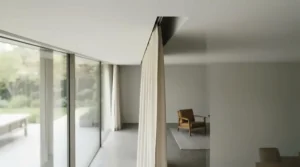
2. Rolls Superglide — best budget track for taming a bay window
Bay windows have a way of humiliating cheap curtain hardware, and the Rolls Superglide is one of the few budget systems that actually copes with the geometry. It’s hand bendable at home, forwards only, to suit all shapes of bay window, and comes complete with slider gliders and universal brackets for wall or ceiling fixing, end stops, fixing screws, wall plugs and fitting instructions.
What that spec sheet doesn’t spell out is how forgiving the bending process feels in practice — you shape it around the bay by hand, no heat gun or specialist tool required, and it holds its curve once fixed. It’s suitable for medium to heavy weight curtains of up to 10kg, which covers the majority of standard lined curtains found in a British sitting room.
Real customer sentiment backs this up rather than just the marketing copy: the product carries a 4.5 out of 5 rating from 38 reviews, with 84% of reviewers saying they’d recommend it to a friend. A handful of reviewers do flag that fitting a bay-window track single-handedly is fiddly and that professional fitting is worth considering for tricky angles — a fair trade-off given the price.
Pros:
- ✅ Bends by hand to fit two- or three-sided bays
- ✅ Handles curtains up to 10kg without sagging
- ✅ Strong aggregated review score with high recommend rate
Cons:
- ❌ Forward bending only, no reverse-bend flexibility
- ❌ Some reviewers found solo fitting on bays fiddly
Priced in the £40-£70 range depending on length, it’s the clear budget-to-mid pick for anyone whose main headache is an awkward bay rather than a straight run of wall.
3. Swish Superluxe — heavy-duty corded track for tall or awkward windows
Step up from the Sologlyde and you land on the Swish Superluxe, a PVC corded track engineered for the curtains that actually strain lesser hardware. Formerly known as Swish, the Hallis Hudson Superluxe is a PVC corded curtain track designed to support heavy curtains with weights of up to and including 15 kg, and the track is supplied pre-assembled and pre-corded with all necessary brackets and roller gliders included.
The corded mechanism is the real differentiator here — rather than dragging fabric across the rail with your hands, you pull a cord, which keeps grubby fingerprints off pale linen and, on tall or stairwell windows, saves you from stretching up on tiptoes every evening. A cross-over arm is also included, letting the curtains slightly overlap so there’s no unsightly gap down the centre when closed.
Where it earns its keep is on dressing rooms with high ceilings, bay windows with a heavier interlined curtain, or any household where little hands might otherwise be tempted to yank at fabric. That said, corded systems bring their own responsibilities, which we cover properly in the safety section further down — don’t skip it if there are children or pets in the house.
Pros:
- ✅ Rated for curtains up to a substantial 15kg
- ✅ Cord operation keeps fabric clean and untouched
- ✅ Cross-over arm eliminates a central light gap
Cons:
- ❌ Requires a compliant cord safety device around children
- ❌ Bulkier profile than uncorded lightweight tracks
Expect to pay in the £50-£90 range for most window widths, which is a fair premium for handling weight a basic track simply can’t.
4. Silent Gliss System 3900 — the premium corded track for a genuinely hushed glide
If you’ve ever wondered why hotel curtains close so smoothly and silently, there’s a decent chance a Silent Gliss System 3900 was doing the work above the rail. It’s a premium-quality, cord-operated curtain track trusted worldwide in luxury homes, hotels and high-end commercial interiors, with a sleek, minimalist aluminium profile that delivers exceptionally smooth, effortless operation.
What separates this from the budget corded tracks isn’t a gimmick — it’s glider engineering. The curtain can be adjusted without friction because the roller gliders sit at the front of the rim, which also significantly reduces dust build-up over time, a small detail that pays off every single time you actually notice how little you’re cleaning the track. The track supports medium to heavy-weight curtains up to 14kg and can be bent forward or reverse for bay window configurations.
This is the track for a formal sitting room, a primary bedroom with statement drapes, or anywhere the sound of curtains scraping across plastic gliders would genuinely irritate you at 7am. It’s overkill for a box room. Reviewers and specifiers consistently note that the quieter glide and near-invisible aluminium profile are what justify the extra spend over a standard PVC corded track.
Pros:
- ✅ Exceptionally smooth, genuinely quiet glide action
- ✅ Bendable for bay windows in both directions
- ✅ Minimalist aluminium profile disappears visually
Cons:
- ❌ Noticeably pricier than PVC corded alternatives
- ❌ Best value realised with professional fitting
At around £140-£160 for a standard set, it sits firmly at the top of the track category — a considered investment rather than an impulse buy.
5. Rothley Klick-Fit — the fastest pole to fit yourself this weekend
Poles have a reputation for fiddly grub screws and brackets that never quite line up, and the Rothley Klick-Fit exists specifically to dismantle that reputation. The extendable pole allows precise adjustment to suit a range of window widths without cutting, and each kit includes Rothley’s patented Klick-Fit brackets, enabling faster fitting and concealed fixings for a seamless look.
The telescopic construction is the headline feature: the mechanism uses telescopic rods with inner and outer tubes that slide into each other, so the rod can be extended while maintaining sturdiness, made from sturdy iron that resists bending or warping over time. In practical terms, that means no hacksaw, no trip to a hardware shop for a blade, and no risk of cutting a pole two centimetres too short at 6pm on a Sunday. Push-fit finials complete the design, removing the need for visible grub screws.
It suits first-time buyers, rental properties where poles need to come down easily at move-out, and anyone who wants a decorative finish without booking a fitter. Weight capacity is the trade-off: this is a pole for medium curtains, not heavy interlined velvet.
Pros:
- ✅ No cutting to length needed, fully telescopic
- ✅ Klick-Fit brackets install in minutes
- ✅ Concealed fixings for a tidy, seamless finish
Cons:
- ❌ Not intended for very heavy curtain fabrics
- ❌ Finish range is narrower than premium pole brands
Typically priced in the £20-£45 range depending on length and finish, it’s an easy recommendation for anyone who wants pole aesthetics without pole hassle.

6. John Lewis Wooden Curtain Pole — the classic, decorative statement piece
Some windows simply ask for wood grain and a proper finial, and the John Lewis Wooden Curtain Pole delivers exactly that traditional register. It’s a wooden curtain pole with an attractive stained finish and classic ball finials, and the kit includes all the accessories and fittings needed to fit the pole, so all that’s left is choosing your curtains.
Construction quality is worth flagging here for buyers used to mass-market poles: the composition pairs a 100% pine wood pole with birch wood brackets and finials, and the curtain rings are made from Schima Wallichii timber, with the pole manufactured in the United Kingdom. That’s a meaningfully different proposition to the painted MDF poles found at the very budget end — the grain shows through the stain rather than sitting under a plastic-feeling coat.
This is the pole for period cottages, panelled sitting rooms, or any scheme where the hardware is meant to be admired rather than hidden. Aggregated customer ratings sit in solidly average-to-good territory rather than universal five-star praise, with the spread of feedback suggesting satisfaction depends heavily on matching the stain shade to existing woodwork — worth ordering a sample where possible.
Pros:
- ✅ Genuine wood construction, UK-manufactured
- ✅ Classic ball finials suit period and cottage interiors
- ✅ Complete kit with all fittings included
Cons:
- ❌ Heavier and bulkier than aluminium pole alternatives
- ❌ Stain shade can vary from online product photography
Prices range from roughly £35 for a short length up to £90 for a longer pole, positioning it as a genuinely mid-range decorative investment.
7. Silent Gliss Metropole — the hidden pole that behaves like a track
The Silent Gliss Metropole is the answer to a very specific brief: “I want the look of a pole but the smooth mechanics of a track.” Metropole features an internal gliding channel, avoiding the need for curtain rings, to give the appearance of a pole but the ease and usability of a track, bringing together precision engineering with considered product design.
What makes it genuinely clever rather than just expensive is how the glide mechanism hides inside the pole body itself. It’s offered in three round pole diameters plus a rectangular profile, made to measure, and can be bent or curved on request, with hand, cord or electric operation available. There’s no visible track above the pole and no rings clacking against each other — the curtain simply glides, while the outside world sees a clean architectural rod.
This is the system for design-led new builds, architect-specified interiors, or a primary bedroom where the client has explicitly said “no visible track, but I still want a statement pole.” It’s a genuine investment piece rather than a casual purchase, and the made-to-measure process means budgeting time as well as money.
Pros:
- ✅ Combines pole aesthetics with track-smooth gliding
- ✅ Made to measure, including curved configurations
- ✅ Hand, corded or electric operation options
Cons:
- ❌ Premium pricing reflects bespoke manufacturing
- ❌ Best specified through a professional retailer
Pricing typically starts from around £150 and rises steeply with length, finish and motorisation — very much the top shelf of this comparison.
Practical Usage Guide: Fitting and Maintaining Your Track or Pole
Getting a track or pole up straight is one job; keeping it running smoothly for a decade is another entirely. Start with bracket spacing: as a rule of thumb, fix a bracket every 40-60cm along a track, and closer together over 30cm if the curtains are heavy — sagging almost always traces back to brackets spaced too far apart, not a faulty track. For poles, two end brackets are fine up to around 150cm, but anything longer needs a centre support or the pole will bow under its own weight within months.
A common first-30-days mistake is fixing into plasterboard alone. Curtain hardware carries real dynamic load every time you draw the curtains, so locate a stud or joist, or use proper plasterboard fixings rated for the weight, not the little plastic wall plugs bundled in cheaper kits.
Maintenance is refreshingly low-effort. Once or twice a year, wipe the track channel with a dry cloth to clear dust — the same dust that eventually makes gliders squeak — and apply a light spray of silicone lubricant rather than oil, which attracts grime instead of repelling it. On corded systems, check the cord tensioner or cleat is still firmly fixed to the wall or floor; a loose one defeats the entire point of the safety device. Gliders wear out eventually on all systems: buy a small spares pack when you fit the track, since matching an exact profile years later can be surprisingly hard.

Real-World Scenarios: Which System Actually Suits Your Room
Picture three fairly ordinary UK households, each solving the same basic problem differently. First, a young couple renting a two-bed flat with a single bedroom window and a tight budget: the Swish Sologlyde wins easily here, cheap enough to abandon at move-out and simple enough to fit in an afternoon with a borrowed drill.
Second, a family with a Victorian bay window in the sitting room, two young children, and a heavier lined curtain inherited from the previous owners: the Rolls Superglide handles the bay’s geometry on a sensible budget, though the household would be wise to pair any future corded upgrade with a proper cord cleat given the children in the house.
Third, a couple renovating a new-build with an architect-specified primary bedroom, wanting a clean, hardware-free aesthetic and willing to spend for it: the Silent Gliss Metropole is the obvious fit, delivering the designer pole look without a visible track breaking the ceiling line. Matching the system to the actual household, not just the window measurements, is what separates a good buying decision from a merely adequate one.
Buyer’s Decision Framework
If you’re still torn, work through this in order. If your priority is invisibility and price, choose a basic track like the Swish Sologlyde. If your window is a bay or has an awkward angle, choose a bendable track such as the Rolls Superglide before considering anything else — poles rarely cope well with tight bay geometry. If the curtains themselves are heavy or interlined, prioritise weight rating over style and look at the Swish Superluxe or Silent Gliss System 3900. If the pole itself is meant to be part of the room’s character, choose a decorative pole like the John Lewis Wooden Curtain Pole or the Rothley Klick-Fit depending on budget. If you want both the decorative look and smooth hidden mechanics and have the budget to match, the Silent Gliss Metropole is the only system genuinely built for that brief.
What Is a Curtain Track vs a Curtain Pole?
A curtain track is a slim, usually concealed rail — plastic or aluminium — fixed to a wall or ceiling that carries hidden gliders to move the curtain; a curtain pole is a visible rod, often wood or metal, from which curtains hang on decorative rings, finished with finials at each end. The core difference is visibility and mechanism: tracks disappear behind the curtain heading, while poles are designed to be seen and admired as part of the room.
That distinction cascades into everything else. Tracks generally handle heavier curtains and awkward shapes such as bay windows more gracefully, because their gliders run in an enclosed channel. Poles are chosen primarily for aesthetics and tend to suit straight, standard windows where the hardware itself is part of the decorative scheme rather than something to hide.
How to Choose Between Curtain Track and Curtain Pole
- Check your window shape first. Bay, bow or curved windows almost always favour a bendable track over a rigid pole, which simply cannot follow the curve.
- Weigh your curtains, not just your budget. Heavy interlined curtains need a track or pole explicitly rated for that weight, or expect sagging within a year.
- Decide if the hardware should be seen. If you want a hidden pelmet-style finish, choose track; if you want a visible design feature, choose pole.
- Consider corded vs hand-drawn operation. Tall windows and households with young children both change this answer, in opposite directions.
- Match the heading style you already own. Not every heading suits every system — see the compatibility section below before you buy.
- Factor in fitting skill and time. Klick-Fit poles and pre-corded tracks suit confident DIYers; bay window tracks often reward professional fitting.
- Budget for the whole kit, not just the rail. Brackets, finials, gliders and cord cleats all add to the real total cost.
Ceiling Mounted Curtain Track: What to Know Before You Fix One Up
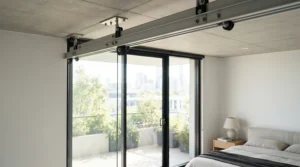
Ceiling mounted curtain track is a genuinely popular category on Amazon UK, and it solves a specific problem: windows with little or no usable wall space above the frame, or rooms where you want the curtain to run flush to the ceiling for a taller, more dramatic drop. Fixing to the ceiling rather than the wall also sidesteps thin plaster above a window lintel, which can otherwise make wall-fixing unreliable.
The trade-off is precision. Ceiling fixings need to be level along their entire run, or the curtain will visibly hang lower at one end — far more noticeable than a slightly uneven wall bracket. Locating joists in the ceiling matters even more here than on a wall fix, since ceiling plasterboard alone won’t safely carry a loaded track. Both the Swish Superluxe and Silent Gliss System 3900 in this guide are supplied ready for either wall or ceiling fixing, which is worth checking before you buy if your room specifically needs the ceiling option.
Track vs Pole for Bay Windows
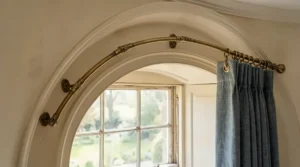
Bay windows are where the track-versus-pole debate gets genuinely practical rather than purely aesthetic, because a rigid pole simply cannot follow a two- or three-sided bay without unsightly gaps at each angled joint. Bendable tracks such as the Rolls Superglide exist specifically to solve this, hand-shaped around the bay and held in place by closely spaced brackets that follow the curve.
That said, bay-specific curved poles do exist from specialist retailers, custom-bent to a bay’s exact angles — but they cost considerably more than an off-the-shelf bendable track and generally need professional measuring. For most UK homeowners with a standard bay, a bendable curtain track remains the more cost-effective and forgiving choice, while a curved pole is reserved for those explicitly chasing the visible-hardware look regardless of expense.
Hidden vs Decorative Hanging Systems
This is really the philosophical heart of the whole track-versus-pole question. A hidden system, almost always a track, aims to disappear entirely behind the curtain heading or a pelmet, letting the fabric itself do all the visual work. A decorative system, almost always a pole, treats the hardware as jewellery for the window — the finials, the ring detailing, the finish, all deliberately on show.
The Silent Gliss Metropole muddies this distinction on purpose, offering a pole’s silhouette with a track’s internal mechanics, and it’s worth asking yourself honestly which camp you actually belong to before paying a premium for that hybrid. If you already own curtains with a valance or pelmet planned, a hidden track wastes none of its budget on looks you’ll never see. If the window is bare above the rail, a decorative pole earns its keep every single day.
Curtain Heading Compatibility: Matching Your Curtains to the Right System
Not every curtain heading works with every hanging system, and this trips up more first-time buyers than almost anything else on this list. Pencil pleat and pinch pleat headings, sewn with integral hook pockets, work happily on both tracks and poles, making them the safest default choice if you’re not certain which system you’ll end up with. Eyelet headings, by contrast, are pole-only by design — the curtain slides directly onto the pole through metal rings sewn into the fabric, and there’s no sensible way to run an eyelet curtain on a track.
Tab-top and tie-top headings are similarly pole-exclusive for the same structural reason. Wave headings, increasingly popular for their neat, continuous ripple, need a specific glider-cord track system such as those offered in the Silent Gliss range rather than a standard track or any pole. Before ordering hardware, check your existing curtains’ heading tape, or decide on the heading first if you’re buying curtains and hardware together — it genuinely dictates half the decision.
Glider vs Ring Runners: Which Glides Better
Tracks use gliders — small plastic or metal hooks that run inside an enclosed channel — while poles use ring runners, decorative rings that slide directly over the pole’s exterior surface. Gliders tend to win on pure smoothness because the enclosed channel keeps dust and debris away from the moving parts, which is exactly why premium corded tracks like the Silent Gliss System 3900 feel so effortlessly quiet in daily use.
Ring runners, however, have their own quiet advantage: they’re visible, replaceable individually without dismantling the whole system, and they contribute directly to the decorative effect a pole is chosen for in the first place. If smoothness and silence are the priority, lean track. If you actively want to hear and see the gentle clack of rings as curtains open each morning, that tactile, slightly old-fashioned quality is part of a pole’s appeal, not a flaw to engineer away.
Corded Curtain Track Reviews: What Reviewers Actually Say
Aggregated feedback on corded tracks tends to cluster around two themes: fabric protection and convenience on hard-to-reach windows. Reviewers of systems like the Swish Superluxe and Silent Gliss System 3900 consistently note cleaner curtain edges over time, since hands never directly touch the fabric during opening and closing — a genuinely practical benefit for pale or delicate linings that would otherwise show finger marks within weeks.
The recurring criticism isn’t about the mechanism itself but about installation: several reviewers mention that getting cord tension exactly right takes a bit of trial and error on a first fit, and that professional installation removes this friction entirely for a modest extra cost. On the safety side, reviewers with young children in the house almost universally recommend fitting a cord cleat or tensioner immediately, treating it as a non-negotiable part of the purchase rather than an optional extra.
Common Mistakes When Buying Curtain Tracks or Poles
The single most frequent mistake is measuring the window rather than the intended track or pole width — hardware should typically extend 15-20cm beyond the window frame on each side to let curtains stack back fully and let more light in when open. A close second is ignoring weight ratings; interlined or velvet curtains routinely exceed what a budget track or slim pole is rated to carry, leading to sagging within months.
Buyers also frequently overlook bracket projection — the distance the bracket holds the track or pole away from the wall — which needs to clear any existing blinds, window handles or deep reveals. Finally, many people buy the pole or track before deciding on the curtain heading, then discover their chosen eyelet curtains simply can’t go on the track they’ve already fitted. Decide heading and hardware together, not in sequence.
Safety, Regulations and Cord Compliance
Cords on window coverings, including curtain tracks, pose a genuine strangulation hazard because loops can form and children can become entangled in them while playing near a window, and children can also climb on window sills or nearby furniture to reach cords they otherwise couldn’t. UK and EU safety standards for corded window coverings exist specifically because of this risk, and while curtain tracks aren’t always covered by the same mandatory testing as blinds, the same practical precautions apply directly to any corded curtain track in this guide.
In practice, that means fitting a cord cleat or tensioner and using it every single day, keeping cots, beds and playpens away from any window with a corded track nearby, and choosing an uncorded, hand-drawn track such as the Swish Sologlyde in any room used regularly by young children. It’s a small habit that costs nothing beyond a moment’s thought, and it’s worth building into your routine from the day the track goes up, not retrofitting after the fact.
Thermal performance is worth a quick mention too, since it’s rarely discussed alongside hardware choice. The Energy Saving Trust estimates that 18% of heat is lost through windows in an uninsulated house, and thermal curtains are one of the most cost-effective ways to reduce that heat loss and cut heating bills. Whichever hanging system you choose, make sure it’s rated to carry a properly lined or thermal curtain if energy efficiency is part of your decision — a flimsy track paired with a heavy thermal curtain is a recipe for sagging brackets by January.
FAQ
❓ What's the difference between curtain track and curtain pole?
❓ Can you use a curtain track for a bay window?
❓ Is a corded curtain track safe with children in the house?
❓ Do eyelet curtains work on a curtain track?
❓ Which is better for heavy curtains, track or pole?
Conclusion
There’s no universal winner between curtain track and curtain pole — only a better fit for the specific window, curtain weight and look you’re after. Budget, hidden tracks like the Swish Sologlyde solve straightforward straight windows cheaply; bendable options like the Rolls Superglide rescue awkward bays without a big spend; corded systems from Swish Superluxe through to the Silent Gliss System 3900 earn their higher price with smoother, cleaner, quieter operation on heavier curtains. On the decorative side, the Rothley Klick-Fit and John Lewis Wooden Curtain Pole turn the hardware itself into part of the room’s character, while the Silent Gliss Metropole refuses to choose between hidden and decorative at all.
Work backwards from your window shape, your curtain weight, and whether you actually want the hardware seen or hidden, and the right choice narrows itself down fairly quickly. Whichever way you land, fit it properly, respect the weight rating, and if cords are involved, use the cleat every single day.
Recommended for You
- Metal Curtain Poles vs Wooden Curtain Poles: 7 Proven Picks (2026)
- Wooden Curtain Pole with Finials: 7 Best UK Picks (2026)
- Curtain Rings for Curtain Pole: 7 Best Picks for UK Homes (2026)
Disclaimer: This article contains affiliate links. As an Amazon Associate, I earn from qualifying purchases. If you purchase products through these links, we may earn a small commission at no additional cost to you.
✨ Found this helpful? Share it with your friends! 💬🤗
